Blog 169: Fiddling around with NGC 772
by Joe Bauman, Salt Lake City
The strangely sprung galaxy is known by several names: NGC 772, meaning it is the 772nd listing in the New Galactic Catalog of galaxies, nebulae and star clusters, assembled in 1888; ARP 78, the 78th entry in the Atlas of Peculiar Galaxies put together by Halton Arp, published in 1966; and my favorite, the Fiddlehead Galaxy, because it looks like the head of a fiddle.
The galaxy, located in the Ares constellation, is an estimated 100 million light-years away, with a diameter of 100,000 light-years.
Like the Milky Way, the Fiddlehead is a spiral galaxy. Unlike our home star city and most spirals, it lacks a central bar, a feature thought to funnel gas toward the central black hole, as mentioned by the European Space Agency and NASA. But the most striking difference is that one of the Fiddlehead’s arms stretches farther away than normal from the bulk of the galaxy.
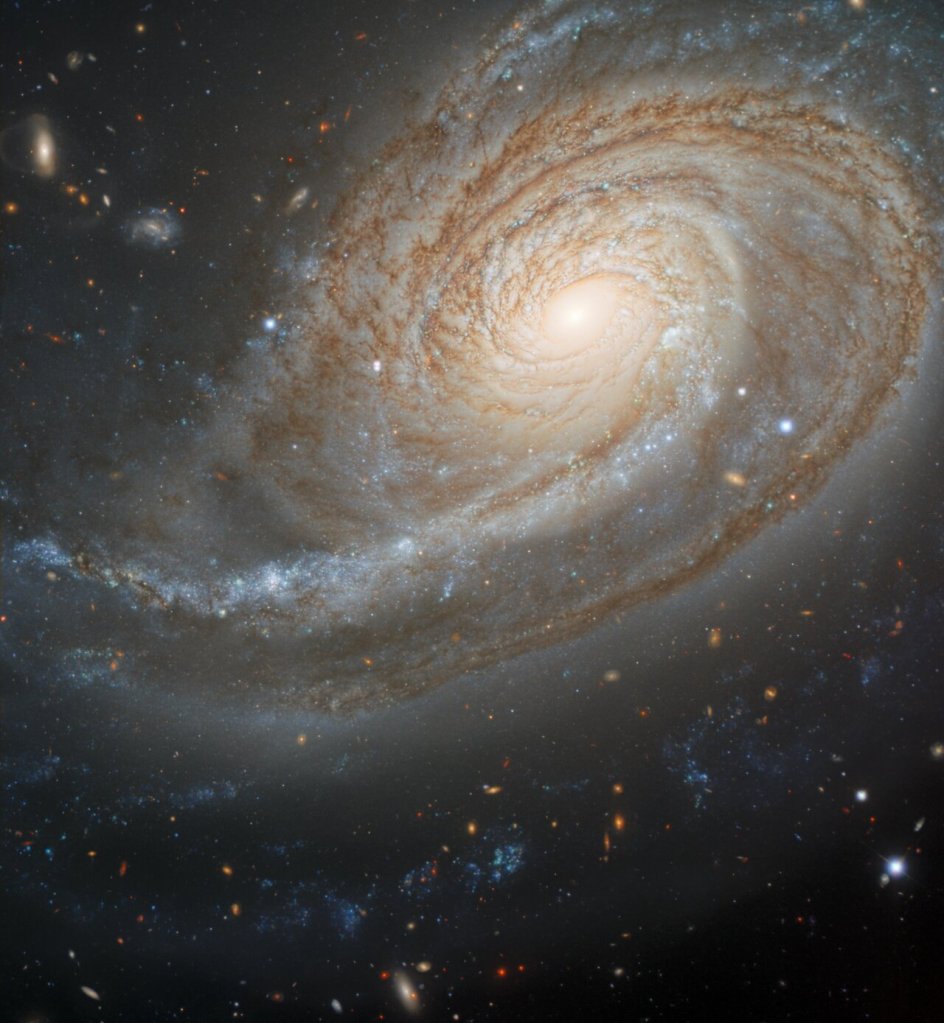
According to NOIRLab (the National Optical-Infrared Astronomy Research Laboratory), “This extra large arm is due to one of NGC 772’s unruly neighbors, the dwarf elliptical galaxy NGC 770. The tidal interactions between NGC 772 and its diminutive companion have distorted and stretched one of the spiral galaxy’s arms, giving it the lopsided appearance seen in this image.”
In my view of the Fiddlehead and its companions, taken during the nights of Oct. 20-21 and Oct. 23-24, 2025, the disrupter is visible at around the 8 o’clock position of NGC 772.
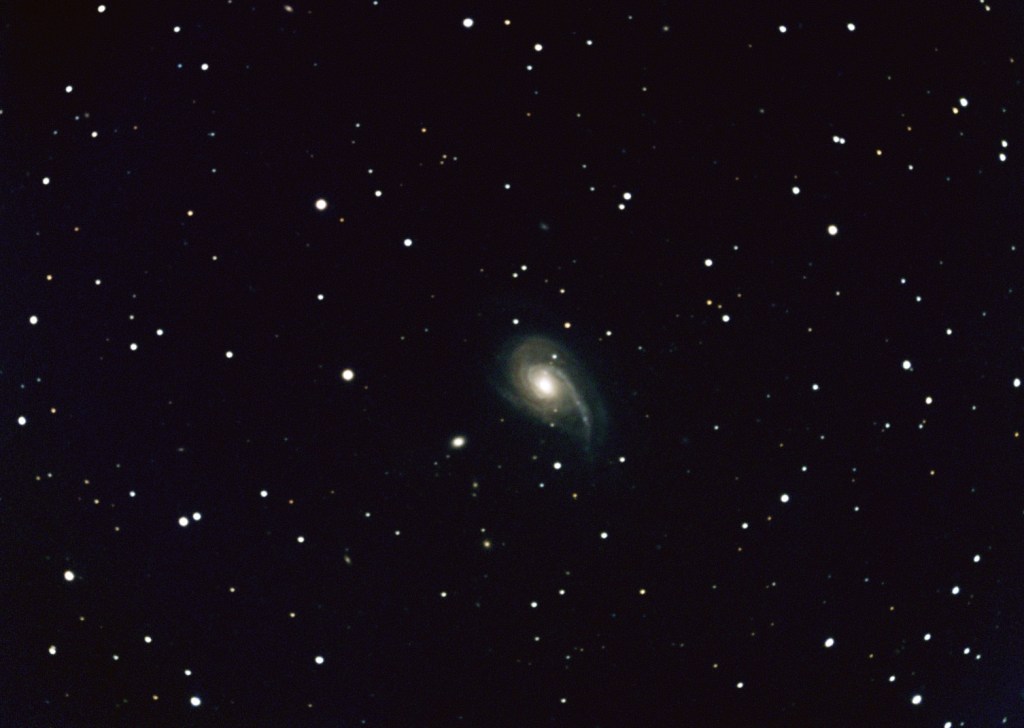
[The Fiddlehead Galaxy, NGC 772, with the smaller galaxy that is interacting with it, an oval called NGC 770, taken from a backyard in Salt Lake City on the nights of Oct. 20-21 and Oct. 23-24, 2025. Photo by Joe Bauman]
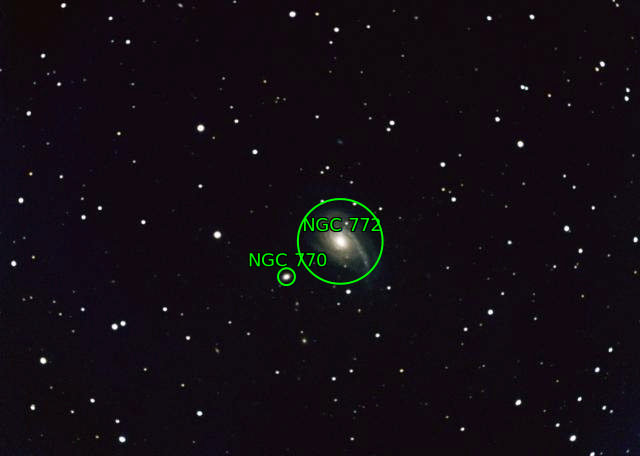
[Location of the galaxies NGC 772 and NGC 770, as indicated by Astrometry.net, a site that will identify objects in astronomical photos.]
The little elliptical galaxy, NGC 770, has a counterrotating core, meaning that its center is rotating in one direction and its outer section in another, says an article published in The Astronomical Journal in June 2005. The authors — M. Geha of the Carnegie Institute, P. Guhathakurta of Lick Observatory and R. Van der Marcel of the Space Telescope Science Institute — comment, “This counter-rotating core is unusual as NGC 770 is not the primary galaxy in the region and it lies in an environment with evidence of on-going tidal interactions.”
One possible reason for the unusual rotations, they theorize, is that NGC 770 smooshed up with a “a small gas-rich dwarf galaxy during a very minor merging event. If this scenario is correct, it represents one of the few known examples of merging between two dwarf-sized galaxies.”
NGC 770 seems to be about the same distance away as the Fiddlehead, which means that it is far smaller. As the writers of the Astronomical Journal report note, it’s a dwarf galaxy, and we know NGC 772 is a major spiral. Everything about astronomy is literally wonderful to me, that is, it prompts me to wonder, with awe, how these features developed. What causes particular pondering about this pair, is that I can’t understand how a relatively lightweight blob like NGC 770 can trigger such a dramatic change in its much bigger companion.
The material in the yanked-askew arm looks to me like it is more massive than the entire dwarf galaxy, which doesn’t look bothered at all.
Vera Ruben, the great American astronomer, proved the existence of dark matter in the 1970s. She showed that without this mysterious material, galaxies wouldn’t stay together. NASA’s science office explains, “Dark matter makes up most of the mass in galaxies and galaxy clusters. In fact, scientists estimate that ordinary matter makes up only about 5% of the universe, while dark matter makes up about 27% ….
“Rubin looked at the stars on the outer edges of the spirals. To explain why these stars moved as fast as they did without flying into intergalactic space, there had to be a large amount of matter holding them in place. But, not seeing any of this matter, Rubin concluded that these galaxies must be held together by dark matter.
“Rubin’s discovery provided such strong evidence for dark matter that the concept was embraced by the scientific community. Today, while not all astronomers agree on what dark matter might be, its existence is widely accepted.”
When NGC 770 floated by, was there a disturbance in the force? (Sorry George.) Did the little guy pack a greater punch of dark matter? I wish I knew.
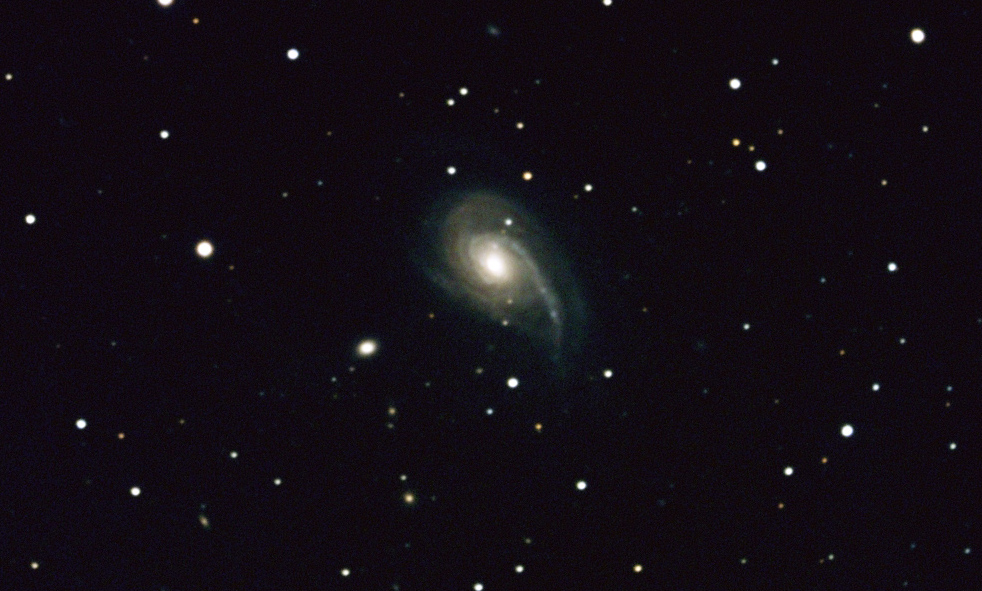
[A cropped view of the image of NGC 772 and NGC 770, making details larger. Photo by Joe Bauman, October 2025]

 Joe's Astro Stuff
Leave a comment