By Joe Bauman, Salt Lake City
Amateur astronomers interested in photographing or viewing a subject that is just a little more challenging than Charles Messier’s list of cosmic objects — (deep-space items that aren’t comets) — might enjoy NGC 6951.
Stationed in the constellation Cepheus the King and close to the north celestial pole, the galaxy can be seen from anywhere in the northern hemisphere. The best period to glimpse it or take its portrait is toward the middle of summer, when it is at its highest. It is visible in a telescope of at least six inches diameter, if not blotted out by stray light.
The dimmest member of the popular Messier list, which has been extended to 110 objects, is the galaxy M 91, rated at visual magnitude 10.2; in size, seen from Earth, it is 5.55 by 4.52 arcminutes. NGC 6951 is dimmer at magnitude 10.65, and smaller at 3.19 by 2.09 arcminutes.
To put those figures into perspective, the Moon is approximately 31 arcminutes across. So to imagine NGC 6951, think of a pale, filmy object about a sixth the width of the Moon. How pale is it? The full moon is 280 million times as bright.
But it’s not only a dim smudge. Once a telescope resolves it, the galaxy and its billions of stars make a lovely swirl, as if we were looking from above at a Mexican dancer with a flaring skirt.
Back on the night of July 31-August 1, 2014, I set up my gear at the site I call Lakeside, in Tooele County, Utah, a.k.a. Puddle Valley. The hardware included a used VAIO laptop I had bought a couple of weeks earlier. The galaxy was hard to find, requiring hours of searching. The Moon had set before I was ready for my close-ups; that was good because moonlight is a natural form of light pollution, detrimental to deep-space images.
While I was photographing it, the VAIO had a failure. It was frustrating and time-consuming to restart the programs. I tried to use a Compaq laptop I had brought as a backup, but I had not set the guiding program to recognize the guide scope; also, the other essential program, MaxIm, which takes astrophotos, could not initialize the camera.
Still, I managed to gather a cumulative exposure of three hours, which was sufficient to show some details.
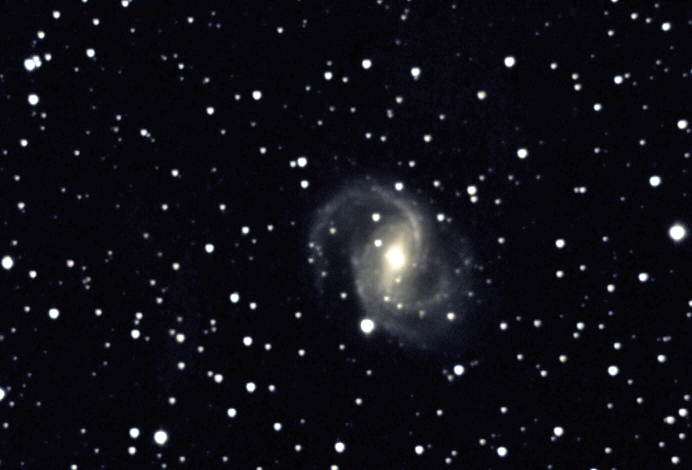
[The galaxy NGC 6951, photographed during the night of July 31-Aug. 1, 2014, from Lakeside, Tooele County, UT, by Joe Bauman]
NGC 6951, which is 78 million light-years away, was discovered by a French astronomer, Jerome Caggia, in 1877 and found again independently by the American Lewis Swift in 1878. Stretching 75,000 light-years across, it is classified as an intermediate spiral galaxy, meaning it is something like a barred spiral and something like a spiral without a bar. The spiral arms do not swing out from a clear-cut central core; it’s termed weakly-barred.
A Hubble Space Telescope image of the galaxy center, taken Oct. 7, 2025, shows a blue-white ring at the innermost. The ring is 3,700 or 3,800 light-years across (depending on the source). “This is called a circumnuclear starburst ring — essentially, a circle of enhanced star formation around the nucleus of a galaxy,” according to the European Space Agency and NASA.
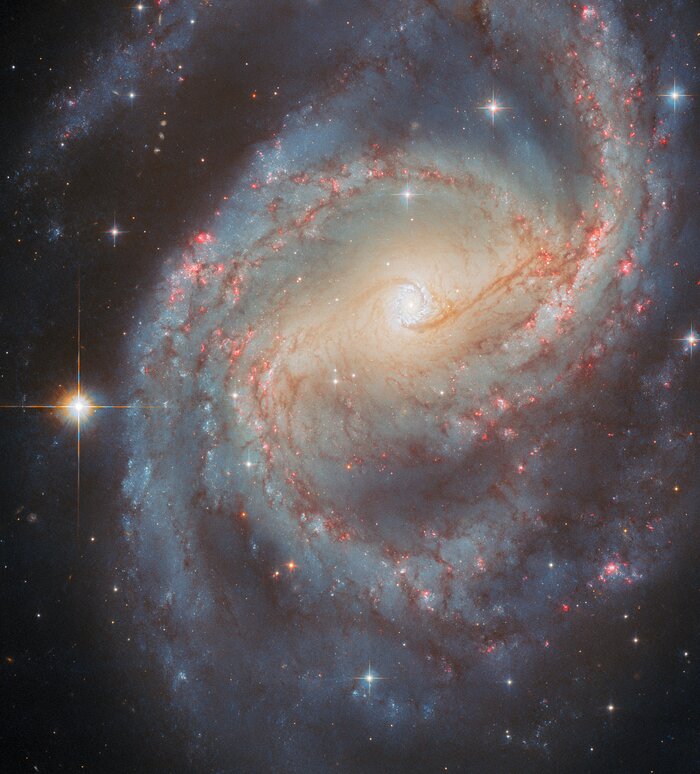
ESA and NASA add that the galactic center is “distinctly elongated, revealing the presence of a slowly rotating bar of stars.” The bar shoots gas and dust onto the ring, which hosts many star-forming regions. “Using data from Hubble, astronomers have identified more than 80 potential star clusters” within the ring, the agencies add.
NGC 6951 has undergone several supernova explosions in recent years.
A study published in December 2007 in the Astrophysical Journal concludes that spirals at the center of the galaxy are “channels through which matter is transferred … to the nuclear region to feed the supermassive black hole” in the middle.
I have questions about that. I wouldn’t presume to declare an accepted scientific study to be wrong, but I always thought black holes don’t suck in anything. If a wandering star got too close it would be ripped to shreds and devoured, but otherwise the hole is quiet.
I have trouble imagining huge structures in a galaxy, like the circumnuclear starburst ring and the channeling spirals, acting to feed the supermassive black hole — but stranger things are believed.
 Joe's Astro Stuff
Leave a comment