By Joe Bauman
An interesting group of galaxies in the constellation Draco shows how different these vast objects can look. From what was highest in altitude to lowest when I photographed them, the members of the Draco Triplet (aka the Draco Trio) are NGC 5985, NGC 5982 and NGC 5981.
Residing in the northern constellation Draco the dragon, the three are visible most nights, though low on the horizon during November and December. The bookend galaxies, NGC 5985 and NGC 5981, are spirals; the latter is edge-on to our line of sight, making it just a splinter with a bulge in the middle. The center galaxy, NGC 5982, is an elliptical, a type that seems like a luminous disk with no features that are easy to discern.
Known as a triplet because they seem so close to one another, in reality they are separated by immense distances. NGC 5985 is generally reckoned at 140 million light-years away, NGC 5982 at 130 million light-years and NGC 5981 is the closest at 112 million light-years. They only appear to be a group because they happen to line up from our perspective. Separated as much as they are, they probably are not bound together by gravity.
According to the National Science Foundation’s National Optical-Infrared Astronomy Research Laboratory (NOIRLab), “It is not clear if or when these galaxies might merge with each other. But there is already evidence that NGC 5982 has already merged with one or more smaller galaxies in the recent past.”
That evidence is the fact that it is an elliptical galaxy. “Elliptical galaxies have shapes that range from completely round to oval. They are less common than spiral galaxies,” says NASA.
“Unlike spirals, elliptical galaxies usually contain little gas and dust and show very little organization or structure. The stars orbit around the core in random directions and are generally older than those in spiral galaxies since little of the gas needed to form new stars remains. Scientists think elliptical galaxies originate from collisions and mergers with spirals.”
Most interesting of the three is NGC 5985, the face-on spiral with its extensive, sweeping arm. It is termed weakly-barred, meaning it has a central bar structure but the bar is not pronounced. It’s further classified as a Seyfert galaxy, a type with an extremely bright center in certain wavelengths, indicating an active supermassive black hole. NASA’s Hubble team says,
“Seyfert galaxies are nearby galaxies with extremely bright central regions that often obscure the much dimmer stars in the surrounding galaxy. Quasars — quasi stellar radio sources — are among the most distant objects in the universe, and are visible from Earth only because they are so bright. Both types of objects, collectively referred to as active galactic nuclei (AGN), give off prodigious amounts of energy. Much of the radiation is in the form of high-energy x-rays and gamma rays.
“Observations over the past 30 years have convinced most astronomers that the only object capable of producing such tremendous amounts of energy in a relatively small galactic core is a black hole.”
At Magnitude 14.22, NGC 5985 is fairly dim. Its size has been estimated at 236,900 light-years across, according to constellationguide.com. By comparison, our home galaxy, the Milky Way, is approximately 100,000 light-years in diameter, NASA indicates.
On the night of June 30, 2014, I photographed the Trio from a favorite site of mine, which I call Lakeside, in Tooele County, labeled on maps as Puddle Valley. To quote my journal from the next day,
“My experience last night at Lakeside was glorious. It was a bit frustrating too, as I had a terrible time getting the telescope on the North Star, and I had to collimate twice — and once is difficult enough. But when everything was ready, around 2 a.m., I instructed the ‘scope to go to a cluster of three galaxies called the NGC5985 cluster in Draco — and it went to it precisely. The top two members of the cluster showed up as soon as I made a focus exposure. I don’t remember the last time, if I ever had one, when the target immediately showed up in the field of view of the camera. I spent the time from then until dawn making a sequence of exposures of the three, for a two-part mosaic. That’s because the galaxies are far enough apart that I can’t get more than two in an exposure.
….
“So far the photos are disappointing. For much of the night I sat in the Jeep, engine running to stay warm, and relaxed or read in my Kindle. Most of the images seem to have static from engine radio noise, no doubt from the car. Next time I’ll have to shiver in the vehicle without starting it.
“The night was clear and generally breezeless. I enjoyed tremendously tracing out the gigantic Scorpius, looking through binoculars at star clouds in the southern Milky Way, and just sitting back dazzled by the beauty overhead. The clear red report covers over the computer helped enormously in preserving my night vision, as did those I put over my Kindle — covering the Kindle display was a last-minute thought, as I was turning it on to read. Fortunately I had brought my extra covers.”
The covers were plastic sheets usually intended to enclose school reports.
Since then I have abandoned that camera with its small chip. My present instrument could easily fit all three galaxies in one view. But back in 2014 I had to take sets of photos of the top and middle galaxies, then the middle and bottom ones. Total exposure was about four hours. Next I brought the sets together in a mosaic, showing all three in proper orientation.
Back in 2014 I was disappointed in the way the picture turned out. Because I kept the raw images, I was able to reprocess them and the result is a little more pleasing. Maybe someday I’ll try photographing the Triplet again with my newer camera.
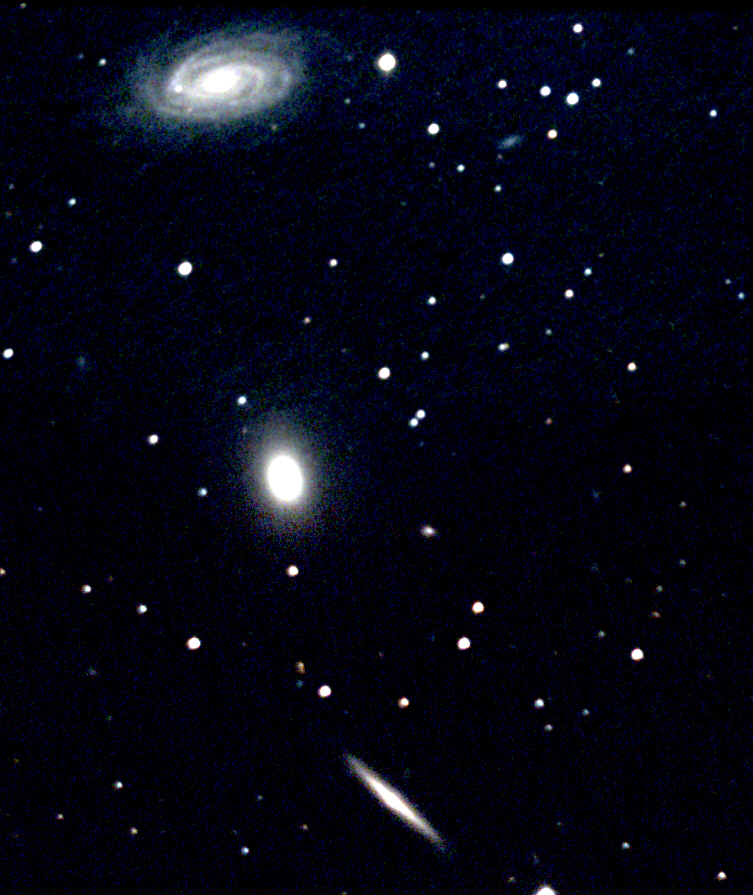
[The Draco Triplet, photographed on the morning of July 1, 2014, at Lakeside, Tooele County, Utah; reprocessed in April 2026. Photo by Joe Bauman]
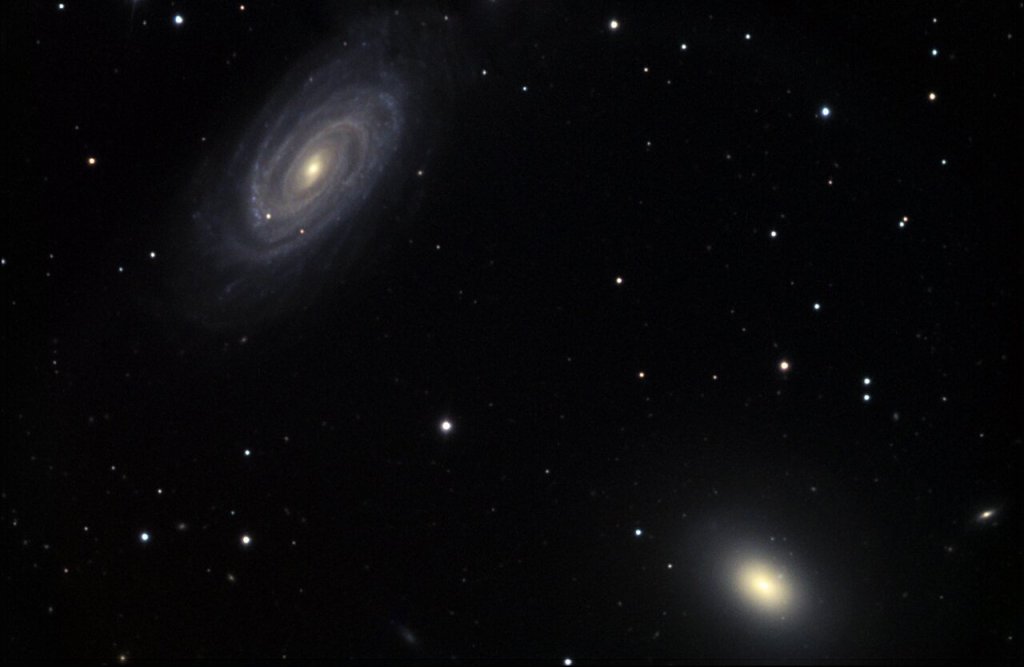
A sharper, more detailed photo of the two of the Triplets was posted by NOIRLab.


Leave a Reply