By Joe Bauman, Salt Lake City
A dim nebular cloud and its associated star, known as the Flaming Star Nebula, was a quiet powerhouse burning away in the autumn sky when I photographed it back on the night of November 3-4, 2025. Located in the constellation Auriga (“the Charioteer”), the nebula’s technical designation is IC 405, for the 405th item listed in the Index Catalog of deep-space objects.
A nebula is an immense cloud of gas and dust, often the birthplace of stars. At 1,500 light-years away and five light-years across, estimates of the magnitude of this one range from 6 to 10. It is difficult to see with many amateur telescopes, especially in urban areas, but shows up in long-exposure photographs.
The brightest star is called AE Aurigae. According to the constellation-guide.com —
“The name Flaming Star comes from the German astronomer and astrophotographer Max Wolf (1863-1932). Wolf found the nebula while photographing Nova Aurigae 1891. He described the star AE Aurigae as a ‘burning body from which several enormous curved flames seem to break out like gigantic prominences,’ noting that the ‘flaming star’ seemed to be physically associated with the nebulosity.”
The guide says the nebula was also independently discovered by the American-German astronomer John Martin Schaeberle in 1892 and by Eugen von Gothard (a Hungarian astrophysicist and instrument-maker), so it has quite a complicated parentage.
“The Flaming Star Nebula, IC 405, might just have the coolest nickname of all deep-sky objects,” says BBC Sky at Night Magazine. The article, written by Lee Dyson, adds that it is both an emission and a reflection nebula, meaning that parts are shining because the gasses are energized directly by the hot blue star, while other sections reflect starlight.
The internet site theskylive.com posted a view from the second Digital Sky Survey that shows the extent of the nebula:
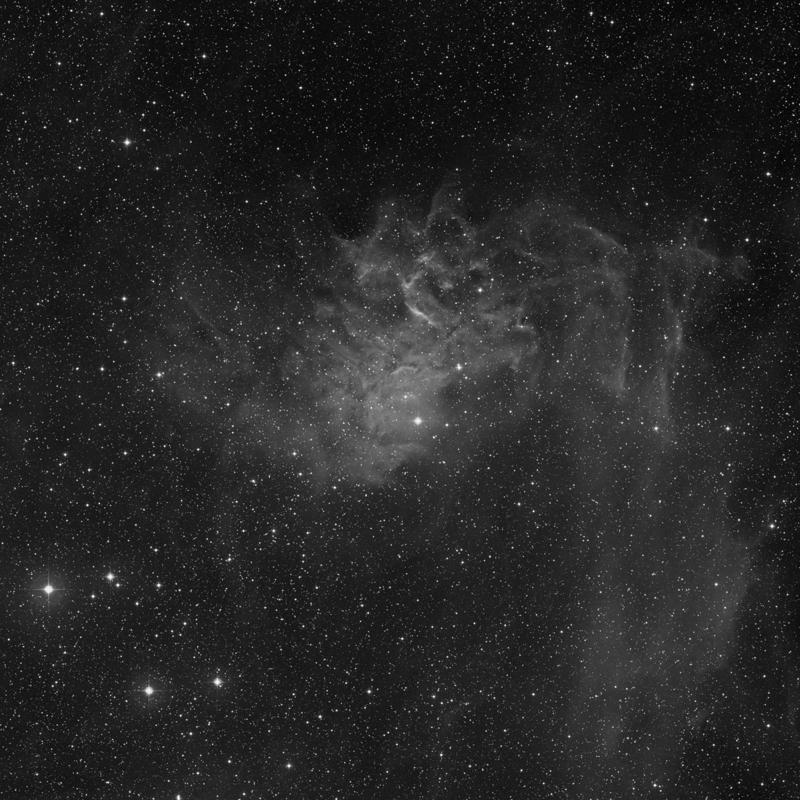
[In this view, posted by theskylive.com, the star causing all that glow, AE Aurigae, is at center. Credit: the second Digital Sky Survey, courtesy of theskylive.com.]
The site estimates the main section of nebulosity to be 50 by 30 arcminutes as seen from Earth. To get an idea of the size, at arm’s length your index finger is one degree wide (unless you have unusually fat or bony fingers). Sixty arcminutes make one degree, so the nebula is just a little thinner than a finger held at arm’s length.
Since our backyard is bombarded by atrocious city lighting, I decided to make my view using narrow-band filters, which cut out nearly all light pollution. As mentioned in Blog 161, the colors that human eyes can see within the spectrum of visible light range from wavelengths of about 380 to 700 nanometers. Narrow-band filters block all but small slivers of that light; they don’t photograph in infrared or ultraviolet, but only sections of the visible spectrum.
Those slices give surprising insight into astronomical happenings.
I use three narrow-band filters, Hydrogen-alpha, Sulfur-II and Oxygen-III.
*** The Hydrogen-alpha filter, called H-α or H-alpha, only allows through somewhat pale brick red light of 656 nanometers. Its importance is that this emission happens with an atom of hydrogen is ionized, its single electron is blown away and then the electron and nucleus recombines at a higher energy state, the new situation isn’t sustainable and the atom returns to its ground state, releasing an H-alpha photon. H-alpha light can illustrate how nebulas evolve and can show where new stars are forming as their heat juices up surrounding hydrogen clouds. Hydrogen is by far the biggest component of nebulas.
*** The Sulfur-II filter, called SII, improves contrast in nebulas, passing through light at around 682 nanometers, the level at which sulfur atoms release energy when ionized. It is a slightly deeper brick-red light, bringing out delicate details that can be distinct from other areas that emit light from excited hydrogen.
** * The oxygen-III filter, called OIII, blocks emissions except at 496 and 501 nanometers, sort of a turquoise to a light green color. OIII refers to doubly-ionized oxygen atoms that are excited by extremely high energy.
In this form of astrophotography, the actual colors of light allowed in by narrow-band filters don’t matter. Trying to differentiate between slightly varying shades of red wouldn’t be helpful, and to get around this, the various intensities are assigned strikingly different colors. The Hubble palette, devised by scientists working with Hubble Space Telescope views made in narrow-band, has these assigned colors: H-alpha is given the color green, SII emissions are painted red and OIII are blue. These correspond to differences in energy levels and processes, allowing scientists to tease out information that would not be obvious in broadband photography.
When these assigned colors interact, they form other colors.
The trouble with narrow-band photography is that much longer exposures are needed than with broadband views. If you’re only recording one small part of the color green, for example, it may take a long time.
For my image, each filter was used for 71 minutes (in one-minute exposures), for a cumulative exposure time by all three of 213 minutes. I increased the effectiveness of each exposure by a technique called binning; I binned by two, giving each minute of exposure the force of four minutes of gathering photons unbinned. Of course, binned photographs are smaller.
Accounting for binning, the exposures were equal to 852 minutes unbinned, as if I had made images for 14 hours, 12 minutes.
When I first processed the raw photos, I used the Hubble palette and was disappointed:
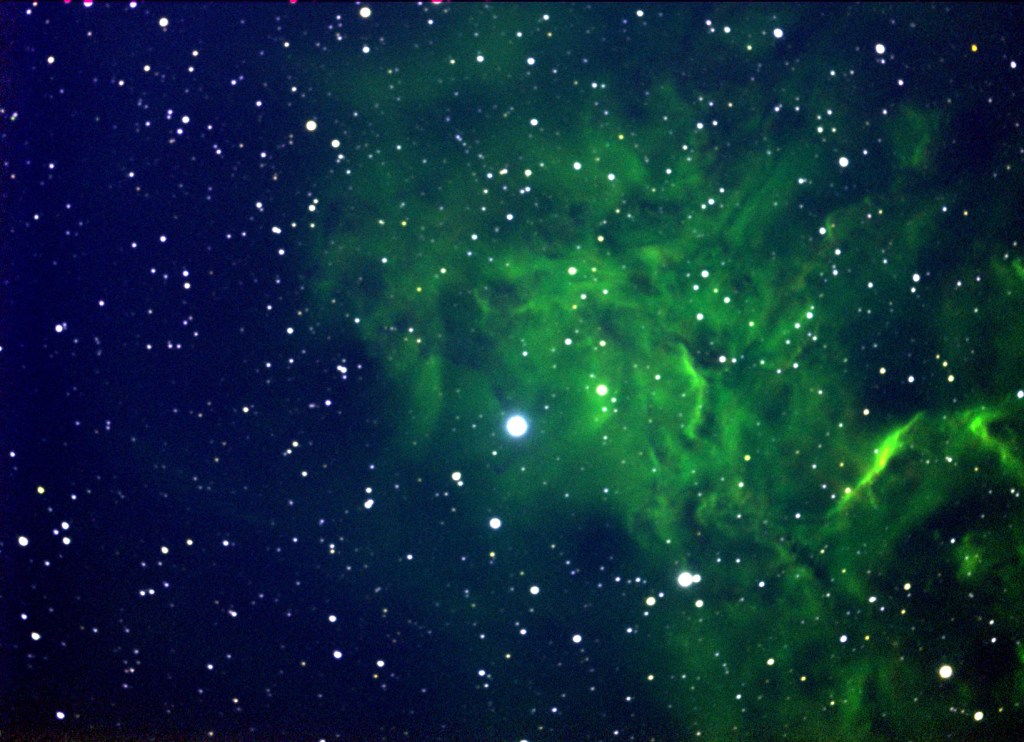
[Photo of the Flaming Star Nebula through narrow-band filters, colors assigned in the Hubble palette, taken November 3-4, 2025 by Joe Bauman in Salt Lake City]
The result was sort of ugly, with all that green, not at all like the beauty of the heavens. Since the Hubble palette is arbitrary, why not create my own?
I reassigned the filter’s results: I made H-alpha red, with an intensity of three, SII green, with a relative intensity of 4; and OIII blue, intensity 3 — that is, the green needed a little more emphasis. The saturation was boosted to 130 percent and the bottom was cropped out (where not all three filters exposed the area).
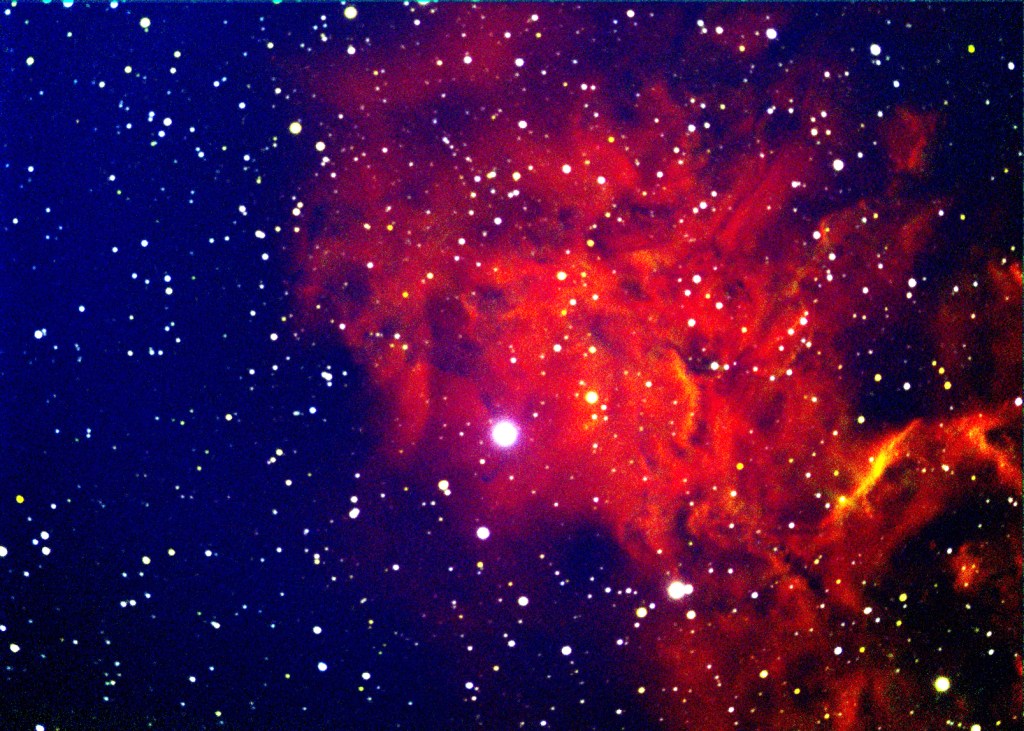
[Final effort, showing the Flaming Star Nebula in my own palette, night of November 3-4, Salt Lake City, by Joe Bauman]
Well, I like it.


Leave a Reply