By Joe Bauman, Salt Lake City
Two of the best deep-sky objects in the constellation Hercules are so close together that it’s possible to get at least a glimpse of one while taking an astronomical photo of the other.
They are Messier 13, among the most majestic of the globular star cluster that are easily visible in Utah, and the brightest spiral galaxy in Hercules, NGC 6207. In fact, I zeroed in on the dim galaxy by first aiming at the cluster.
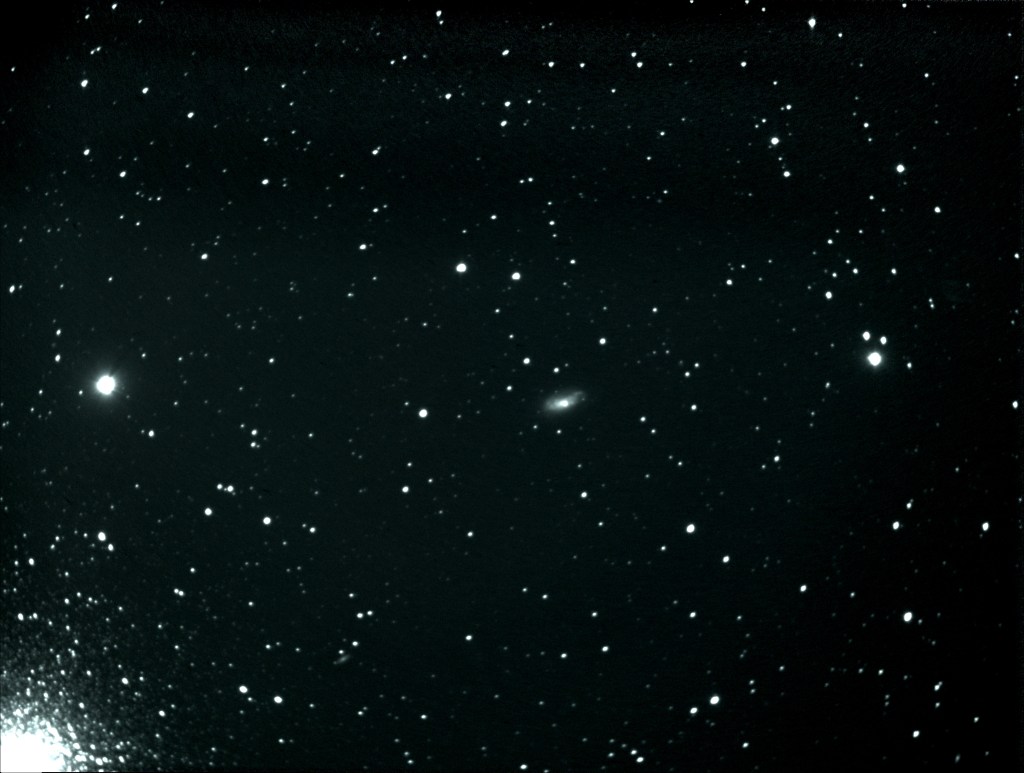
[The spiral galaxy NGC 6207 with part of the globular cluster M13 in the Hercules constellation. Photo made by Joe Bauman in Salt Lake City, morning of June 17, 2026]
The only galaxy that is brighter than NGC 6207 in this constellation is NGC 6482, and it is an elliptical — a type with few interesting discernable features. For all I know it is teeming with advanced civilizations and monsters that stalk jungle worlds, but in my telescope an elliptical only looks like a smear with a brighter center. (An exception is the elliptical galaxy M87 with its fantastic jet shooting from the black hole in its middle, a jet so huge that I was able to photograph it.)
As galaxies go, NGC 6207 is rather small, with estimates ranging from 34,000 light-years across to 39,100 light-years. NASA has it that our Milky Way Galaxy is 100,000 light-years across. The Hercules beauty is far dimmer than the faintest object in the famous Messier list of deep-sky objects, which is M91 at magnitude 10.2. (Lower magnitude number equals brighter.)
Theskylive.com posts that NGC 6207 glows at magnitude 11.65, not the easiest subject for backyard astrophotography in a city, and that it is only about three and a half arcminutes long and a little over one and a half wide. Another site places its length at 3 arcminutes. As mentioned here, the Moon is 31 arcminutes wide, which means the galaxy is about a tenth the width of our natural satellite as seen from here.
Located 45 million light-years away, NGC 6207 was the scene of one of the most titanic explosions in the universe, a supernova. Although the star blew up 45 million years ago, its light reached Earth in 2004.
The Kopernik Observatory and Science Center in Vestal, New York, used its 20-inch-diameter telescope to take a splendid picture of the galaxy and its supernova on June 24, 2004. It has posted the view along with a diagram to show which star is the culprit.
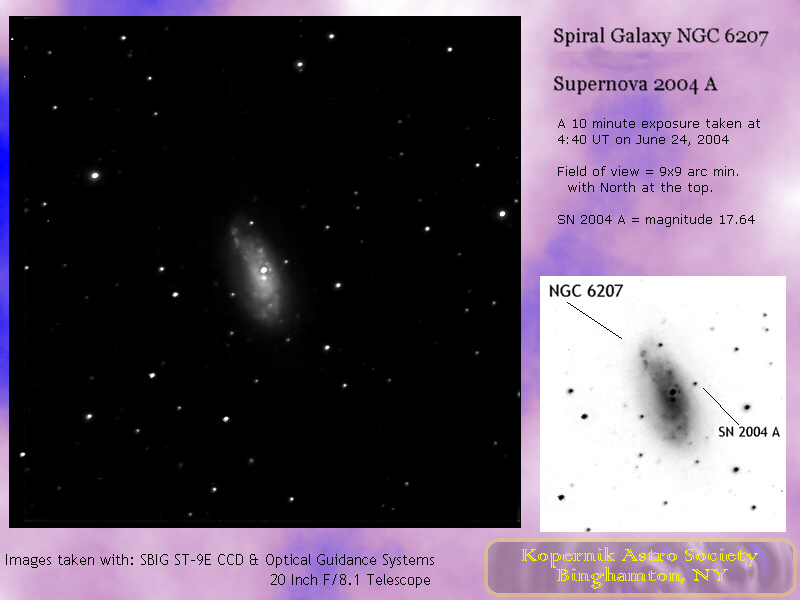
[View of NGC 5207 and its most recent supernova. Credit: Kopernick Observatory and Science Center]
Unfortunately, no star was popping off when I photographed it.
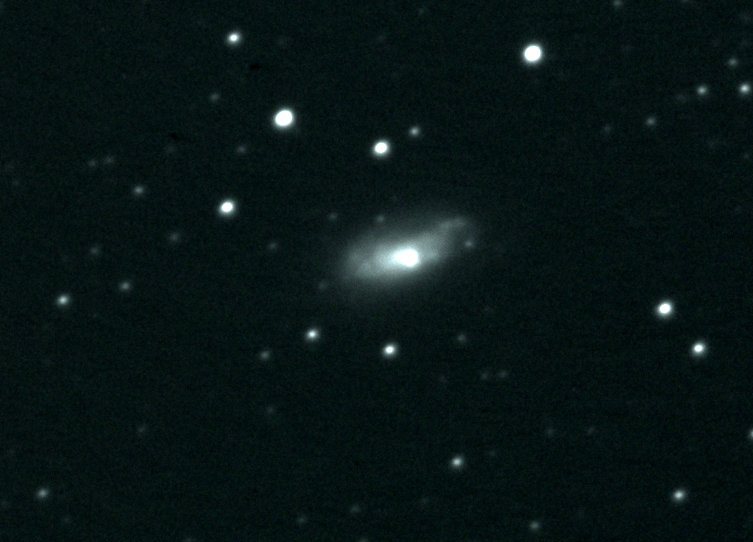
[A cropped version of the first image in this blog, showing NGC 6207. Stars in the view are in the foreground, part of the Milky Way. Photo by Joe Bauman, June 17, 2026, in Salt Lake City.]
M13, on the other hand, is one of the most popular — and easiest seen — objects outside our solar systems, available to anyone in our hemisphere who has a telescope. June and July are good times to see it. As it shines at magnitude 5.8, even a pair of binoculars will bring it into view at a site with dark skies. The globular cluster is a mass of 100,000 to 300,000 stars, depending on who does the calculating. It is “one of the brightest star clusters visible from the Northern Hemisphere,” NASA says.
It’s 25,000 light-years away and 145 light-years across, the agency adds. By comparison, sciencenotes.org notes, the nearest star to our world, besides the Sun, is Proxima Centauri at 4.24 light-years.
Globular clusters hang around in the fringes of galaxies. The Milky Way is known to have 158 of them, says Space.com. Some of the oldest stars in the universe make up globular clusters. According to messier-objects.com, “The Hercules Globular Cluster has an estimated age of 11.65 billion years and contains about 300,000 stars.”
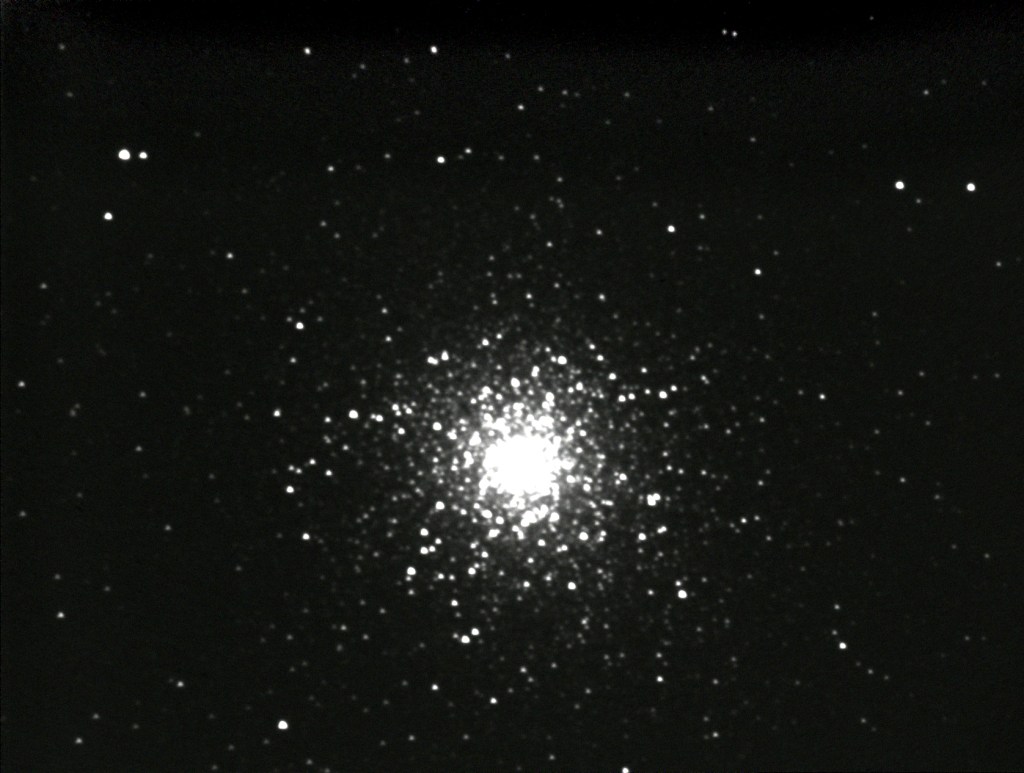
[Globular cluster Messier 13, nearby companion to the galaxy NGC 5207 in Hercules. Photo by Joe Bauman, morning of June 23, 2026]


Leave a Reply