By Joe Bauman, Salt Lake City
Last November, when the Moon was just two nights past full, I experimented with narrowband imaging, the Crab Nebula my subject. When I made the exposures, I wasn’t concerned about the obviously glaring Moon because those specialized filters are supposed to block light pollution.
I should have realized the filters work to prevent artificial light pollution from reaching a camera’s chip but not the natural spillage from the moon, which includes plenty of the frequencies that the filters let through. The result was the Crab, also known as Messier 1, showed up in the midst of a glowing film of moonlight pollution. It’s definitely eerie. But I like it. I think of it as the crab floating in moonlight. Having lived for a time on the Eastern Shore of Maryland beside the Chincoteague Bay, I imagine a crab on the bottom of a shallow region with moonlight shimmering on the water.
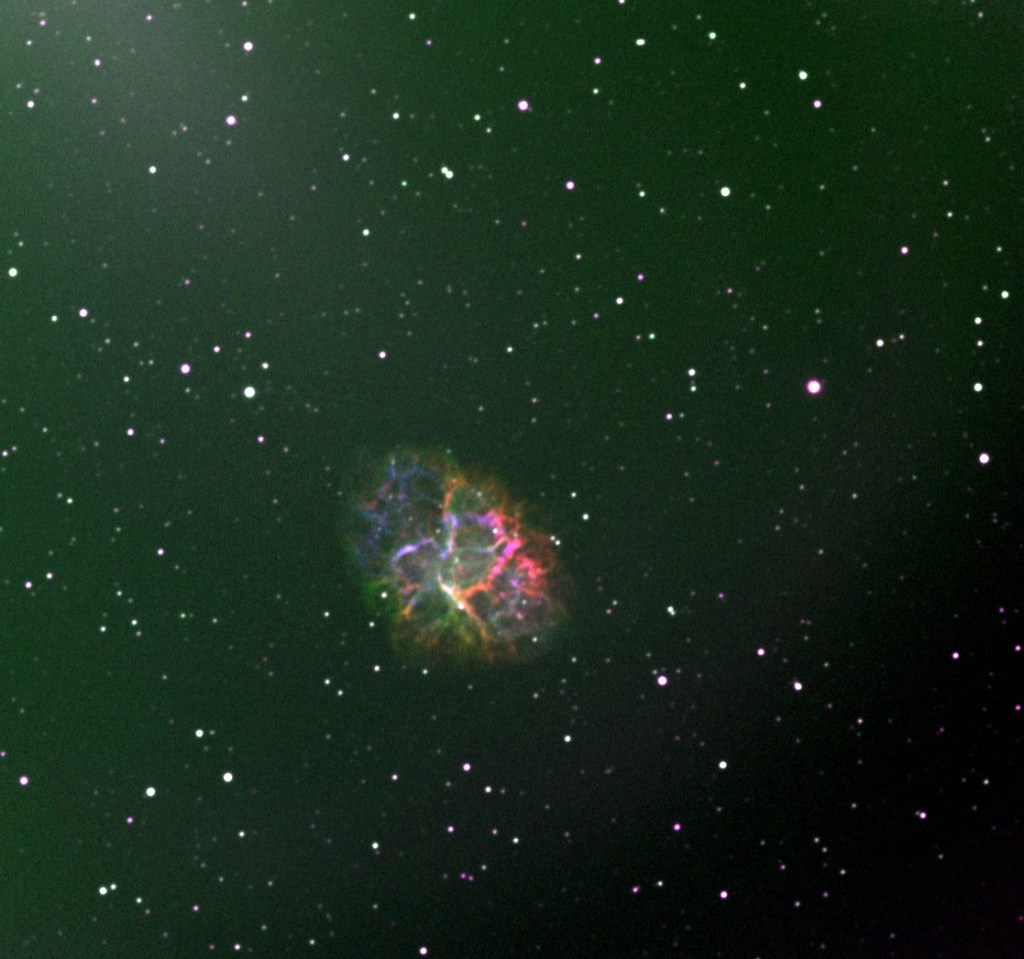
[The Crab Nebula, also known as Messier 1, as photographed on the night of Nov. 6-7, 2025, from a Salt Lake City backyard. Photo by Joe Bauman]
Six thousand, five hundred light-years away, the Crab is the remnant of a supernova explosion that wrecked its progenitor star. The detonation was around 7,500 years ago (rounding off), we know, because its bright beams were noticed in the year 1054 by Chinese astronomers, who noted the location of a “guest star” in what we now call the constellation Taurus. The BBC says this strange visitor “was visible for nearly a month in the daytime sky.”
Flying debris — streaks of gas and dust, mostly hydrogen and helium — are still expanding at the rate of 1,300 kilometers per second, according to course material at the University of California at Los Angeles; in ordinary language, that’s 807 miles a second. A rocket going that fast could cross the United States in a little more than three seconds. The material has been flying at that speed for 7,500 years. Though not evenly spread out, the Crab is about ten light-years across. The nearest star system, other than the Sun, is that of Proxima Centauri, 4.2 light-years distant.
The supernova was so powerful that its debris field is more than twice as wide as Proxima Centauri is far away. That’s from a single star, not even the largest that could blow up in a supernova. We know this because two results can happen with such a detonation: a black hole forms when a star 25 or more times the mass of our Sun blows, and a neutron star remains after a supernova of a star that’s from nine times the mass of Sol to the black-hole threshold, according to Cambridge University, England. (This is simplified; Cambridge also talks about ” black hole formation by fall back to be somewhere between” 18 and 25 solar masses.)
We know the Crab Nebula was formed by the less powerful supernova type because a neutron star was discovered in its center on Nov. 9, 1968. It was detected by the amazing Arecibo radio telescope in Puerto Rico (now deceased). The fast sweeping of its radio beams showed that the star was rotating at 30 times a second. A neutron star is the densest object known, and while one might have as much mass as the Sun, it is only the size of a small city. Let’s think of Provo whirling around at 30 times a second.
In the Tarus constellation, the Crab is reckoned at Magnitude 8.4. It is visible to binoculars and small telescopes from dark sites. For the northern hemisphere, January is a good time to see it, though not during fuller moon periods.
Photographs taken in ordinary light show that its interior pale blue. This glow is caused by synchrotron radiation, which is emitted when particles are accelerated to nearly the speed of light. Electrons are tossed around at that speed by the spinning neutron star at the Crab’s center.
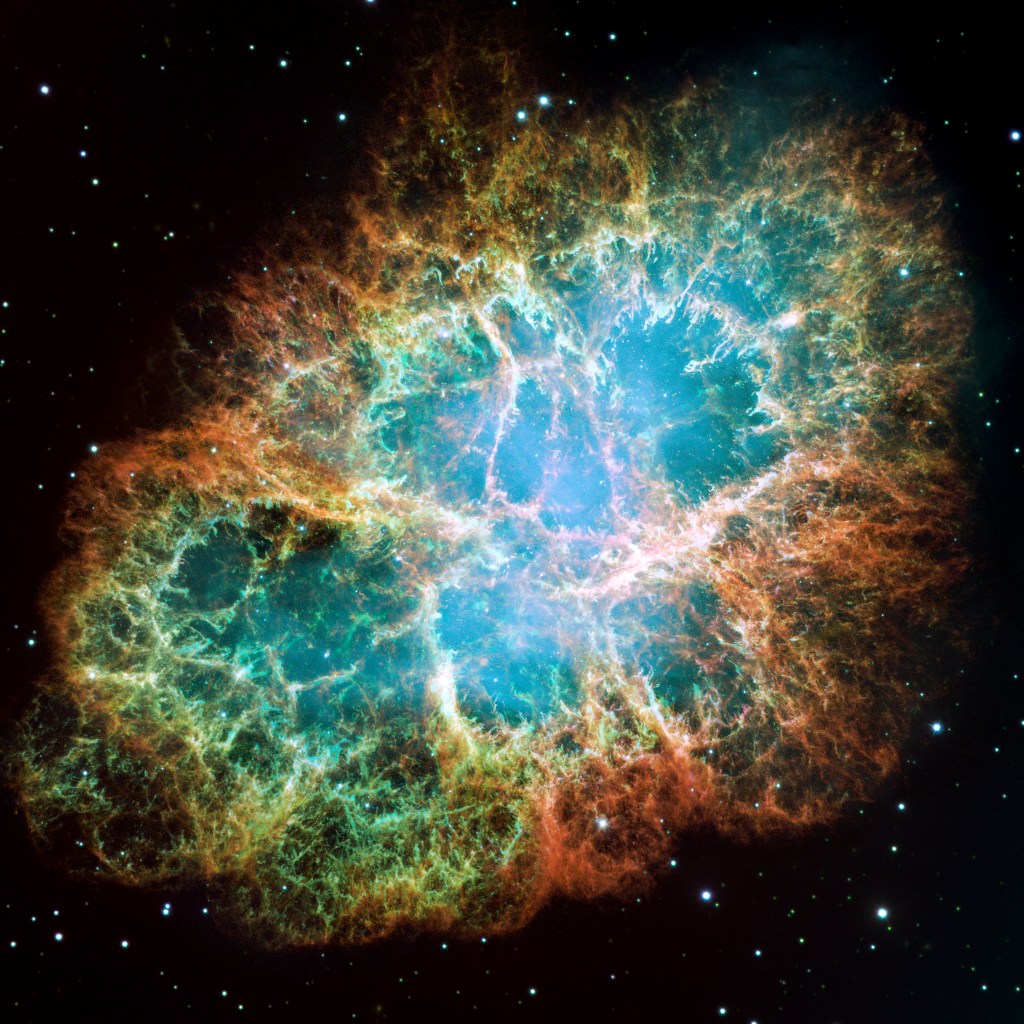
[A view of the Crab Nebula taken by the Hubble Space Telescope in 2005 in ordinary light. Credit: NASA, ESA and Allison Loll/Jeff Hester (Arizona State University). Acknowledgement: Davide De Martin (ESA/Hubble)]
Those creepy tendrils remind me a little of fulgurites, the twisty glass signatures of lightning when it strikes sand and melts it into the shape of the electrical blast. Maybe some kind of relationship exists between the enormous force of the supernova sending ionized material through space and the shock of a lightning bolt in sand.
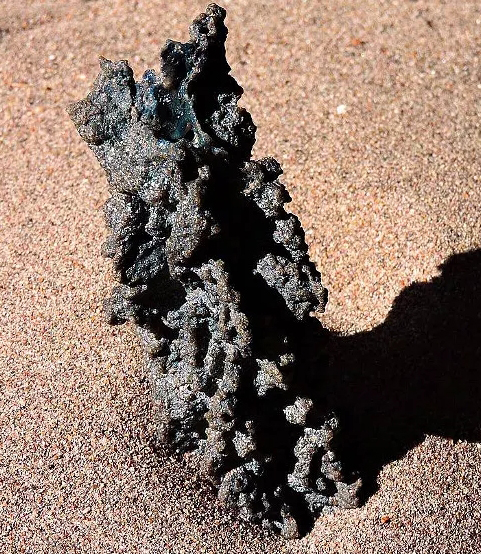
[A fulgurite found at Great Sand Dunes National Park and Preserve, Colorado. Image credit: NPS/Patrick Myers]
The Crab Nebula has the designation Messier 1, or M-1, because it is the first in Charles Messier’s list of objects that look like comets but aren’t. As explained here, Messier, 1730-1810, was on the look-out for comets. In 1758, anxious for the return of Halley’s Comet, he noticed a dim patch in Taurus, which at first he thought was the famous comet. But it didn’t move, contrary to cometary habit, and he realized it was another type of deep-space object. When he compiled his list of non-comets, meant to be useful when searching for comets, he called the nebula Messier 1. The Messier List of 110 objects is a wonderful set of astronomical targets that aren’t too dim for amateur telescopes.
William Parsons, the 3rd Earl of Rosse, observed M-1 through a 36-inch telescope from Birr Castle in Ireland in 1844 and made a sketch of it. With its spindly appendages, it seemed to look like a crab.
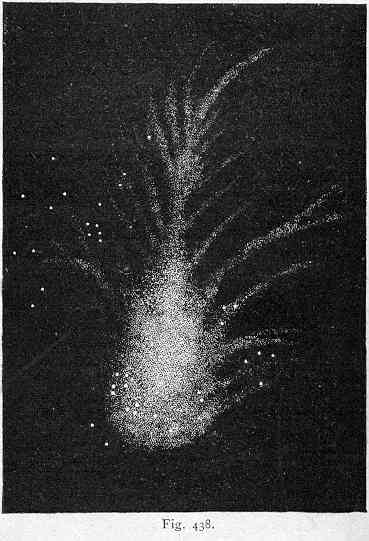
[William Parsons’ 1844 sketch of the Crab Nebula, from this site on the internet]
The photo I took of the Crab Nebula is strangely colored. Rather than the natural ones, its hues are arbitrarily assigned. The exposures were taken with three narrowband filters, as explained here. Each filter allows through only a narrow slice of the spectrum, corresponding to frequencies of light at 656 nanometers, 672 nanometers, and (for a single filter) 496 and 501nanometeers. The filters are called, respectively, hydrogen-alpha, Sulfur-II and Oxygen-III.
As Blog 161 explained,
* Hydrogen-alpha emissions, captured with that filter, occur when an atom of hydrogen – the simplest and most common element – undergoes a change in the energy level of its electron; it has just one electron and one proton.
* Sulfur-II filters allow transmission of light released when sulfur atoms are ionized.
* Oxygen-III filters let through light from doubly-ionized oxygen atoms, excited by extremely high energy.
With my exposures of almost four hours, I assigned the color red to Hydrogen-alpha, blue to Sulfur-II and green to Oxygen-III. The final photo shows that strands of the Crab Nebula crackle with different states of energy and/or a varying predominance of elements.
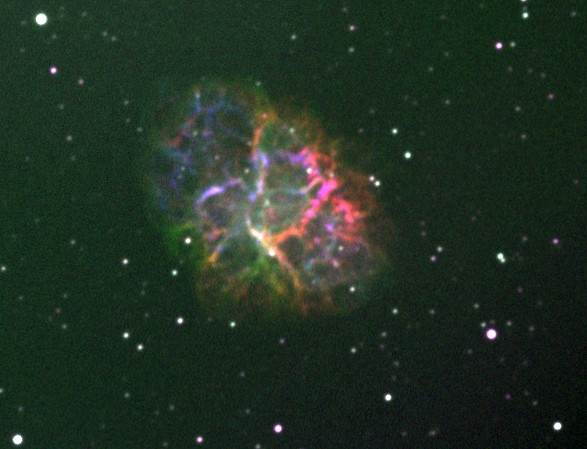
[A cropped image of the Crab Nebula taken with narrowband filters over four hours, night of Nov. 6-7, 2025. Photo by Joe Bauman]
 Joe's Astro Stuff
Leave a comment