By Joe Bauman, Salt Lake City
Frisco Peak, the highest point of southern Utah’s San Francisco Mountains, pokes up 3,000 feet above the sagebrush desert. The heavily wooded mountaintop houses a big set of microwave repeater towers. Windswept bristlecone pines and other evergreens and shrubs lean around the peak, which reaches the elevation of 9,660 feet. Mountain range after mountain range recede to the horizon.
But what brought Nightly News there wasn’t the microwave towers or the spectacular Beaver County scenery. Jolting and banging up the steep Jeep trail with its switchbacks, razor-edge jagged rocks and falling-away cliffs had one purpose, to visit the University of Utah’s Willard L. Eccles Observatory.
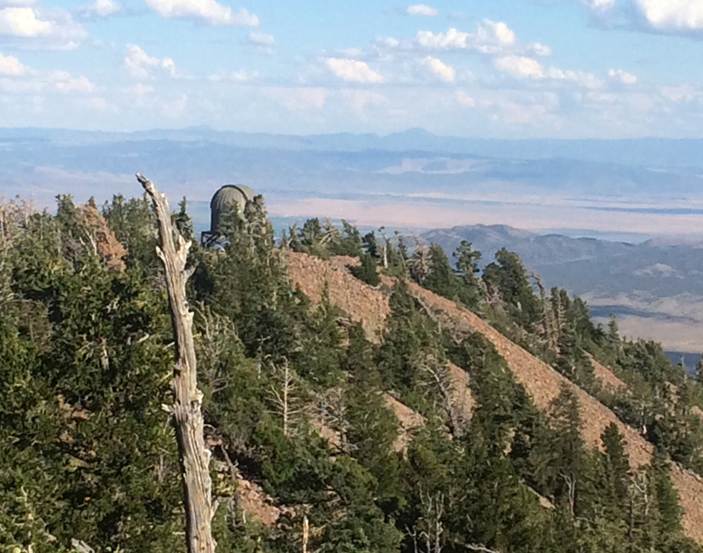
[The Willard L. Eccles Observatory’s dome, seen from the site of microwave relay towers]
Paul G. Ricketts, a U. graduate in astronomy and a staff member of the Department of Physics and Astronomy, drove to the peak to open it for an observing season. This fall, he is teaching a course in landscape astrophotography. With him, besides the writer, were helpers Shelby Stock, a political science student from Bryce Canyon, and Brandon Westoby, from Alpine, Utah County. All are astronomy enthusiasts.
Ricketts has worked with the observatory since the start; site surveying began in 2007 and construction was finished in 2009. Its main scientist is Prof. Wayne Springer.
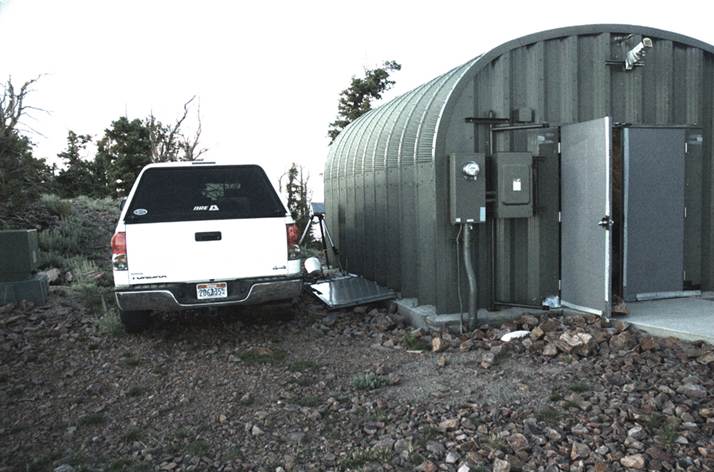
The $1 million observatory, which can be operated remotely from the Department of Physics and Astronomy in Salt Lake City, consists of a green dome structure that houses the telescope and a next-door control building, shaped like a Quonset hut and built like a fortress. The huge telescope, with a primary mirror 32 inches in diameter, is of the Ritchey-Chretien variety and is capable of carrying 200 pounds of instruments. It was built by DMF Engineering of Longmont, CO.
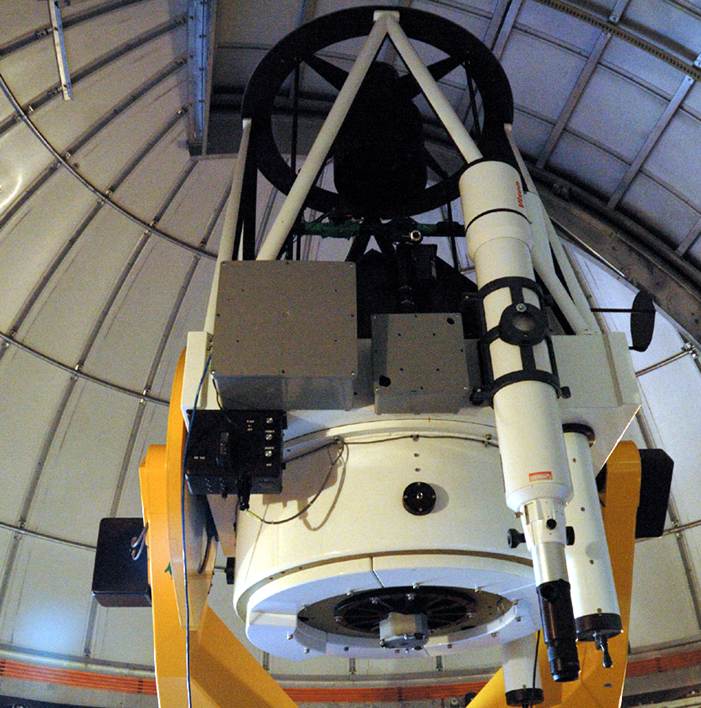
[The DMF telescope]
The dry atmosphere, elevation and remoteness from serious light pollution is ideal for telescope work. At dusk, standing near a steel-grid platform built to launch hang-gliders — like a diving board into nothingness — one can see the lights of Milford, 17 winding miles away to the southeast; gleaming points from a closer mine, and a distant smudge that is Cedar City. “That’s about all there is (by way of light pollution), and if you look out to the west there’s one light, from the west to the north,” said Ricketts.
[The observatory’s control room]
The control room’s ceiling and walls are lined with white, lumpy reflective material, insulation against the peak’s winter temperatures. Scientists seated at tables with computer screens and keyboards can operate the telescope from the hut. Tools line shelves and hang from racks, thick strands of dozens of cables and a surge protector or two are bound together along a floor. One of the metal chassis holding large computers reaches toward the ceiling.
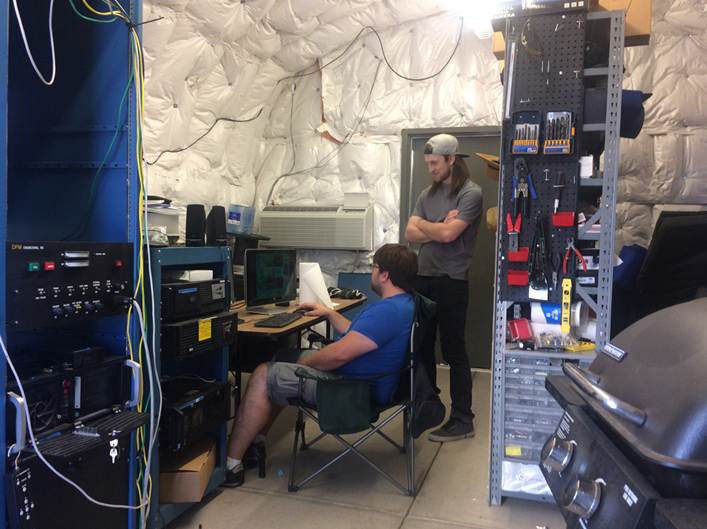
[Paul Ricketts, seated, and Brandon Westoby in the control room]
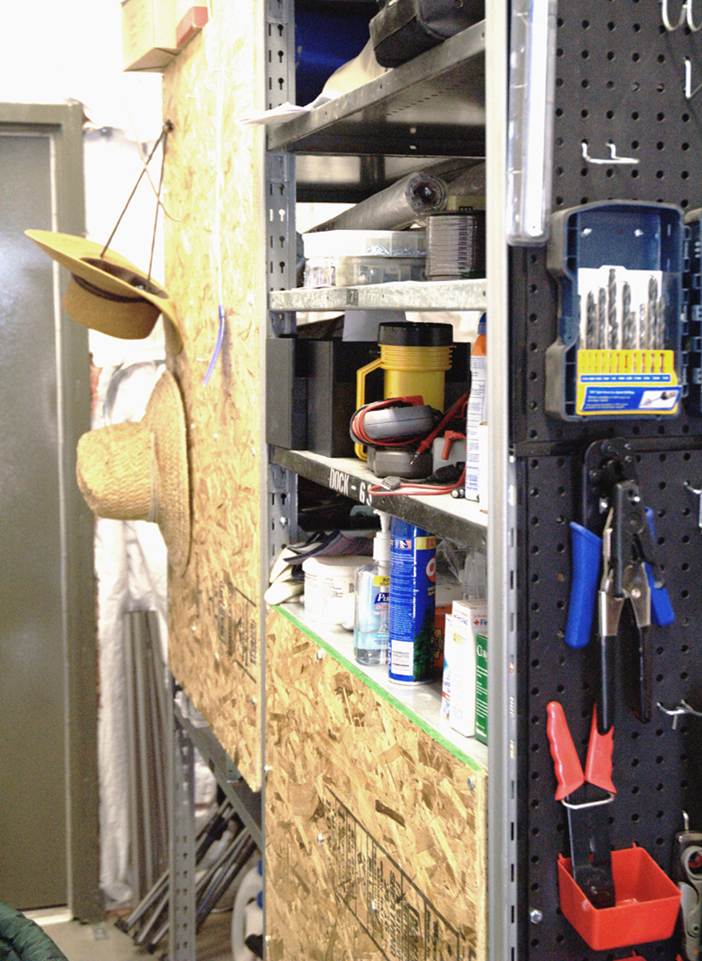
[Tools in the control room]
On one occasion, Ricketts stayed at the observatory four days, replacing a computer’s motherboard and preparing the equipment for long viewing sessions by university students. “I can see see how people go crazy after being alone in a very isolated environment, with very little human contact if any at all. But it’s kind of an amazing thing, just to experience,” he said.
This night he and his helpers tackled an ever-growing list of projects, Ricketts said: “Make sure everything’s running right, turn the scope on, did some cleaning, hooked the cameras up, make sure they’re working, did some observing.”
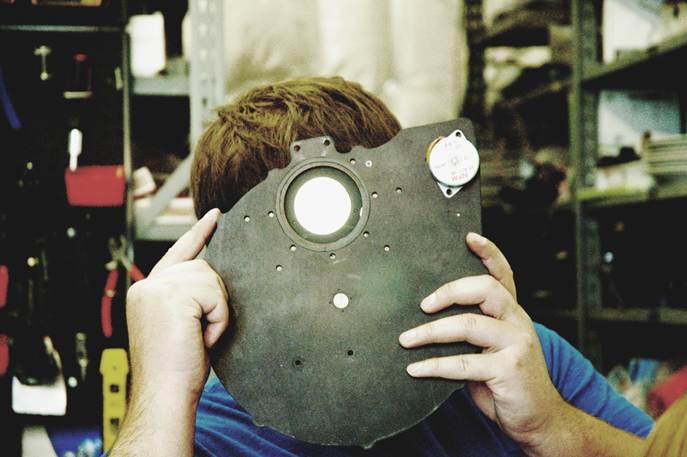
[Ricketts checks a filter in a camera’s filter wheel]
Our first observations were visual, with stunning views of the Whirlpool Galaxy (M-51), the Ring Nebula, the M-13 star cluster, Saturn and other targets. Afterward, the crew cleaned the heavy astrophotography camera and checked the filters, then took photographs from the control room. Finally, they attached a new security camera and a weather-watching “all sky camera” outside.
When the dome rotated, the view through its opening was like looking out the porthole of a spaceship. The mechanism chugged in the dim lighting while constellations seemed to slide past the viewer; they weren’t moving, but the dome’s motion made it look as if we were flying past the Big Dipper.
A surprising amount of the work was physically demanding, from standing on a ladder connecting the heavy camera to the telescope, to another ladder-climb to attach an outside security camera.
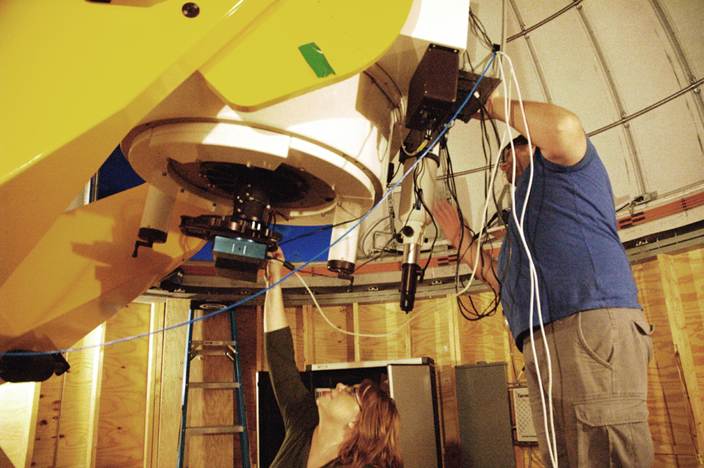
[Plugging in wiring that connects to the camera]
Westoby said he enjoyed the visit, especially the isolation from city lights. “It’s high on top of a mountain, that’s another thing,” he said.
“I’ve never messed with a telescope of this size. It’s just a great opportunity.”
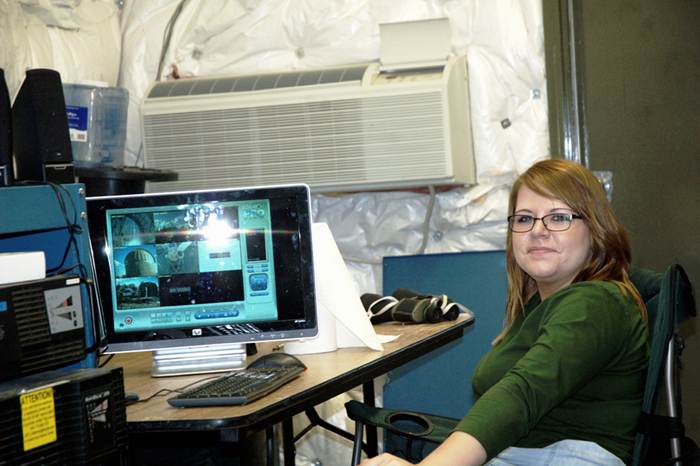
[Shelby Stock. The computer screen shows live shots from some of the security cameras]
Stock was awed by the observatory. “I love it, it’s amazing,” she said. The telescope is “the best I’ve ever seen. I loved looking at the Whirlpool and Saturn — everything was just so crisp and clear.”
Once all seemed in order, Ricketts began taking photographs of celestial objects. But when the telescope slewed, a tiny piece of debris fell onto the glass plate that protects the camera’s light-sensitive chip. Off came the camera and into the control room, where it was opened and the object carefully removed. Although minute, it had caused a flaw on the image.
The camera was reinstalled and Ricketts again fired it up. Now the pictures were clear. They included the Ring Nebula (M-57), the dramatic remains of a star that exploded 4,000 years ago at a distance of 2,000 light-years from Earth. Even though the images were single frames, not stacked or calibrated, they showed intricate details of layers and ropy folds in the dust and gas that make up the nebula.
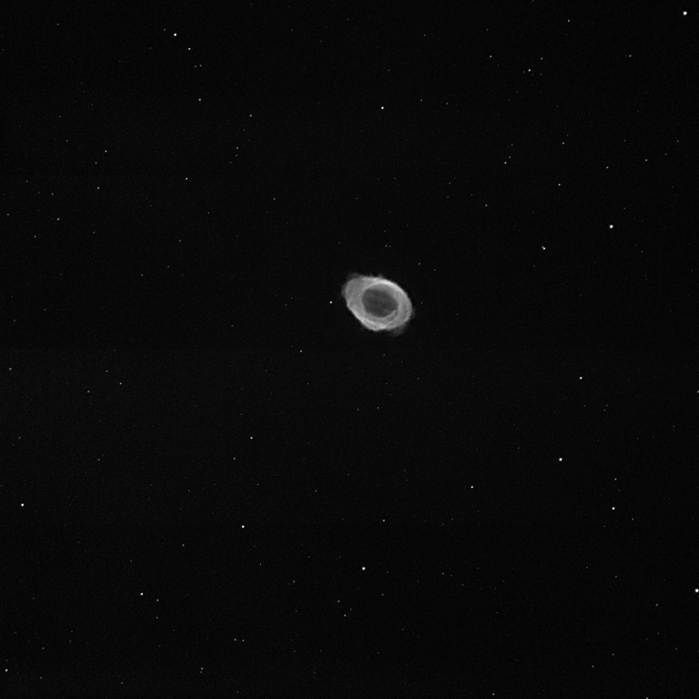
[One of Ricketts’ images of the Ring Nebula, M-57, a five-minute exposure through an H-alpha filter. He said the picture was “slightly processed but not calibrated”]
All photos posted here were taken during the night of Aug. 10-11, 2017, at the Willard L. Eccles Observatory. Paul Ricketts made the view of the Ring Nebula; the others are by the author.


Leave a Reply