By Joe Bauman, Salt Lake City
This is the first of a two-part series
Consider an earthworm. Because it lives underground, inching along eating soil – as millions of generations of its ancestors have – it has no need for eyes and no concept of light, let alone color. When a giant, multi-sensory predator, the robin, strikes, what an unpleasant surprise!
Or take flowers. Without any conception of color, they evolved specialized coloration to attract insects to their pollen, allowing fertilization to take place as bees buzz from one bright plant-offering to another. “Plants attract pollinators by displaying distinctly coloured flowers,” according to the introduction to a 2016 study published by Proceedings of the Royal Society B: Biological Sciences. “The role of flower colour has been studied in many experiments, providing valuable insight into the complex nature of plant-pollinator interactions.” The colors of these non-seeing organisms evolved to appeal to the eye-brain dynamics and visual conceptions of insects, including some colors and patterns not perceptible to human eyes.
How these complicated adjustments formed I don’t pretend to understand. It’s one of the many wonderful mysteries of evolution.
This is demonstrated by a photographer named David Kennard, who supplies stock photography to businesses and organizations. A picture of marsh marigolds that he took without specialized filters shows them as we would see, uniformly bright yellow. But the same flowers photographed with an ultraviolet filter – which emphasizes light immediately beyond the violet end of the spectrum – reveals that the flower petals have distinct dark patterns leading into the pollen-filled stamens at the center. You have to be a bug with visual receptors sensitive to the ultraviolet to get the full, complex view of a marsh marigold.
Electromagnetism and vision
Electromagnetic emissions include these — going from low frequency to high — radio, microwave, infrared, visible light, ultraviolet, x-ray and gamma radiation. If we lived on a star, maybe we’d see in gamma rays; a star releases all of these types. Color is our understanding of the difference in frequencies within the relatively narrow slice of wavelengths called visible light.
We perceive light as vision when it passes through the lens of our eyes and is focused on the retinas, a layer of cells at the back of the eyeballs. The retina is part of the brain connected to the main section by way of the optic nerve. Each retina is made up of millions of photoreceptor cells called rods and cones. The rods allow vision in low-light situations and do not differentiate among colors. The cones allow color recognition; they come in three types, which are sensitive to red, blue and green.
Each eyeball is studded with 120 million rod cells and 6 million cone cells.
According to the visioncenter.org, usually 10 percent of cones recognize blue, 60 percent red and 30 percent green. Light of these wavelengths stimulate their corresponding cones. The cones transmit electrical impulses to the optical center of the brain, which decodes the signals and allows us to see. Think of millions of telegraphs sending dot-dash-dot information along their wires.
It’s not as if we have a little person sitting in our skull, watching a movie screen. The brain’s visual cortex somehow processes the signals to create vision. This is equivalent to the way other nerve cells transmit touch, allowing the brain to decode that sensation.
In some people, to make a figurative allusion, the wires are crossed; they perceive input in two or more senses when one is called for. People with this rare condition, termed synesthesia, might perceive numbers as both numbers and colors.
From a larger standpoint, I wonder whether each brain’s translations of nerve signals are similar, of if one person’s sensation of vision is alien from another’s.
The colors that human eyes can see within the spectrum of visible light range from wavelengths of about 380 to 700 nanometers. These correspond to seven basic colors: violet, indigo (or deep blue), light blue, green, yellow, orange and red. They’re called pure colors, as they are not mixtures of any others. However, a spectrum showing these seven is not abruptly divided between colors, but is a continuous shading of one hue into another.
We recognize a host of other colors — one site says a million — such as aquamarine, ochre, buff and purple. These are combinations of pure colors. The dimness and intensity of colors also play a part in determining the looks of a scene.
Eyeball sensitivity varies greatly among people. According to sciencenotes.org, to “You may see further than 400 nm. to 700 nm., but most people see 425 nm. to 690 nm.”
The camera
The camera is an ancient instrument, the name coming from the Latin camera obscura, or darkened room. A hole in a wall of a darkened room could project a vision of an upside-down landscape onto the opposite wall. The Metropolitan Museum of Art in New York City says
this effect was mentioned by a Chinese philosopher named Mo Ti, who lived from 470 to 390 BCE.
In the 500s CE, a Greek Philosopher named Anthemius of Tralles “used a type of camera obscura in his experiments,” according to the Metropolitan. Leonardo da Vinci clearly described a camera obscure about the year 1502.
The darkened room equates to an eyeball and the opposite wall is equivalent to the eye’s retina. Construction of small cameras as an aid to drawing began in the 15th century. Rather than a pinhole, the devices were improved by mounting a lens at one end to focus the light.
Astronomical photography
Our universe is filled with electromagnetic radiation, continuously flowing from stars, galaxies and other objects. These impulses fly right through each other without affecting one-another. The universe is a jumble of waves, many, like radio, going through ourselves. Without an instrument to focus them, such as an eye, a camera lens or a radio receiver, we are unaware of their presence. (The situation is complicated by the fact that light is both a wave and a set of particles, but not entirely one or the other.)
Most astronomical objects are dim to viewers on Earth. In the past, astronomy pictures were taken on film, and that dimness forced astronomers, professional and amateur, to keep the camera pointed at the subject for long periods as the film was exposed. Decades ago, I would make astrophotos by hand-guiding the telescope and camera, which was loaded with film, and it was an awful task that rarely resulted in good images. Of course, our closest astronomical objects, the Sun and Moon, don’t require long exposures, though correct filters are essential in the case of the former.
More recently, CCD and CMOS cameras have overtaken astrophotography, vastly simplifying and improving the process. At the same time, automatic guidance systems were developed, in which telescope movements are controlled by computers responding to a target’s motions on a camera chip. These systems could be either a small camera attached to a separate guide telescope or a chip within the main camera.
CMOS stands for Complementary Metal-Oxide Semiconductor, one type of chip that the light falls upon. CCD means Charge-Coupled Device, another type.
CMOS cameras are generally lightweight and less expensive than CCD cameras. OPT Corporation — Oceanside Photo and Telescope, an Oceanside, California, company, now closed — was a premier dealer in telescopes, mounts, filters, cameras and other astronomical gear. OPT put it this way:
“Both CCD (Charge-Coupled Device) and CMOS (Complementary Metal–Oxide–Semiconductor) cameras have their own advantages and disadvantages when it comes to astrophotography. Generally speaking, CCD cameras are preferred for the long exposure shots needed for deep space images, since they have high quantum efficiency and low dark current noise. CMOS sensors are better suited for short exposures that require faster frame rates and lower power requirements. Both types of sensors provide clear, detailed images depending on your shooting style and preferences. Ultimately, the best camera for astrophotography will depend on your individual needs.”
Both types of chips depend on the photoelectric property of light, which was explained by Einstein; for this he received the 1921 Nobel Prize in Physics. The effect occurs when material releases an electron as light falls on it. When a photon — a light particle — hits the camera’s light-sensitive chip, it releases an electron. The camera notes the change in voltage and where on the chip it occurred. The process continues across the chip as an exposure takes place. The camera continues counting electrons and recording where the voltage change happened. At the end of the exposure, the data is sent to the computer’s astronomy processing software, which records it. The software plays it back as an image when requested.
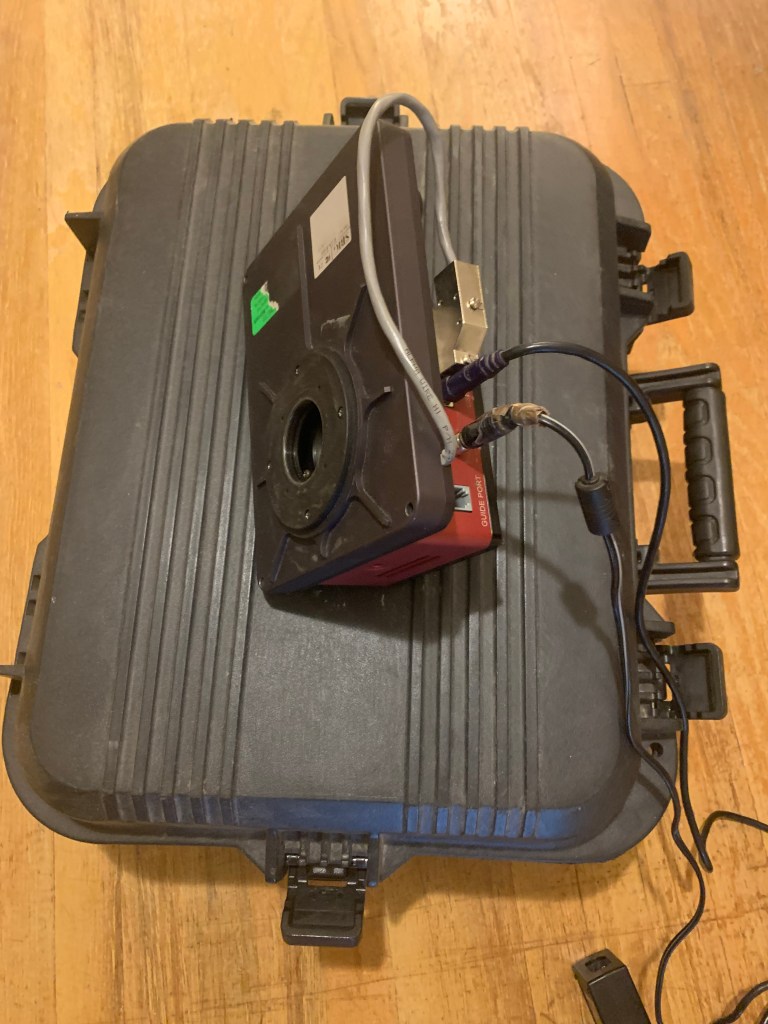
[This is the main camera I use for astrophotography, an SBIG model called an STF-8300, now a bit obsolete, lying on its carrying case. It is a CCD camera. The hole in the center is where it attaches to the telescope, making the telescope the camera lens. Photo by Joe Bauman, May 12, 2025]
Light coming through a telescope passes through the camera’s colored filters before reaching the chip. The filters are of several varieties. Only one is used per exposure.
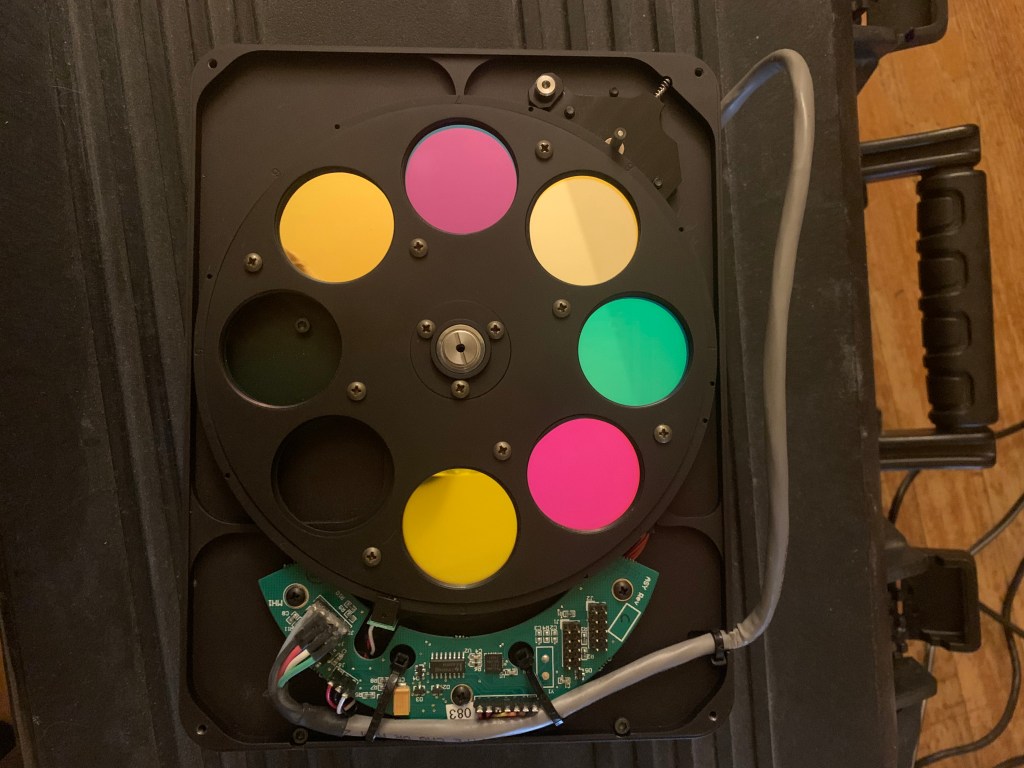
[Inside the camera, we see the filter wheel with seven filters and one empty place where another could be added. The filter wheel rotates on command to allow an exposure through a particular filter. The luminance filter is so nearly clear that it is barely visible here; it’s in the 7 o’clock position. The colors look strange because we’re seeing them by reflected light bouncing off the glass rather than by light coming through the filters. The light-sensitive chip is behind one of the filters. Photo by Joe Bauman, May 12, 2025]
The four most commonly used filters are luminance, red, green and blue, producing a set of exposures that is abbreviated as LRGB. When properly adjusted, the combination of colors and luminance gives a view like you would see if you had an eyeball a foot across that could accumulate light for a long time. The red, green and blue filters are self-explanatory, allowing light from each of those frequencies to expose the chip most strongly. A luminance filter is said to make an ordinary black-and-white photo but it’s not that simple.
The luminance filter doesn’t allow all light rays through. It transmits light from about 400 to 700 nanometers, blocking ultraviolet and infrared light, which otherwise might fog the image; this is no loss to the human enjoyment of astronomical photos because we can’t see infrared or ultraviolet. The filter improves contrast and detail, adds syronoptics.com.
The luminance filter presents a detailed view of the cosmos while the colors splash in where needed. Often astrophotographers will take longer exposures in luminance and will shut down the red, green and blue exposures to a smaller scale. The color exposures are scaled up by the software; they aren’t as detailed as the luminance scenes that they fill in. Personally, I usually shoot LRGB without scaling down any of the exposures.
Because deep-space targets are dim, many light exposures are taken per finished view; mine range from half a minute to two minutes each, and other astrophotographers take much longer exposures. Each image must be adjusted to remove thermal noise and other defects; this is termed calibration. Software calibrates images automatically using exposures that the photographer makes called flats, darks, dark-flats and bias.
A dark frame records the thermal noise inherent to an exposure and must be for the same length and at the same temperature as the light exposure. The frame is taken without any light reaching the chip, and it show the many specks of brightness resulting from electrical current in the camera; the dark frames are subtracted from the images.
Bias frames subtract readout noise that is present in the camera; as opposed to the length of a dark frame, a bias is instantaneous.
A flat field corrects any vignetting and subtracts problems such as dust motes in the train of optical elements. Each flat exposure is based on the length of time a fixed light source is needed to get the correct exposure for a filter; the four filters require four different settings and we need multiples of them. I use a light panel that goes over the end of the telescope and provides even illumination. A dark-flat is a dark of the same length of time as the flat.
If this sounds complicated, that’s because it is. Especially devilish is determining the length that flats must be exposed, but formulas are available.
At the start of a season of astrophotography, I build up a library of dark and bias images, with the darks varied by length of exposure and temperature; the camera regulates the temperature, within limits. The library will be good all season. Flats are a different problem and must be done for each session because they are different according to such factors as the orientation of the camera to dust specks on the lens or filters.
Because the light from deep-space objects is so dim, many exposures are needed for each filter. As an example, in the night last Oct. 12-13, I took light exposures of the Cocoon Nebula totaling two hours – 30 exposures of one-minute duration for luminance, red, green and blue filters; total, 120 exposures. Here’s what one exposure looked like for each filter:
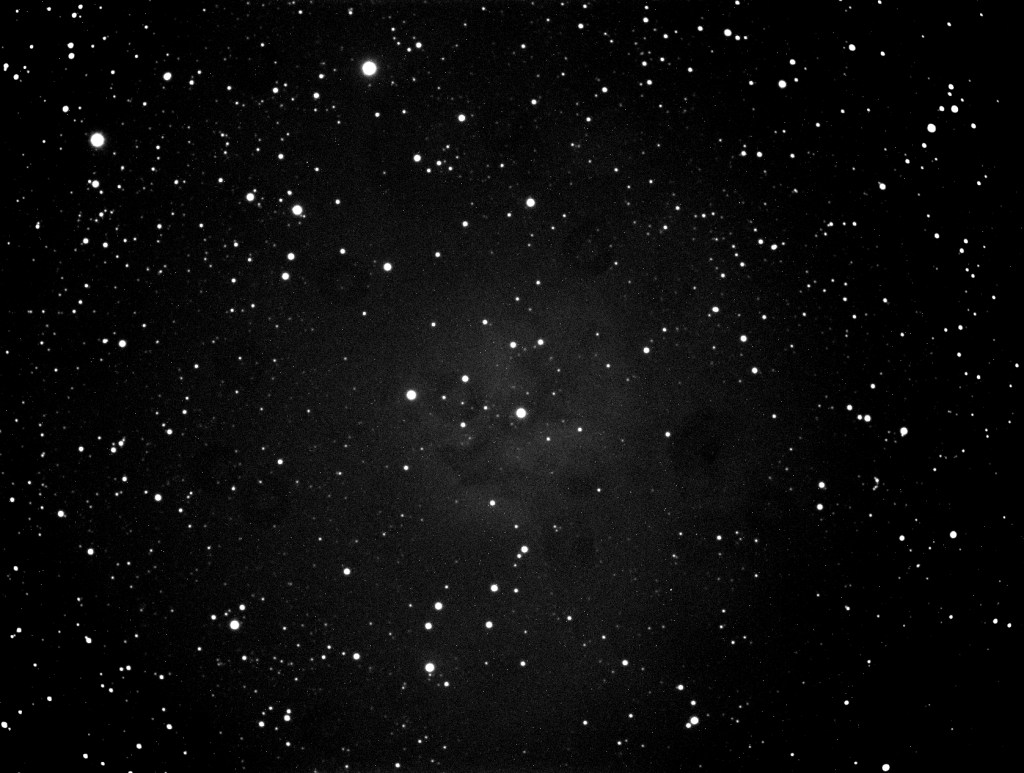
[The nebula shows up as a faint blur in a one-minute view taken with the luminance filter; that is, without color filtering.]
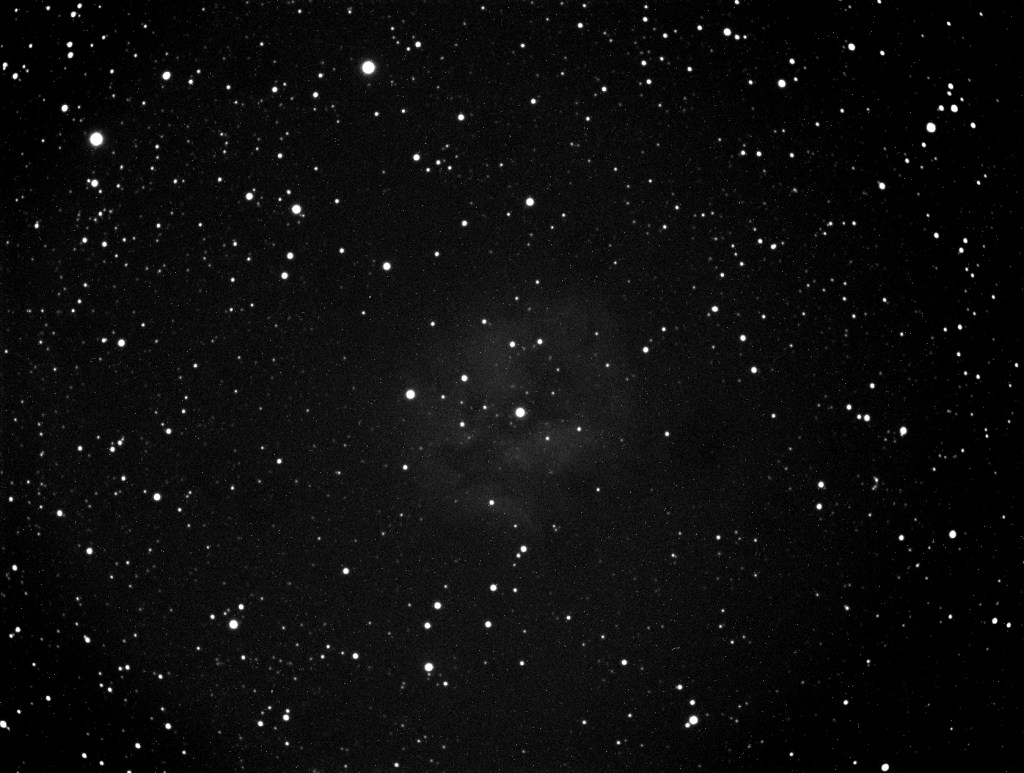
[This is a single frame of the red exposure. Because the nebula is largely red, this is the brightest it will seem in any color filter]
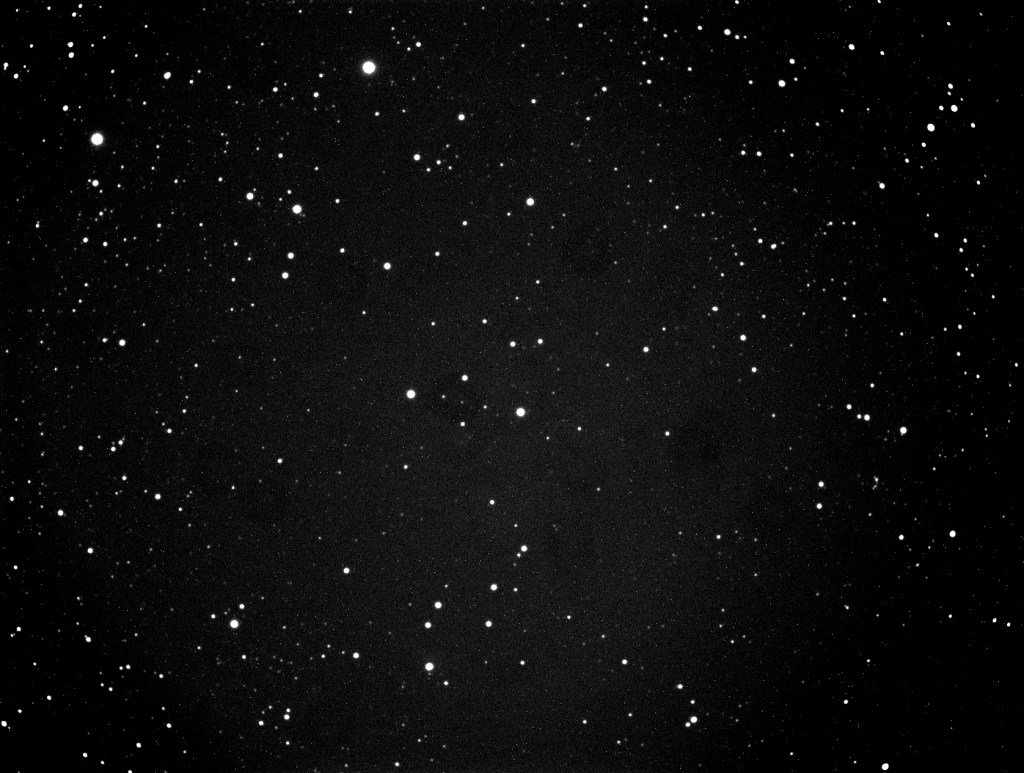
[This is a one-minute exposure through the green filter. Because the nebula doesn’t show any green, it’s a dim feature. But there is some modulation from pure red. As the Cocoon isn’t absolutely crimson, some material is visible here]
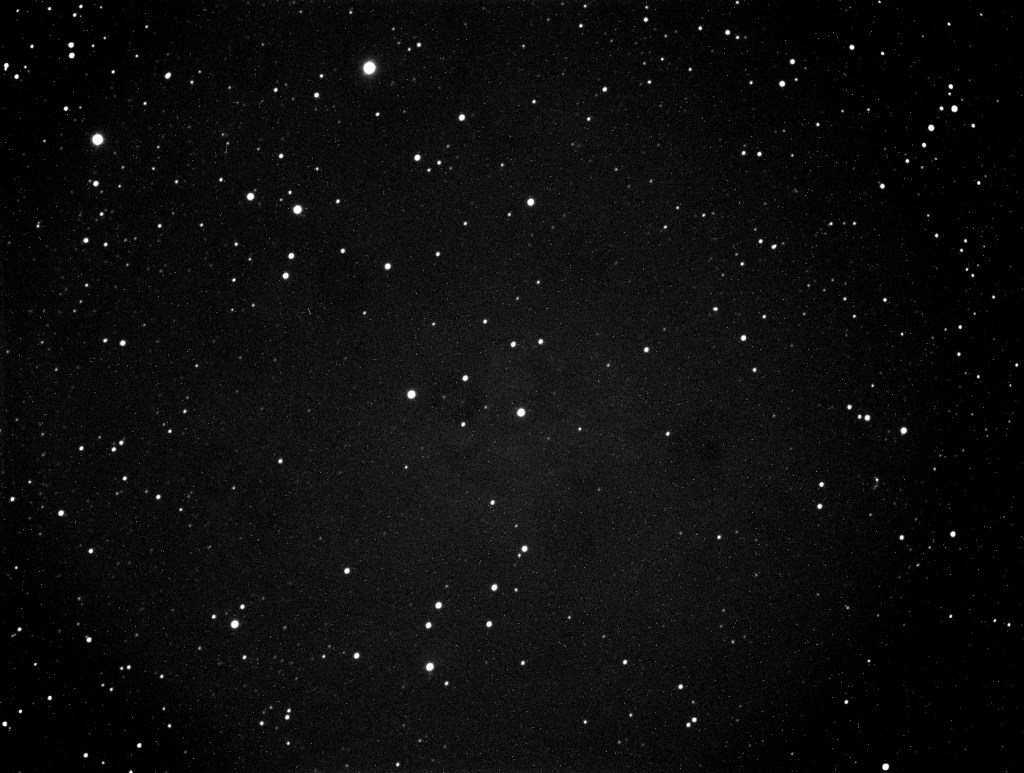
[This is a one-minute exposure through the blue filter. The tonal values are different from those seen in the red or green exposure because the nebula is not just one pure color but a combination]
The software allows the photographer to exactly align each exposure and stack groups of them according to filter, and to calibrate them with flats, darks, bias and dark-flat images. Stacking is a way to increase the exposure; 30 views from the red filter, each of one minute, are stacked to make an overall red view of 30 minutes exposure. Finally, the software combines the views to get what, to our eyes, if they were big enough, would be a full-color picture:
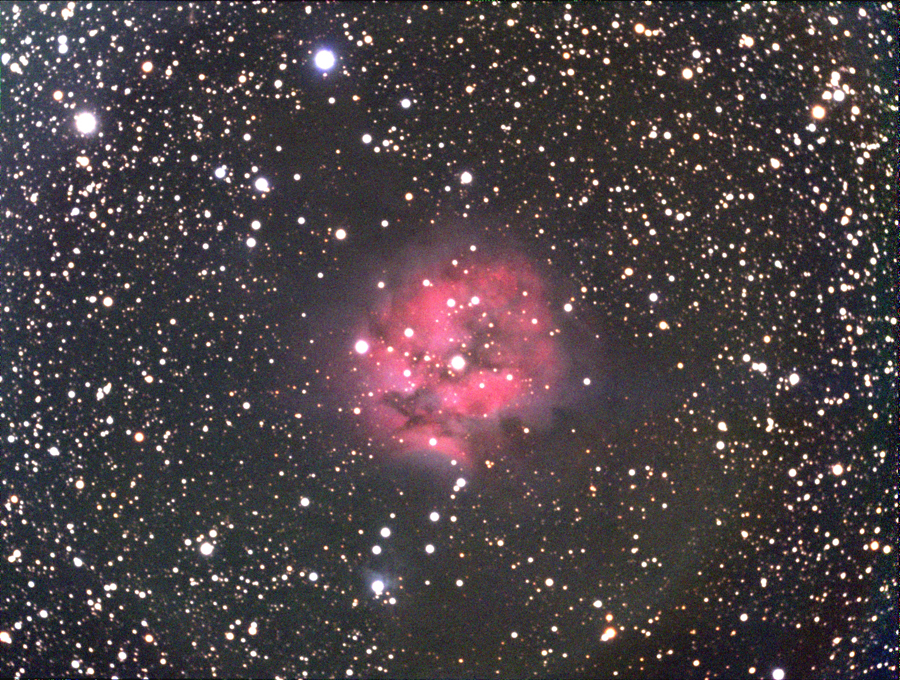
[The final product showing the Cocoon Nebula, which is comparatively close. NASA estimates its distance as 4,000 light-years away and its size as 15 light-years across. Assuming that is accurate, we’re seeing it as it was 4,000 years ago. Photo by Joe Bauman, taken in Salt Lake City, night of Sept. 12-13, 2024]
In the photo of my filters, you’ll remember three others besides luminance, red, green and blue. The others are called Hydrogen-alpha, Sulfur-II and Oxygen-III. They are narrow-band filters, as each is a narrow slice of the visual spectrum, corresponding to special conditions. As NASA points out in a discussion of the Crab Nebula, such filtering will “yield insight into the composition” of deep-space objects.
From a practical viewpoint, narrow-band filters are difficult to use as they can take ten times as long to get a usable exposure as ordinary filters. To take the Cocoon in narrow band, presumably one would rack up 20 hours of light photography, requiring night after night of effort. The resulting image will not seem natural, as it emphasizes special features of the view. But besides the scientific value, narrowband filters have the immense advantage of blocking light pollution and natural sky glow.
Hydrogen-alpha, universally called H-alpha, allows through only light of 656 nanometers. (Much larger H-alpha filters are designed for solar viewing. In this discussion we’re only talking about H-alpha for astrophotography; using the small astro filters for solar viewing would lead to instant blindness and destruction of instruments.)
OPT Corp. warned, “If you’re observing the Sun, never use an H alpha filter [that is designed] for nighttime observing. They do not reduce the Sun’s brightness sufficiently and will not protect you from its harmful rays.”
Without getting too technical, H-alpha emissions occur when an atom of hydrogen – the simplest and most common element – undergoes a change in the energy level of its electron; it has just one electron and one proton. When a hydrogen atom is ionized through excess energy, the electron may be blown away; then the electron and nucleus can recombine at a higher energy state. This isn’t sustainable and the system will return to its ground state, releasing an H-alpha photon.
This filter passes photons released by excited hydrogen gas, showing how nebulas evolve and expand, for example. Also, H-alpha images point out regions where new stars are forming, their heat juicing up the surrounding hydrogen clouds.
For astrophotographers, H-alpha filters will render stars smaller and bring out interesting structural details in nebulas and galaxies.
According to Agnena Astro, to which acquired OPT, “The most commonly used line filter, the H-alpha filter passes red light emitted by ionized hydrogen and brings out the fine, delicate detail in emission nebula and supernova remnants. The filter is also useful for bringing out HII (ionized hydrogen) regions in nearby galaxies.”
The Sulfur-II filter, called SII, improves contrast in nebulas. It allows transmission at about 672 nanometers, the level at which sulfur atoms release energy when ionized.
Agena states, “There is very little sulfur in nebulae, but the SII emission is strong and well favored for the physical conditions in many such objects. The deep-red light from SII reveals delicate detail that may be distinct from regions that emit light from hydrogen. When used with monochrome cameras, images of SII emission at 672 nm is often assigned a false color.” In other words, it picks out particular regions that otherwise might be swamped in the general color of a nebula.
Oxygen-III, that is, OIII filters, block emissions except at 496 and 501 nm. Agena comments, “OIII filters are very useful for extracting detail from planetary nebulae and some emission nebulae and supernova remnants while blocking much of the light from stars and other broadband light sources.”
OIII refers to doubly-ionized oxygen atoms, excited by extremely high energy.
NASA has developed what is known as the “Hubble Palette” of assigned colors for photos taken through narrow-band filters. They are called false colors, as they are arbitrary and not what one would really see. But they facilitate understanding of complicated events. H-alpha is assigned the color green, SII emissions are painted red and OIII are blue. These correspond to differences in energy levels and processes, allowing scientists to tease out information that would not be obvious in broadband photography.
Just as with our vision using normal pure colors, narrowband mixtures of these assigned tints create any number of peculiar colors. Other narrowband filters capture emissions at different levels and from different elements. The space agency also assigns false colors to other readings, such as X-rays, infrared and ultraviolet imaging. All the filters, broad and narrowband, teach us something about cosmic processes.
A beautiful example is a photo showing the remains of a supernova explosion whose blast was noticed in 1054 by Chinese astronomers. Back then, it was so bright that the so-called “guest star” could be seen in the daytime. Almost a thousand years later its remnant, the Crab Nebula, was photographed by the Hubble Space Telescope using narrowband filters:
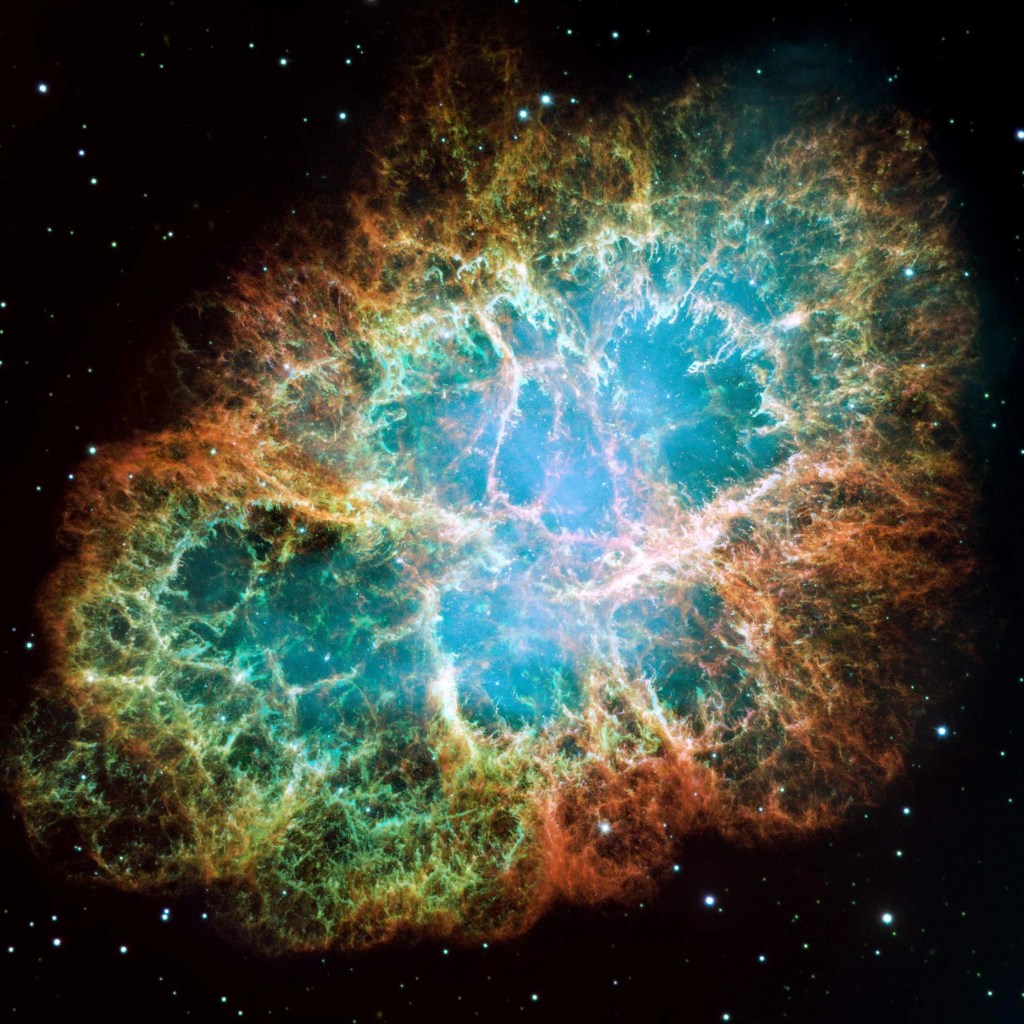
[The Crab Nebula photographed by Hubble narrowband filters, including some not part of the typical Hubble Palette. Courtesy NASA via the Hubble Telescope]
“This large mosaic of the Crab Nebula was assembled from 24 individual exposures captured by Hubble over three months. The colors in this image do not match exactly what we would see with our eyes but yield insight into the composition of this spectacular stellar corpse. The orange filaments are the tattered remains of the star and consist mostly of hydrogen. The blue in the filaments in the outer part of the nebula represents neutral oxygen. Green is singly ionized sulfur, and red indicates doubly ionized oxygen. These elements were expelled during the supernova explosion.
“A rapidly spinning neutron star (the ultra-dense core of the exploded star) is embedded in the center of the Crab Nebula. Electrons whirling at nearly the speed of light around the star’s magnetic field lines produce the eerie blue light in the interior of the nebula. The neutron star, like a lighthouse, ejects twin beams of radiation that make it appear to pulse 30 times per second as it rotates.”
Next: The development of photography, including color images


Leave a Reply