By Joe Bauman, Salt Lake City
This is the second of a two-part series
In the previous blog, the topics were color — as it is perceived by the human eye, as it is radiated by astronomical processes and as it is recorded by astronomy cameras. But how did we become able to take pictures through a telescope? This blog attempts to cover the invention of photography, some theories about the science of photography, and the recording of color in photographs.
As research into chemistry advanced, scientists began experimenting with photosensitive material in the late 18th century. They knew that certain substances, such as silver iodide, darkened in sunlight. This wasn’t surprising, as everyone knew that a face will darken or redden if a person is outside in bright sunlight for a long time. Where the sunshine is blocked, say by a hat, that part remains unaffected. You might call it the photosensitivity of skin.
Wedgewood
A notable advance came with the concoctions of a wealthy Englishman named Thomas Wedgewood (son of the famous potter Josiah Wedgewood). The internet site Photograms.org says Thomas Wedgewood experimented with chemicals in his father’s shop and was able to produce images in the 1790s, which were not fixed and did not last long. He and Sir Humphry Davy presented a paper to the Royal Institution of Great Britain in 1802 titled, “An Account of Method of Copying Paintings upon Glass, and making Profiles by the Agency upon Nitrate of Silver.”
Photograms.org adds, “This was in essence a method of making photogram images on paper impregnated with silver nitrate – a process not dissimilar with techniques used today. He [Wedgewood] is known to have produced designs on leather, glass and ceramic items using light and heat to change chemical substances. These images, although temporary, can be considered photograms.”
A photogram is an image produced on light-sensitive material without a camera. What Wedgewood made weren’t camera view, but silhouettes formed by placing objects like lace onto treated paper and letting the Sun go to work. However, he had taken an important step toward photography.
In 1777, a German-Swedish chemist named Carl Wilhelm Scheele described a method of dissolving unexposed silver chloride with diluted ammonia. Removing unexposed material would have been a way to fix a photo so that it was more or less permanent. If Wedgewood and Davy had thought of putting treated paper in a camera, taking an exposure and fixing the paper with dilute ammonia, practical photography might have been developed decades earlier than it was.
The discovery of a letter by Niépce to his brother, evidently uncovered after the Getty research was published, establishes the date of the First Photograph as 1824. French experts at the Maison Nicéphore Niépce posted the letter on the internet; the translation of the pertinent section is:
“I am pleased to finally be able to announce to you that, thanks to the refinement of my processes, I have succeeded in obtaining a view as I had wished for, though I scarcely dared to hope for it, as until now, my results had been very incomplete. This view was taken from your room facing Le Gras; and for this purpose, I used my largest camera obscura and my largest plate. The image of the objects is rendered with astonishing clarity and fidelity, down to the finest details and their most delicate shades. Since this counter-proof is almost uncolored, one can best appreciate its effect by looking at the plate obliquely: it is then that it becomes perceptible to the eye, through the shadows and light reflections; and this effect, I must say, my dear friend, truly has something magical about it. … In the meantime, you can, as of today, consider the success of applying my processes to views, whether on stone or on glass, as a demonstrated and indisputable fact.”
In 1827, during a visit to England, Niépce presented this astoundingly valuable image, as well as photocopies he had made of etchings, to an English friend, the botanist Francis Bauer. Taken from a second-story window of the Niepce estate, La Gras, it is preserved in the Harry Ransom Center, University of Texas at Austin.
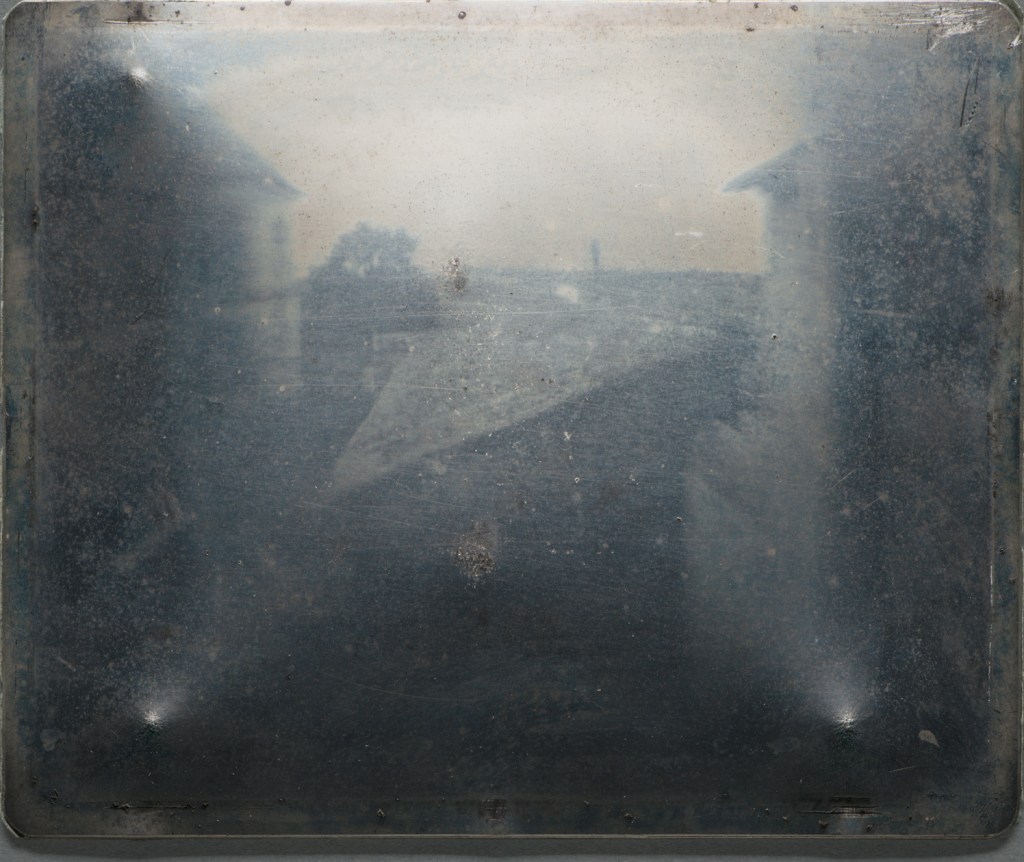
[Joseph Nicéphore Niépce, 1824, the world’s first photograph. Courtesy Harry Ransom Center, University of Texas at Austin]
On the left is a pigeon-house; in the left center a plum tree, then the slanting roof of a barn, the chimney of the estate’s bakery, and another wing of the house, as described by smarthistory.org On the left is a pigeon-house; in the left center a plum tree, then the slanting roof of a barn, the chimney of the estate’s bakery, and another wing of the house, as described by the site smarthistory.org.
How he made it is ingenious.
Niépce dissolved bitumen, a sort of tar, in a solvent called oil of lavender. This formed a varnish, which used it to coat a piece of highly polished pewter. He dried the plate with heat. Then he put it in a camera aimed from a second-floor window at La Gras and exposed the plate. I have read an estimate that it took eight hours, and also a guess that it took several days.
Sunlight hardened the tar where the rays were most intense and left the material soft elsewhere. Niépce then rinsed off the softer material with a solvent, a mixture of oil of lavender and kerosene. Finally he washed it in lukewarm water and the photograph was finished. Microscopic droplets of hardened bitumen and calcium carbonate were left on the plate where the light was strongest. Where less light had fallen on the varnish, the pewter now showed. Tiny brownish droplets form a negative. When a dark object is reflected onto the plate, the pewter looks dark and the droplets are lighter, making a positive photograph.
Later, Niépce experimented with silver plates and iodine vapor to darken the images. He mostly copied engravings placed in direct contact with the plates, not taking camera exposures.
Daguerre
Enter Louis-Jacques-Mandé Daguerre, 1787-1851. A successful artist and businessman, he formed a partnership with Niépce in 1829, aiming to work toward a practical method of photography. Niepce died in 1833, before their dream came true. Daguerre continued experimenting, and in the late 1830s he hit upon the right combination. It was the daguerreotype, the first practical, commercial photographic process. I can imagine Daguerre’s excitement when he was the only person in the world who could make a photograph, aiming his camera at the streets of Paris and then developing the scene. What a thrill!
Details of the process were announced publicly on August 19, 1839, and the process swiftly spread around the world. Experimenters began constructing daguerreotype outfits that year. By the early 1840s, with improvements in the chemistry, the system had become fast enough for portraiture. These refinements reduced exposure time to seconds and improved contrast. Daguerreian galleries sprouted in cities and towns, and traveling daguerreotype wagons fanned out through the back roads. Photography was here to stay.
How Daguerre did it:
A sheet of silver-coated copper was buffed to a fine, bright sheen, as reflective as a mirror. Then in a light-proof box it was bathed in iodine fumes, which formed silver iodide, a light-sensitive coating. The plate was exposed in a camera for several minutes. Then it was developed with the fumes of mercury, which produced a beautiful, highly detailed image. Mercury vapor is toxic, and the process required the greatest care. The plate was rinsed and fixed in a bath of hyposulfite of soda. Like Niépce’s invention, the daguerreotype is actually a negative, but when seen with something dark reflecting on the silver surface, it shows as a positive.
Meanwhile, a wealthy British experimenter named William Henry Fox Talbot, 1800-1877, invented the system of a separate negative and its positive print. In the early 1830s he experimented with light-sensitive paper in a camera. He produced fixed negatives on paper in 1835 and improved the process to make positive prints from negatives in the 1840s. Each daguerreotype was unique; the finished picture that the customer got was on the metal plate that went into the camera. Talbot’s system had the advantage that many prints could be made from a single negative. Eventually the separate negative and positive form of photography became the prevailing system. But when it was announced, the process could not compete with the beautiful daguerreotype in terms of clarity, fineness of shading or detail.
In the early days of photography, the medium was orthochromatic, that is, capable of capturing light only on the violet-indigo-blue end of the spectrum. It was blind on the red side, the light at the weaker end of the spectrum.
Here is a scan of a daguerreotype from the early 1850s that my friend Doug York allowed me to use:
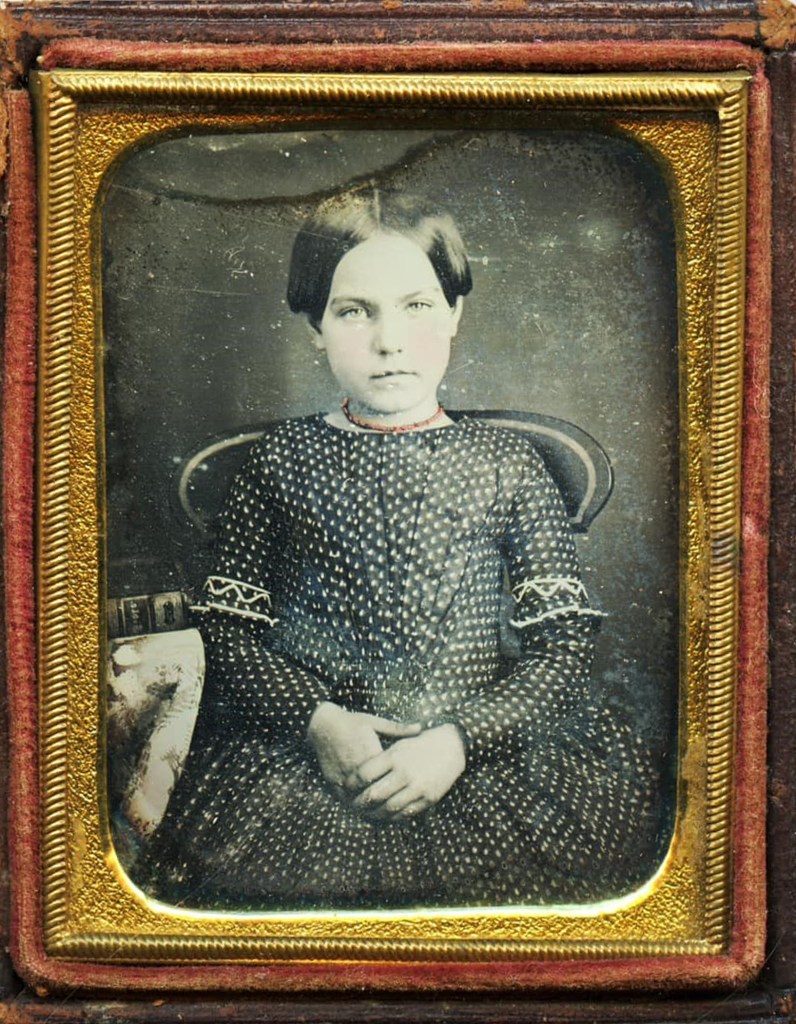
[Daguerreotype portrait of a girl, taken in the 1850s. Image courtesy of the Doug York Collection]
The photograph is in its case, protected by a mat and a sheet of glass. It is a black-and-white image, with its only color being pink tinting that the daguerreotypist or an assistant put on the little girl’s coral necklace and her cheeks. (Such necklaces were believed to ward off childhood illness.)
The aspect to think about is the main area of her dress, call it the background, the part that the small heart-shaped dots are on. See how dark it is?
Someone — probably her mother – took a swath of the same fabric that the dress is made of, and pinned it to the silk padding of the daguerreotype’s case. Here is the view showing both sides of the open case:
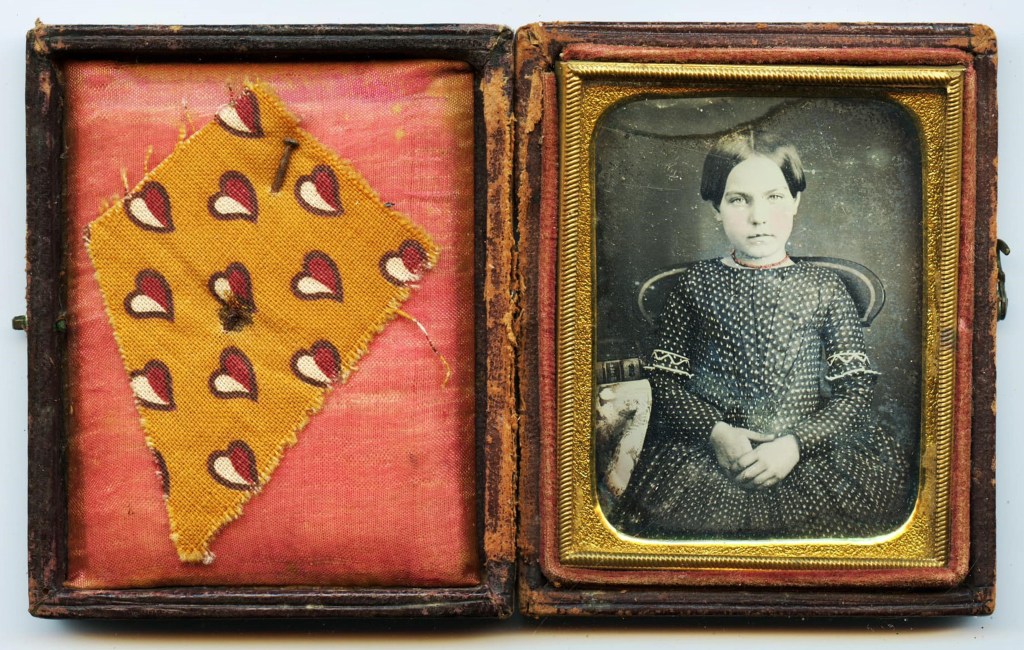
[Overall view of the daguerreotype and its padding, courtesy of the Doug York Collection]
On the patch of fabric, the background section is a cheerful yellowish-orange. This illustrates the fact that the daguerreotype, like almost all photographs of the 19th century, was unable to register much light from the yellow-to-red end of the spectrum. Therefore, many people today, when looking at antique photos, believe that their ancestors were doomed to wear drab, dark fashions – which is not true.
Daguerreotypes gave way to ambrotypes in the middle 1850s, and negative-positive prints became popular around the time of the Civil War. Glass plate negatives were replaced by sheets and rolls of film. In the early 1900s, additives were devised that made film panchromatic – these photos were still black and white but they exposed all colors correctly. No longer would blue eyes overexpose, taking on a ghostly look; a photo of a red rose wouldn’t look black.
Levi Hill
A search for methods to preserve the colors of nature began nearly as soon as the daguerreotype was announced. A clergyman in Westkill, N.Y named Levi Hill, startled other daguerreotypists in the early 1850s with the claim that he had invented a way to take color daguerreotypes. He called them Hillotypes. For a time the portrait business dropped off, as clients waited to get their pictures in color. Hill was denounced as a fraud. Eventually he published his process and it turned out to be almost impossibly complicated and the invention died with him.
“Hillotypes were continually dismissed or denounced as fraudulent even long after Hill’s death,” notes the Smithsonian Institution at an on-line site.
The Smithsonian retains 62 of his Hillotypes. They are muddy and sometimes hard to make out. The museum adds, “However, x-ray and infrared studies of the Smithsonian’s unique collection of Hillotypes in 2007 prove that many of these images demonstrate true natural color photography.” Admittedly, some show evidence of tinting or enhancing color. But somehow Hill and his wife Emmeline — who worked with him — actually did create an emulsion that reproduced color.
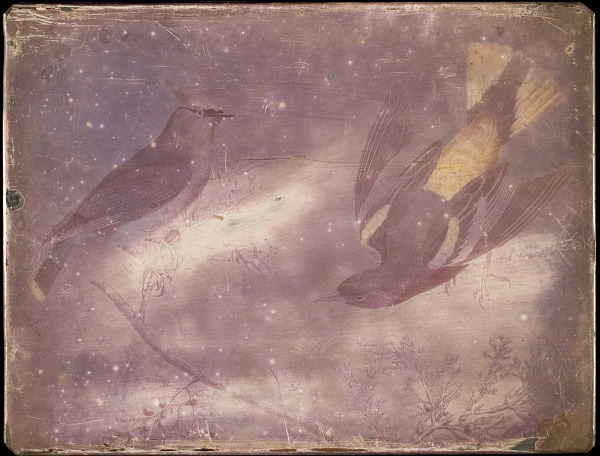
[Levi Hill, Hillotype photograph from the 1850s of a color print. Photo courtesy of the Smithsonian Institute]
An art historian named Joseph Boudreau found a copy of Hill’s treatise and, in the 1990s, was able to use its instructions to produce color photographs. He published his findings in Pioneers of Photography: Their Achievements in Science and Technology. Springfield, VA: The Society of Imaging Science and Technology, 1997, distributed by the Northeastern University Press.
Maxwell
In 1861, James Clark Maxwell, a Scottish physicist, made a color photograph by combining three images of a tartan ribbon, taken through red, green and blue filters. (Part 1 explains how these three colors can be combined to make all colors that the human eye can discern.) Maxwell made positive slides of each picture, then projected them onto a screen through the corresponding filters. Knowing the insensitivity of the plates to most of these colors, the red and green exposures must have taken a long time. Nevertheless, he made a color photo.
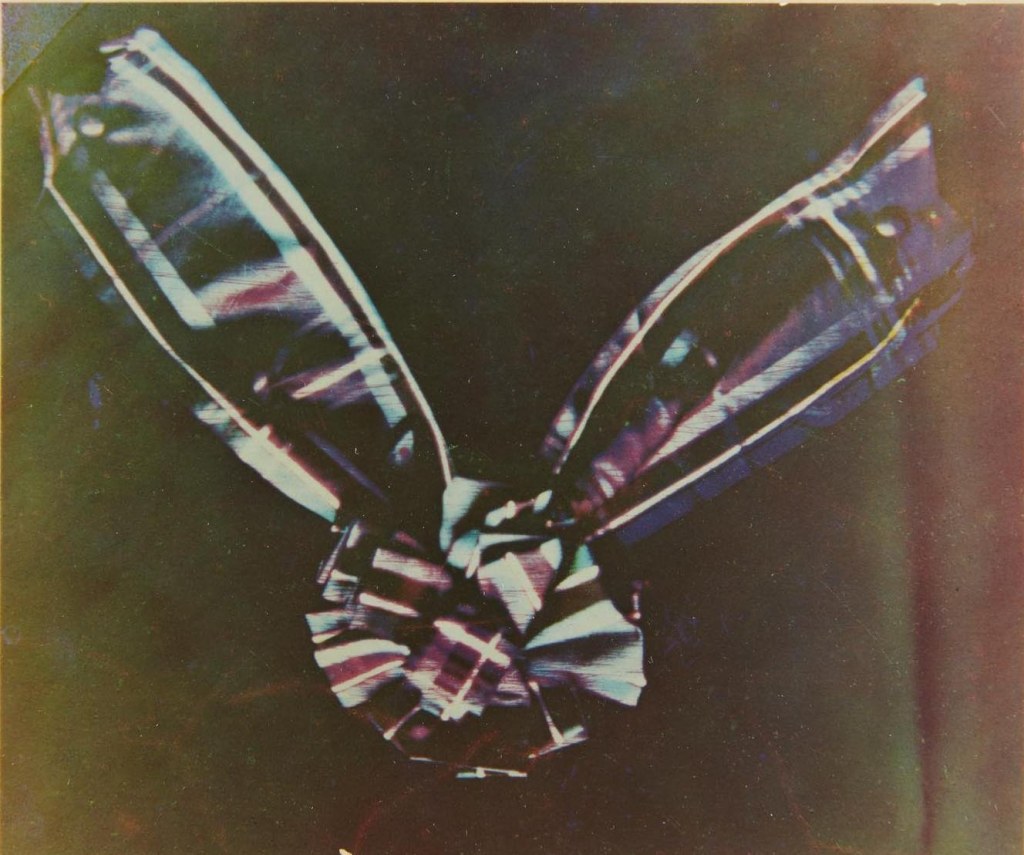
[James Clark Maxwell, 1861, a tartan ribbon. Photo courtesy of the Science and Media Museum, Bradford, England]
When panchromatic film became available, inventors turned out interesting ways to create color photos. A camera took three views at once, each through a filter colored red, green and blue. The results could be printed as color images.
Gabriel Lippmann
So far, all color processes discussed relied on dyes. But one astonishing process, developed by Professor Gabriel Lippmann beginning in 1891, does not. Lippmann, a scientist from Luxembourg, was awarded the 1908 Nobel Prize in Physics for his discovery.
A thick emulsion of black-and-white film of exceedingly fine grain was spread on a glass plate. The plate was placed in the camera with the lens aimed at the glass, the emulsion on the other side of the glass. The emulsion was backed by a sheet of mercury that acted as a mirror. During the long exposure, light of different colors bounced off the mercury and formed standing waves within the emulsions; the waves varied by the colors recorded. When the plate was developed as a positive and again backed with mercury, the scene’s original colors were visible. The system is called interference color photography.
Dr. Hans I. Bjelkhagen, writing on the internet site alternativephotography.com, notes,
“Only a minority of photographers recorded successful Lippmann photographs. Those who did were skilled in making and coating their own emulsions and dedicated many years to the cultivation of the technique. Despite the difficulties, Lippmann’s photography remains, to this day, the only direct process of true colour photography known. It is a technique of exquisite beauty, both technically and aesthetically. The ultra- fine grain plates, essential to the medium, display the highest photographic resolution ever achieved. The encoding of colour, as a periodic volume diffraction grating of pure silver offers excellent and unrivaled archival longevity.”
The system is used today by a group of dedicated practitioners, whose efforts can be seen on the Facebook site. The site’s moderator, Jonathan Tod Hilty, recently posted some gorgeous flower photos he took with the Lippmann process. Based in Grand Rapids, MI, he uses mica powder, “which seems to act, at least partially, as a replacement for mercury as a reflector.”
Hilty added in an exchange of messages with this blog, “The Lippmann photographic process uses ultra-high resolution plates to record the interference pattern of light — essentially using black & white plates with such insanely high resolving power that it can record the wave patterns of different colors directly.”
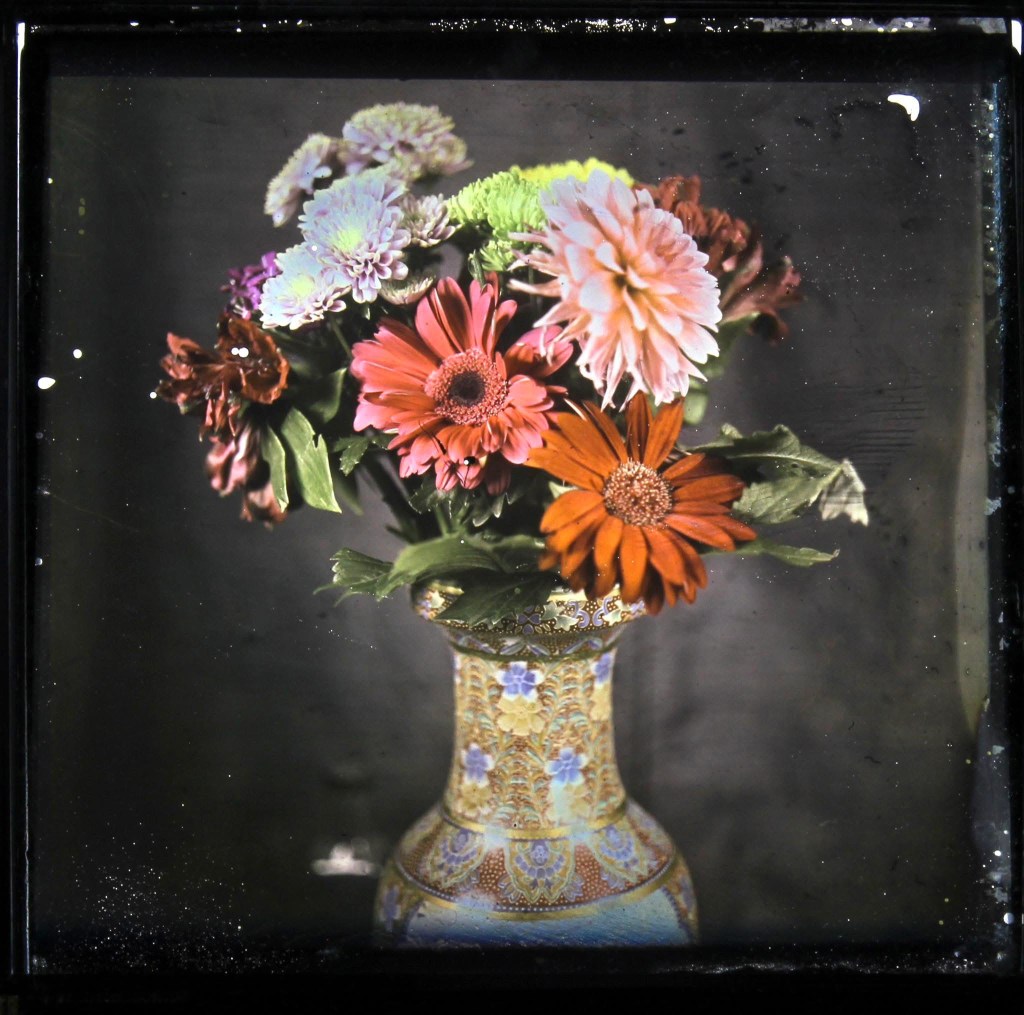
[Jonathan Tod Hilty, Grand Rapids, MI, a vase of flowers recorded in a single exposure on black-and-white film, a modern example of the Lippmann photographic process. Exposure was 25 minutes at f/2.8. Photo courtesy of Jonathan Tod Hilty]
The original Lippmann system was complicated, relied on special emulsions, required long exposures and had the severe disadvantage of using mercury. It never became popular and eventually it was discarded in favor of autochrome photos. Yet it is a most amazing form of color photography.
The Lumière brothers
This first practical and popular color system was created by an amazing pair of by inventor brothers in France, Auguste and Louis Lumière. For this blog, we must pass over their other inventions such as a movie camera and projector. (Their film, “Workers Leaving the Lumière Factory,” 1895, is counted as the first motion picture.)
The brothers announced their success in making color film in 1904. They began the production of autochrome plates in 1907 and these were popular until the 1930s. After a few decades, the autochrome was supplanted by modern color film, which uses built-in filter layers.
The autochrome was an ingenious solution to the color problem. Tiny grains of potato starch were dyed red, blue and green, and mixed randomly. These were distributed over a glass plate – the Science and Media Museum in England says there were about 4 million grains per square inch of plate. Negative emulsion was spread across the starch and the plate was exposed in the camera, starch grains facing the lens. In development, the negative was converted to a positive slide.
Wherever red light struck the plate, the red grains would allow it through to expose patches, and the same was true for other colors and combinations of colors. When the finished plate was held to the light, the original color was visible. The production had a dreamy, almost pastel look.
I wrote an article many years ago for the Deseret News about a Utah man who had acquired several autochrome plates taken during World War I; I think they were about six by eight inches. Here is one I copied, showing French soldiers in a ruined town:
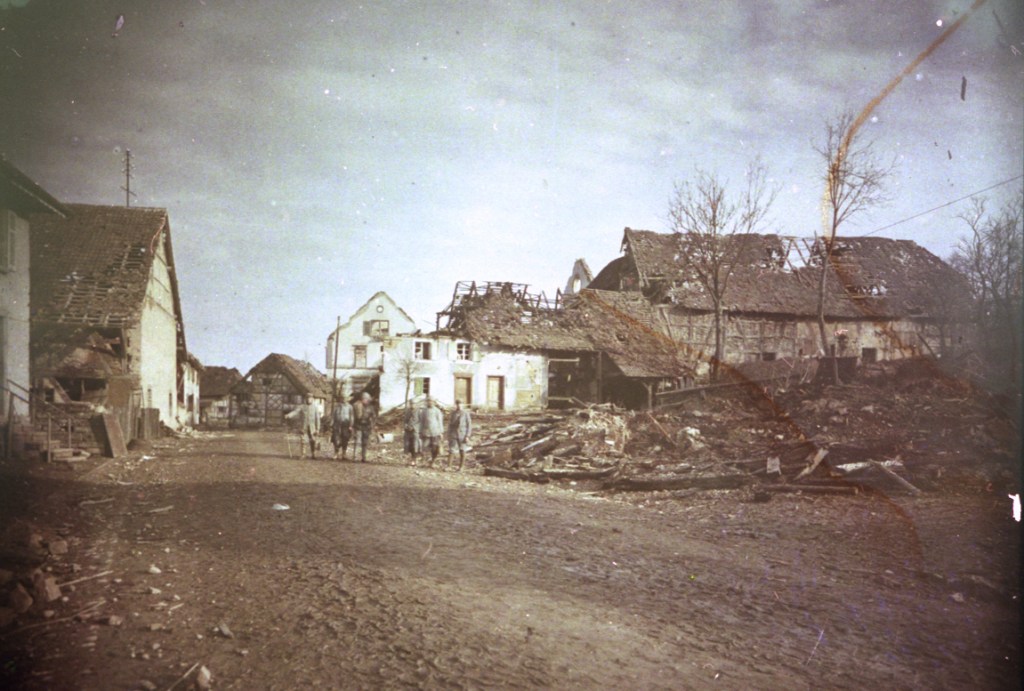
[Unknown photographer, C. 1916; a World War I photo take in color by the autochrome process. Photo copied by Joe Bauman, Salt Lake City]
Zooming in for a closer view of the same photograph:
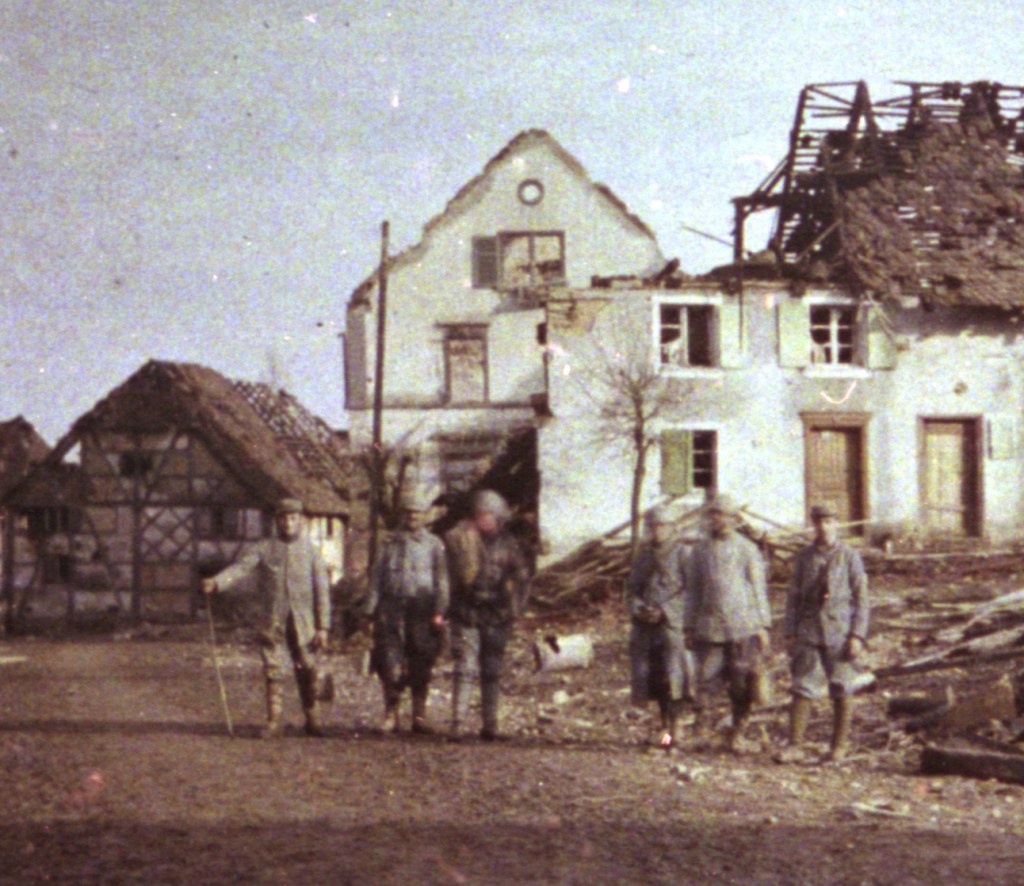
[Closer view of the above autochrome. The blotchy grains of colored starch are a bit more evident]
Personal experiment
I’ve always been interested in light. Around third grade, I got into trouble at school by arguing about it. I claimed that if I had a powerful enough flashlight and shined it into the night sky, the light would continue going up after I switched it off. The teacher disagreed. We got into an argument and I was told to be quiet. A day or a few days later I was called into the principal’s office. I thought I was really in for it. The principal must have heard about the disagreement from my teacher. To my surprise, he said I was right and praised me for my insight.
It’s the same physical law that allows us to see stars as they were millions of years ago, when they are millions of light-years away. Some may have blown up in supernova explosions, but we see them shining in their healthy youth.
During high school on the missile base of Kwajalein, Marshall Islands, I got it into my head to try to make a color photograph on black and white film. The year was 1962 or early 1963, probably the latter – I know it wasn’t any later because a friend, Chris Holmberg, whom I photographed on the same roll of film, left the island in 1963 when his father was assigned to another post. I was 16 or 17. I don’t believe I had heard of Maxwell. But my notion was like his, to take photos through red, blue and green filters, then combine these on a screen, projecting the images through the same filters. I would need to convert the negatives into positive slides and rig up three projectors to make the final product.
I only got as far as taking the pictures. I set up a bike as the subject in our backyard, and shot Kodak Plus-X black and white film. My father owned a set of several colored filters, apparently designed to let a photographer bring out different aspects of scenes. I used blue, green and red filters, respectively, over the camera lens. I remember my disappointment when a cloud showed up, which changed the lighting on one of the exposures; I knew it would distort the end result.
I’ve kept thousands of my photos through the years. Recently I scanned in the negatives from the 1963 experiment and used MaxIm-DL astrophotography software to color each of the scans according to the filter used. Here are the scans:
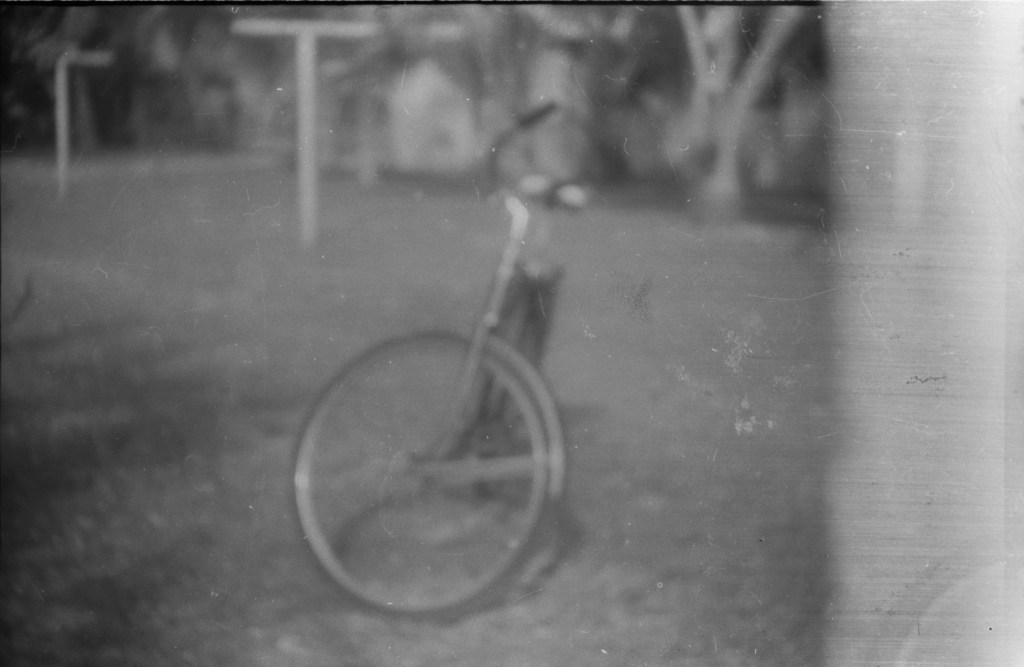
[This is a photo I took with a blue filter. It’s badly out of focus. Possibly I took another with that filter before this one, but when I cranked the film back into its canister, I didn’t continue long enough and the end of this image was exposed to sunlight, resulting in the gray section on the right. If I took one before this, it was obliterated. So this is my only blue exposure.]
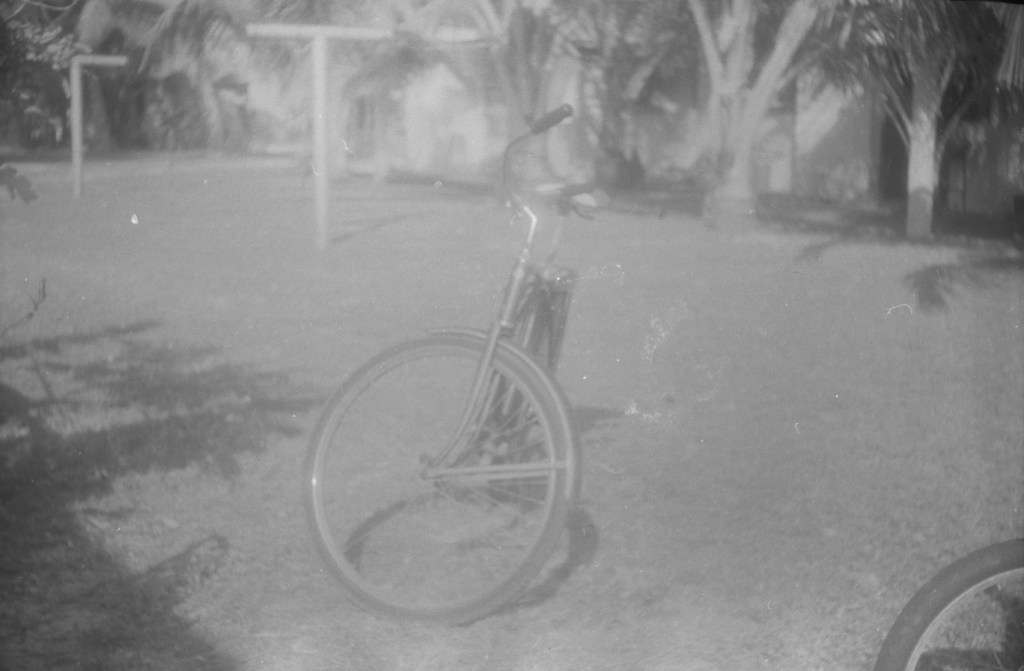
[This is the green exposure, affected by a passing cloud, which dimmed part of the scene to the right of the bicycle.]
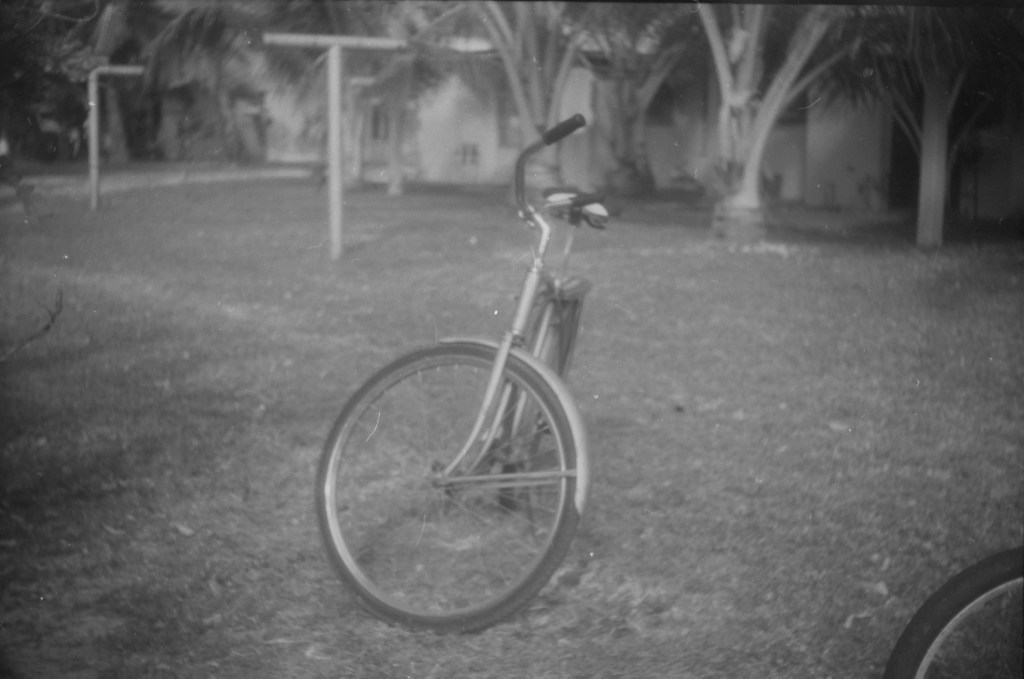
[This is the view I took through the red filter.]
The images waited, unfulfilled, for more than 60 years, until I got around to combining them and restoring the color. It took some adjustments and realigning, flaws are obvious, but I got the result I was aiming for in my experiment all those decades ago.
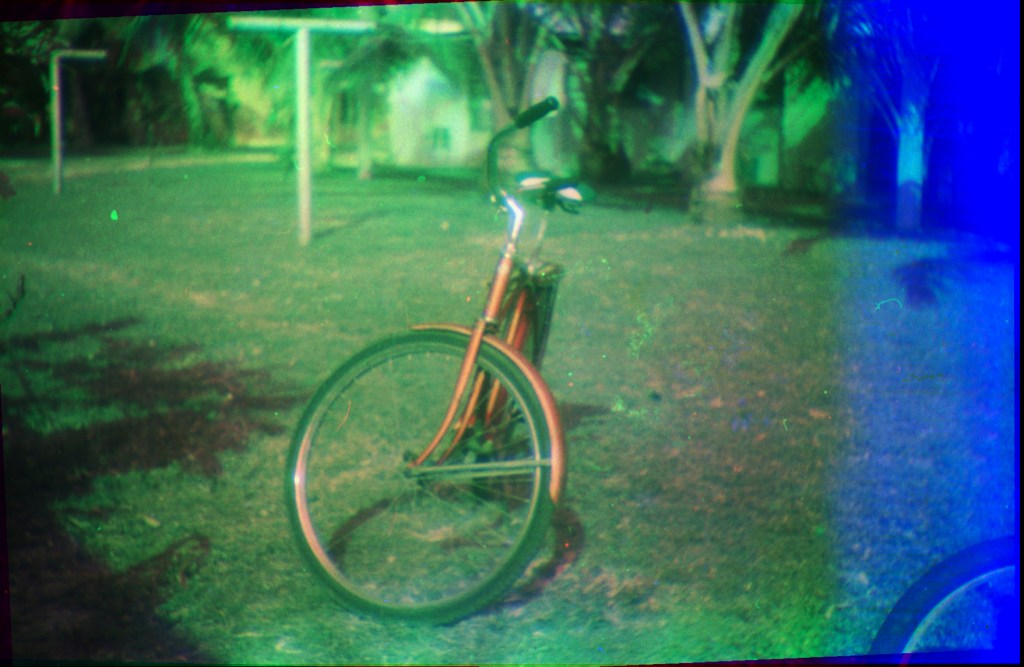
[Color restored to a scene taken in 1962 or 1963 on black and white film. The blue bar at right is from overexposure of the end of the film that affected the blue exposure, the lawn’s off-color to the right of the bike is because of the cloud, and some of the palm frond shadows on the left look strange because a breeze blew during one of the exposures. But it has color. Photo taken by high school student Joe Bauman on Kwajalein, Marshall Islands]


Leave a Reply