By Joe Bauman, Salt Lake City
It took three months to reach this point, while Spring’s great galaxy parade came and went, while the new moon waxed, waned, waxed, waned etc., and when the days broiled so badly that the telescope was too hot to lift before dusk.
It began simply, as I’m sure many screw-ups do. On the night of May 1-2, after decades of use, the telescope’s on-off switch was worn out. Also, the telescope was making sounds that I think of as ratcheting, caused when the framework of the screw that moves the gears is loose and the scope swings across it when it shouldn’t.
The switch: annoyingly, I had to flip it back and forth 20 or more times to turn the power on, and after a while no number of clicks would do it. Correcting this minor problem can be done in either of two ways: buy a new switch (if I could find one that fit) and soldering the leads where they belonged, or just solder the leads of the existing switch together. I chose the latter, which meant that the switch was useless, but I only had to plug in the power supply to turn it on. I chose the latter and it worked well.
Ratcheting: In the past, I had tightened the bracket that held the right-ascension motor assembly against the gear. It takes two little bolts that go from the assembly into the base. Although this requires putting Baby the Telescope on a table and taking off the bottom plate, it wasn’t particularly difficult. But this time, while tightening the bolts I accidentally dislodged one of the Hall sensor wires from its mounting below the motor. The sensor is critical in counting the motions of the gears. I wanted to glue the wire back in place, so took out the motor assembly. While trying to remove a set of three other wires at the top of the assembly, I clumsily gouged out their minute plastic bracket.
Although others have glued sensor wires back in place successfully, judging by comments on astronomy forums, I could not. And the wrecked wire attachment on top of the motor was another problem. On-line I found a used motor and bought it, as it had the Hall sensors attached.
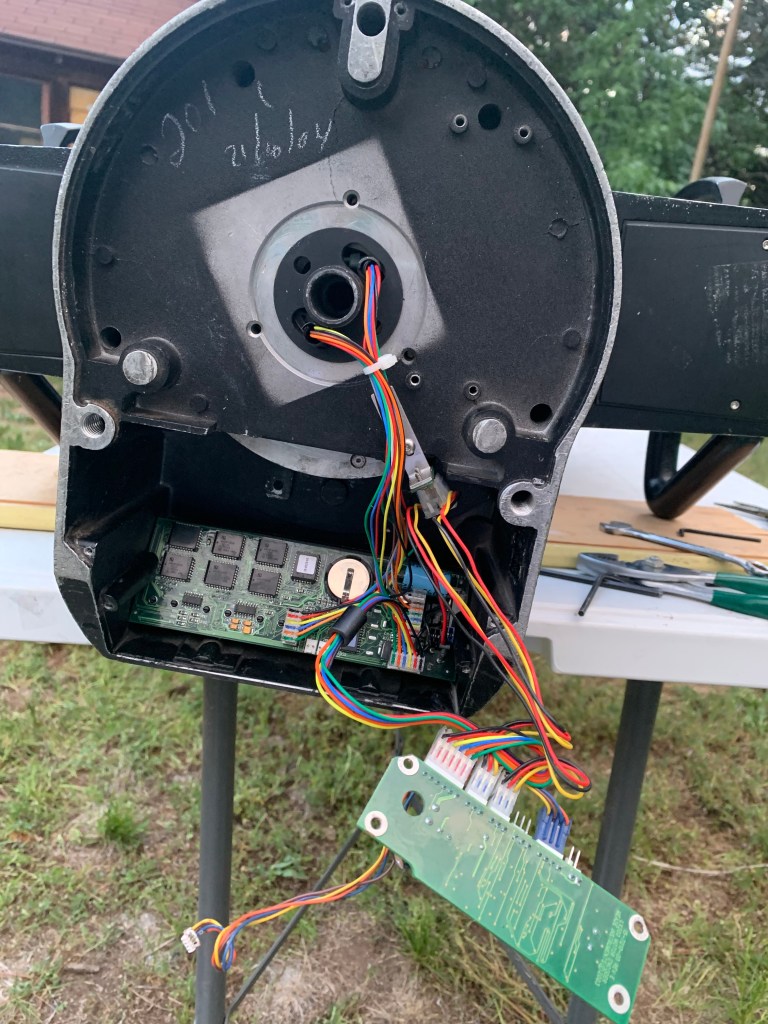
[In the midst of working on Baby the Telescope, May 15, 2025. The right ascension motor and other parts have been removed. Photo looking up the base by Joe Bauman]
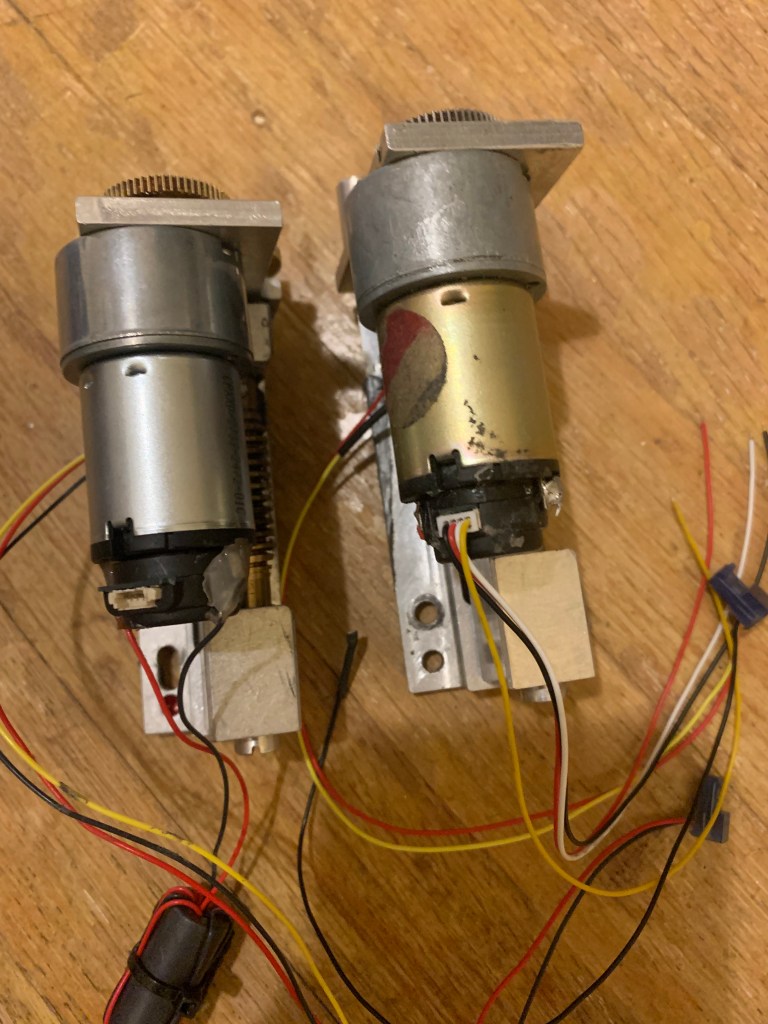
[The “new” used right-ascension motor is on the left, Hall sensor wires intact; the old is on the right, with the detached sensor wire, which is black, between the motors. Photo July 9, 2026, by Joe Bauman]
Installing the “new” motor was a hassle as the mounting bolts needed to be slightly different. This required a trip to Home Depot for bolts and washers. But soon enough after it was installed, as the motor turned the telescope it made loud screeching sounds. The mechanism had frozen up. When I took the motor out and tried to turn its gears with my fingers, they barely moved. It was shot.
So it was back to the old motor. I removed the gears from the “new” assembly, took off the motor, and put the old onto the new bracket, with the Hall sensors still intact. I also jerry-rigged a harness for the wires that go into the connection on the motor’s top. I soldered where necessary.
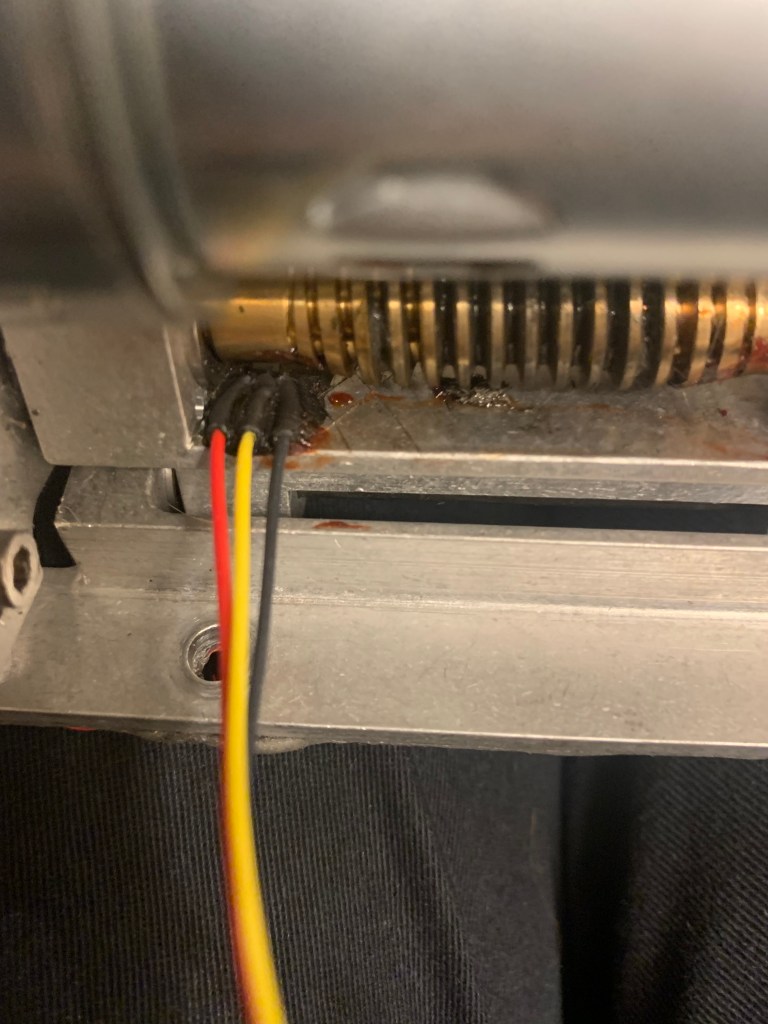
[The three Hall sensor wires on the kinda-new motor, before the motor died. Photo by Joe Bauman, July 9, 2025]
Meanwhile, I wanted to improve the telescope’s tracking, so I switched out my old tracking camera and put in a better camera (a ZWO); it could only work with a special cable, which I ordered. But the tracking was terrible. In the end, after much experimenting, I found that no matter how tightly I thought the ZWO camera was taped to the tracking ‘scope, it still wiggled. I put the old tracking camera (an ST-i) back on because the tracking scop’s connection allowed it to be clamped tight. The tracking was better but still imperfect. Then I realized the trouble might be with the new that fancy cable I was using. Last night I went back to the cord that I’d used before, and the results were as good as ever.
The summary sounds like a few easy steps but it actually took weeks of lifting and adjusting, greasing, unscrewing, bolting, tightening with and without washers, soldering, sending away for various kinds of wire connections, trying to rewire, buying two types of glue (Loctite was the better brand) and putting colored wires together with wires of different colors. Several times I was extremely discouraged and thought I might have to dump astronomy. One major problem involved the main camera, which took effort to work though. To avoid making my report any more tedious than it is, I have glossed over a lot of grunt work. I am forever in debt to Paul Ricketts of the University of Utah and others for help and advice.
Now Baby is running smoothly and tracking, and the cameras do their jobs well. I’m back to amateur astronomy.
For the past two nights I’ve been imaging NGC 6781, a small planetary nebula near the prominent star Altair, high in the summer sky. The first night the tracking was so awful that the picture was unusable, but it was fine last night.
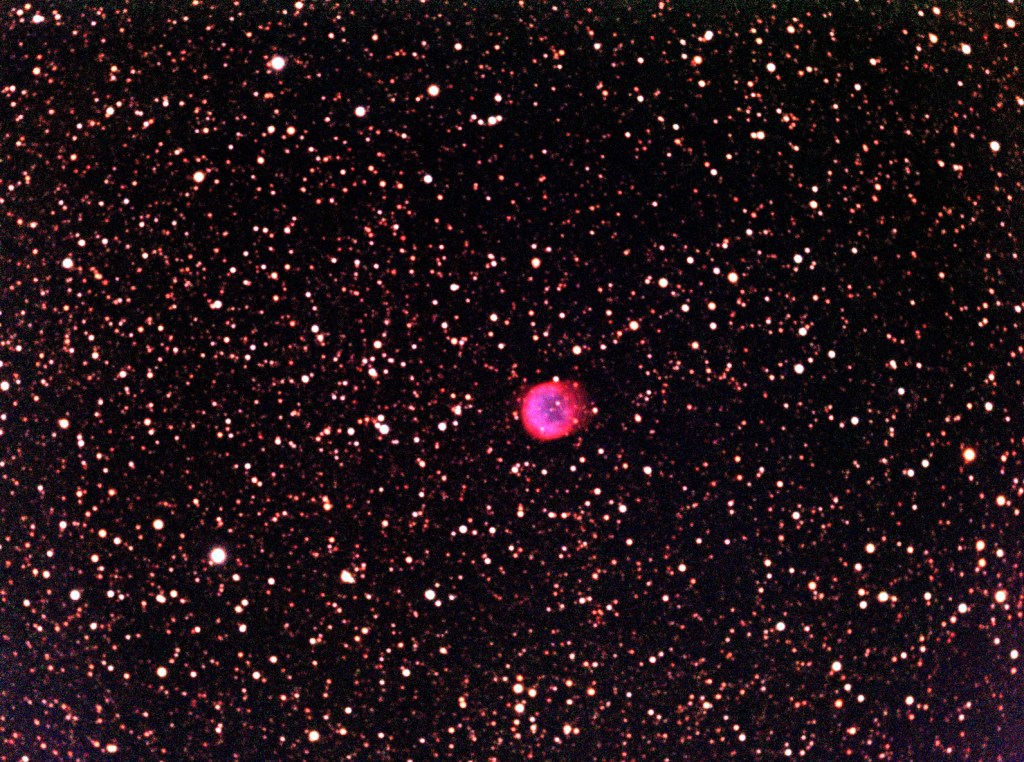
[NGC 6781, a planetary nebula in the constellation Aquila. Photo taken through heavy light pollution from the nearly full moon and artificial lighting, in Salt Lake City, the night Aug. 5-6, 2025, by Joe Bauman]
A planetary nebula is called that based on its appearance when seen through a telescope — a globe, like some far-off planet. In reality these objects are the remains of stars like our Sun, glowing beautifully at the end of their lives. The European Space Agency offers this explanation for their origin —
“Since their discovery in the late 1700s, astronomers have learned that planetary nebulae, or the expanding shell of glowing gas expelled by a low-intermediate mass star late in its life, can come in all shapes and sizes. Most planetary nebulae present as circular, elliptical, or bi-polar, but some stray from the norm ….”
Eventually the gas expands and dissipates until the nebula disappears. This happens rapidly, in cosmic terms. Says NASA, “From far away, the former layers of the star appear as a glowing planetary nebula, about 1,000 times the size of our solar system. The fluorescent light of planetary nebulae lasts for only about 10,000 years.”
Aquila, the constellation known as the Eagle, is lucky to host NGC 6781 — it’s one of the best objects in the little constellation. That most valuable reference, theskylive.com, which I frequently consult when planning starry excursions, lists no Messier objects in the constellation. There are many open star clusters (boring), one globular cluster, an “association of stars” (like the Rat Pack?), ten galaxies none brighter than
magnitude 13.3, and a plethora of planetary nebulas. At magnitude 11.4, NGC 6781 is tied for second place in terms of brightness of Aquila’s star-remains. It’s one of the most interesting and, as it is close to Aquila, it’s easy to find with a telescope.
NGC 6781 is nicknamed the Snowglobe Nebula because it looks spherical and the stars within it, behind it and probably in front of it that seem like the flakes of “snow” in one of those globes.
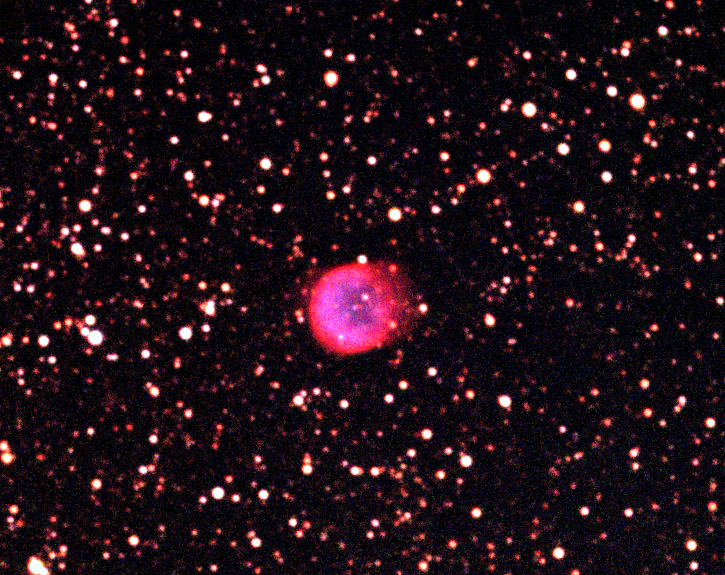
[A cropped and enlarged view of the previous photo of NGC 6781, the Snowglobe Nebula, by Joe Bauman]
Our Snowglobe is 1,500 light-years away and only 1.9 arcminutes by 1.8 arcminutes in apparent size when seen from Earth, according to wwwconstellationguide.com. By comparison, the full moon averages half a degree across, or 30 arcminutes. The guide adds that the nebula’s spherical look is an illusion.
“Even though it appears as an almost perfect bubble of gas from our point of view, the Snowglobe Nebula has a bipolar dust shell that is in fact barrel shaped. We see the nebula as it appears almost pole-on. The appearance of the perfect ring is an optical illusion. If we were to see NGC 6781 from the side, the cosmic bubble would appear as an hourglass ….” A hint of the barrel shape is visible on the nebula’s right of my picture.
Once I got everything working, the Snowglobe was a treat.


Leave a Reply