By Joe Bauman, Salt Lake City
The constellation Andromeda’s most famous galaxy is the easiest of all these “star cities” to spot. Messier 31, known as the Great Andromeda Galaxy and sometimes just called Andromeda, is so bright, close and large (Magnitude 3.58, 2.5 light-years away, covering 4 degrees of the sky) that you can see it with the naked eye on a clear, dark night. Not so with another remarkable spiral in the same constellation, NGC 7640.
An amateur astronomer has to really work in order to enjoy and study NGC 7640, the great galaxy’s neighbor. Instead of the relatively nearby 2.5 million light-years, it is located far beyond, with the European Space Agency estimating its distance as 30 million light-years. Rather than glowing at 3.58, this galaxy is rated at Magnitude 11, a difference of 7.42 magnitudes, meaning that it is somewhere around 1/1000 as bright to us on Earth as the great galaxy is. Its apparent size is about 10.5 by 1.8 arcminutes; when seen from here, at the longest it’s only around a fifth the length of M 31.
If you have ever seen M 31 with the naked eye — or while wearing glasses, as I have — you know how small and dim even this greatest nearby spiral looks.
To gather enough photons to show galaxy NGC 7640, I photographed it four times, once last year and three times in 2025, for just over ten and a half hours’ cumulative exposure through luminance, red, green and blue filters. That doesn’t include the thousands of flat, dark, dark-flat and bias images that were essential to calibrate the light exposures.
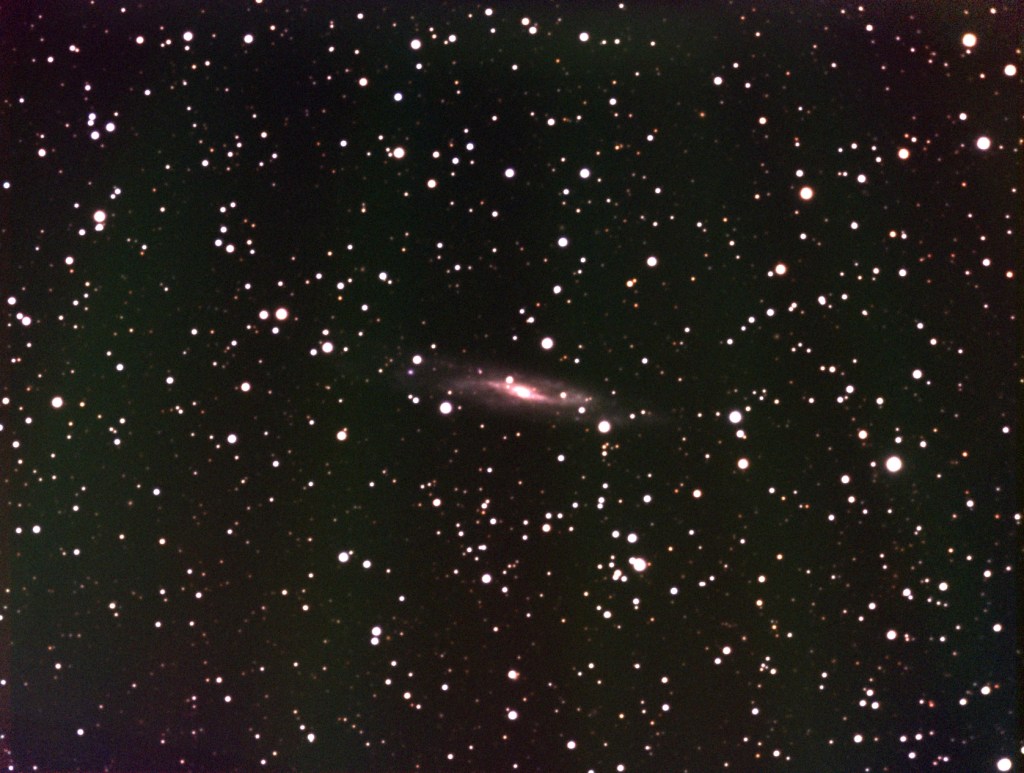
[NGC 7640, imaged on Oct. 4, 2024; Aug. 9, 2025; Aug. 10, 2025, and Sept. 2, 2025, from a backyard in Salt Lake City. The cumulative light exposure was more than 10 and a half hours. The stars are in the foreground, part of our Milky Way Galaxy. Here and there in the background are greenish blotches, an effect of urban light pollution that I could not overcome. Photo by Joe Bauman]
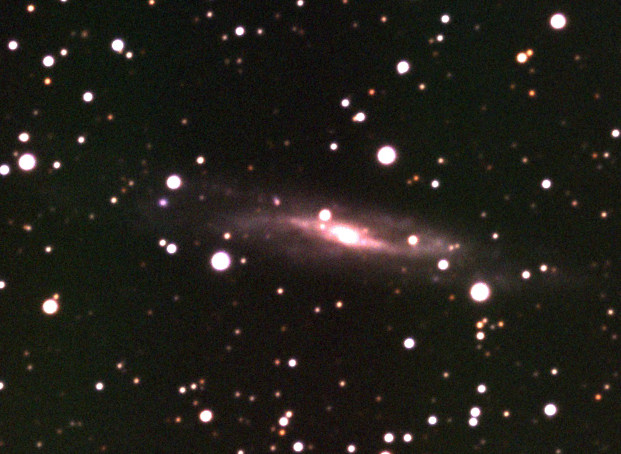
[A cropped view of the above photo gives a larger look at galaxy NGC 7640. Photo by Joe Bauman]
One might expect that at 3 o’clock in the morning, long after the Moon had set, the night would be black. Not true for Salt Lake City and almost every other urban area, which are awash in oceans of light pollution.
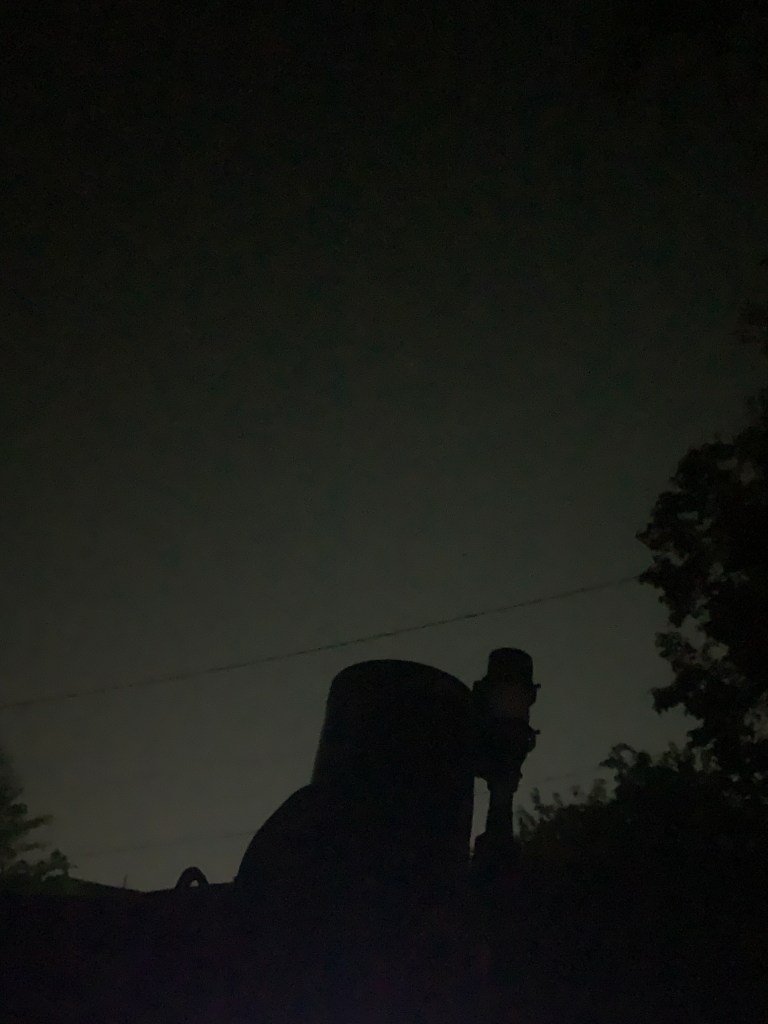
[Baby the telescope silhouetted against light pollution in the cloudless sky, taken at 3:01 a.m. Sept. 2, 2025, in Salt Lake City. Photo by Joe Bauman]
(Light pollution vanishes for those using narrow-band filters. With narrow-band imaging, certain wavelengths that defy light pollution are photographed and then arbitrarily assigned colors, producing a pleasing and scientifically interesting picture, which nevertheless is far removed from the colors our eyes would see if they were big enough. Narrow-band photos require extremely long exposures. A rule of thumb I’ve come across is that the exposure is ten times that required for a picture in normal colors.)
While NGC 7640 looks stretched out, this is an illusion caused by its orientation to our viewpoint. If we could see it from directly above, it would be a disk with a denser nucleus and a pair of dramatic arms spiraling around the center.
In some spiral galaxies, the arms are spread wide while in others they hug the nucleus closely. Some have multiple spiral arms. Scientists have identified eight arms or spurs of our Milky Way Galaxy, which might as well be renamed the Octogalaxy. We live the Orion Arm or the Orion Spur.
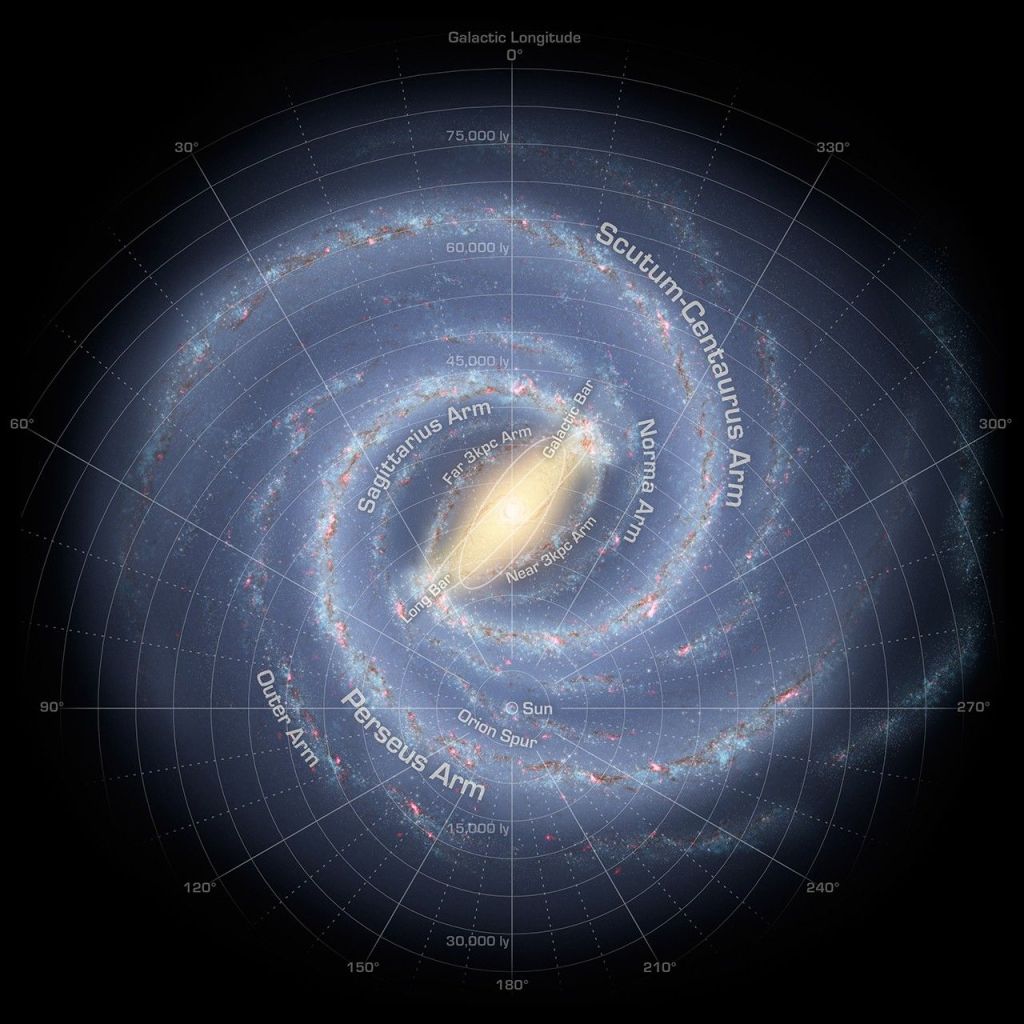
[A NASA illustration showing the Mily Way Galaxy with its galactic bar, spiral arms and spurs. Courtesy NASA]
On NGC 7640, a band of stars crosses the nucleus and connects it to the closer ends of the arms, which is what classifies this as a barred spiral galaxy. NASA says the band is like the diagonal slash in a “no smoking” sign. According to NASA, “Bars form when stellar orbits in a spiral galaxy become unstable and deviate from a circular path.”
The bars can an indication of a smaller galaxy’s maturity. The same NASA release cites a study of 2,000 spiral galaxies, carried out by the Hubble Space Telescope, which found that in the universe of 7 billion years ago, only 20 percent of spiral galaxies had bars, compared with 70 percent today. The agency quotes Kartik Sheth of the Spitzer Science Center at the California Institute of Technology, Pasadena, as saying the newer bars are “forming mostly in the small, low-mass galaxies, whereas among the most massive galaxies, the fraction of bars was the same in the past as it is today.”
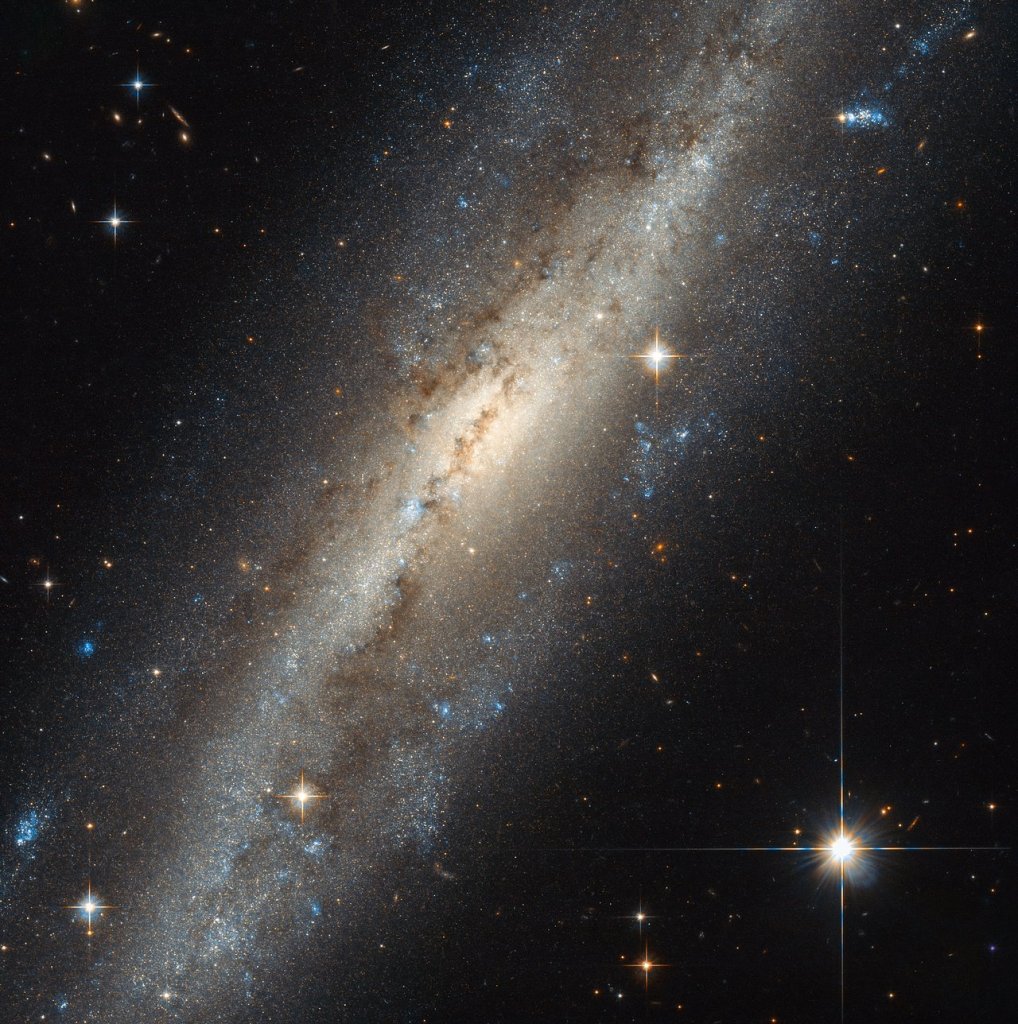
[A Hubble Space Telescope view of galaxy NGC 7640 shows crisp details. Photo credit: ESA/Hubble and NASA]


Leave a Reply