By Joe Bauman, Salt Lake City
These nights the Helix Nebula is about as high as it ever gets, as seen from northern Utah. Unfortunately for local astrophotographers, that isn’t very high, reaching only about 30 degrees above the southern horizon before sinking into the west. Still, I wanted to give this famous planetary nebula a try, because it fits in with a speculation I have about alien civilizations.
I’m glad I did. It’s the largest and one of the most dramatic and beautiful planetaries.
The low altitude caused problems. We who image deep space objects want them high, certainly above 30 degrees, because the lower they are, the more atmosphere their light travels through to reach us, and the layers of air absorb photons and can blur details. It’s why most observatories are on mountaintops: less air to look through. Worse, in an urban setting, the lower our aim, the more light pollution the camera collects. In my attempts, so much light pollution accumulated that I was forced to darken the edges of the picture with Photoshop, something I’ve never done with other space objects.
The Helix Nebula, designated NGC 7293 among other names, is the second brightest object in Aquarius, not counting stars. Glowing at magnitude 7.6, it is second only to the globular cluster of stars Messier 2 (magnitude 6.25) in that constellation. And it’s big! I was surprised by its size when it drifted onto my laptop screen. According to the Encyclopedia Britannica, from our vantage point on Earth, it’s about 20 arcminutes across, “two-thirds the angular size of the moon.”
It’s so large and bright because it is close, as deep-space objects go.
In a list of 113 planetary nebulas (usually abbreviated as PNs) posted in Wikipedia, it is the nearest at an estimated 680 light-years. The farthest on the list is Minkowski 2-42, which Wikipedia puts at 31,000 light-years. The next farthest is the Stingray Nebula at 18,000 light-years. All the others are 15,000 light-years or closer. (Wikipedia isn’t always accurate, but this was the only list of PNs I could find that gave an idea of distances. Presumably the list includes all that are known at or under 15,000 light-years.)
That’s not to say planetary nebulas are always nearby. The Harvard-Smithsonian Center for Astrophysics says that because of their short lifespan and small size, “we only know of about 3,500 planetary nebulas in our galaxy.” Those in other galaxies are too far away to study. Fifteen thousand light-years seems to be a general limitation on how far away we can easily tell that a dot is a planetary nebula.
Like every other PN, the Helix is the remains of a star at the end of its life. To make a planetary nebula, a star has to be no larger than about eight times the mass of our Sun, which is classified as a G star and further subdivided into the category of yellow dwarf. Larger stars end up going supernova and forming either black holes or neutron stars, not planetary nebulas. Stars like ours become red giants toward the end (which NASA says look more orange than red). Eventually they puff off their gasses when they are no longer able to hold themselves together through gravity. This leaves a glowing planetary nebula with an astoundingly hot white dwarf star in the center. The white dwarf gradually cools and fades out.
The Harvard and Smithsonian’s Center details the formation of planetaries:
“Nuclear fusion is what makes a star a star: smashing atomic nuclei together deep in the star’s core. Eventually, though, every star will exhaust the ability to fuse nuclei into heavier elements. When that happens for a star less than about 8 times the mass of the Sun, it swells up to a huge size, large enough to engulf some of the planets orbiting it. Meanwhile, its core shrinks, and it no longer has enough gravity to hold onto the star’s outer layers.
“The dying star then sheds those layers to make a planetary nebula. The new nebula contains chemicals that were present when the star formed, but also new ones: atoms formed via nuclear fusion, and molecules made in the dying star’s outer layers as they cooled and drifted into space. … That’s one way dying stars change the chemistry of the galaxy, since new stars and planets can form from these atoms and molecules in a planetary nebula. Our Sun may also make a planetary nebula when it runs out of nuclear fuel in about 5 billion years.
“The beauty of planetary nebulas is short-lived: they only linger a few thousand or tens of thousands of years before dispersing into interstellar space. That’s a long time in human terms, but it’s short in astronomical terms.”
As the Center mentions, a PN’s gases continue to expand, thinning out to nothing much. Eventually the Helix Nebula will disappear.
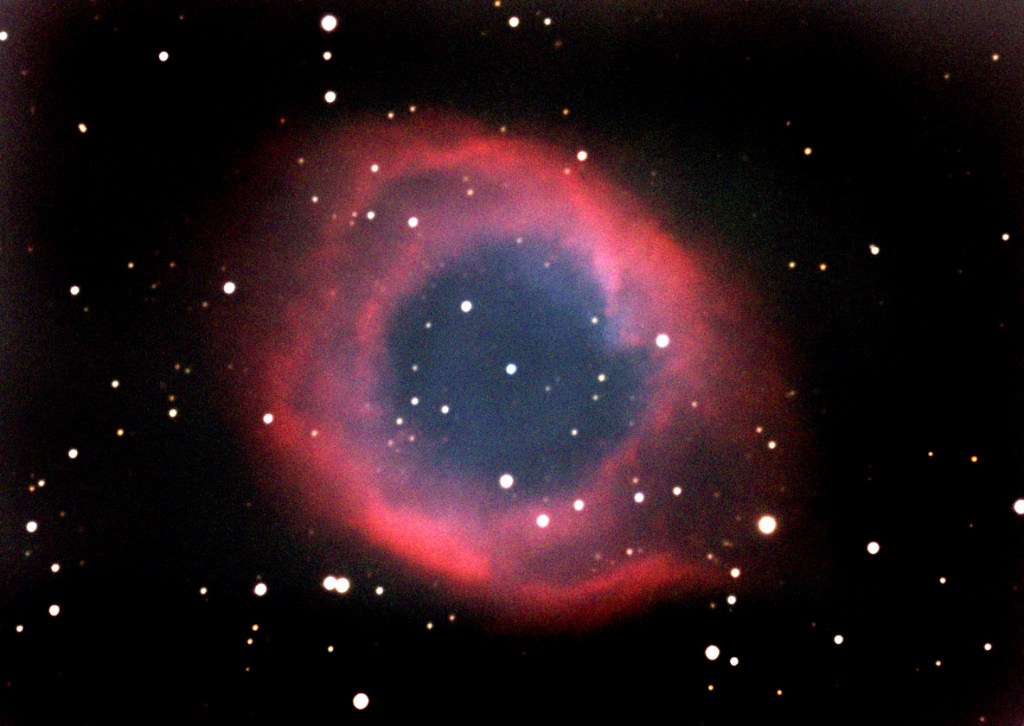
[A cropped picture of the Helix Nebula, NGC 7293, as imaged during the nights of Sept. 26-27 and Oct. 12-13 from Salt Lake City. Photo by Joe Bauman]
If I were very rich, naturally I’d set aside a few million for myself and family. I would donate the rest to some form of SETI, the Search for Extraterrestrial Intelligence, as the discovery of an alien civilization — regardless of how far away or whether its signals could be deciphered — would be the premier scientific event of our time.
I have no doubt that other advanced societies exist in our galaxy (in other galaxies too, but let’s keep the discussion close to home.) The elements, molecules and conditions that formed our planet are common. Somewhere else life would get a start through a random combination of chemistry, and then evolution could take off. Mind-power is a strong survival trait. Given enough time, competition for survival could prompt the development of enough thinking ability for life to form civilizations.
But I’m under no illusions that SETI will discover another civilization anytime soon.
I have come up with a rule of thumb to estimate the maximum number of civilizations within detecting distance of Earth. Its implications are discouraging. My idea is much simpler than the often-cited Drake Equation, propounded by the astrophysicist Frank Drake in 1961 to estimate the number of observable civilizations in our galaxy. Without getting into the equation’s confusing initials, its meaning as described by the SETI Institute is this —
“The number of civilizations in the Milky Way galaxy whose electromagnetic emissions are detectable” is equal to “The rate of formation of stars suitable for the development of intelligent life (number per year)” times “The fraction of those stars with planetary systems” times “The number of planets, per solar system, with an environment suitable for life” times “The fraction of suitable planets on which life actually appears” times “The fraction of life bearing planets on which intelligent life emerges” times “The fraction of civilizations that develop a technology that produces detectable signs of their existence” times “The average length of time such civilizations produce such signs (years).”
It’s an awkward and unwieldy formula. Overall, it verges on meaningless because some factors can never be known, resulting in our never getting an answer.
The Drake equation takes no real account of distance, yet radio and other electromagnetic emissions dim rapidly. (I suppose distance could be covered, indirectly, by the word “detectable” in the Drake formula.) The time aspect — that is, the likelihood that the alien society’s transmissions would reach Earth in our present — is poorly developed.
Some parts of the equation can never be calculated, such as the fraction of suitable planets on which life actually appears — how in the universe could we know that? Slicing through the rigmarole, if you could know just two of the factors — the number of civilizations that produce detectable signs and how long those civilizations produce them — you would have some kind of answer.
My idea involves using planetary nebulas as an indicator.
First, consider that all stars of our Sun’s type and larger, up to supernova size, will develop PNs. We won’t count the really big stars, which don’t produce planetary nebulas, because apparently they do not last long enough to develop civilizations. Their lifespans are much shorter than the 4 billion-plus years that it’s taken Earth to develop technology. They last “from a couple of billion years to as low as 10 million years only, and they end their lives with a spectacular explosion,” according to sciencefacts.net.
Just as G stars, for example, last approximately 11 or 12 billion years, we need to filter the number so we’re not talking about some period billions of years in the past; we’re counting civilizations that are active at the right time. All stars die, and planetary nebulas are beautiful tombstones for our type of star.
We will use PNs to represent time: a set of years in the life of an appropriate star.
Pretend that environments around all stars of the right size develop civilizations; that’s ridiculous, but remember, the goal is to find a maximum possible number of detectable civilizations. If many planetary systems don’t develop life, others might have civilizations that rise, fall, rise again and again over billions of years. In my theory, call it the Bauman conjecture, planetary nebulas are a partial stand-in for stars whose planets have detectable civilizations at the present or had them when their signals began traveling toward Earth to arrive now.
If we assume that all right-sized stars have civilizations that emit detectable signals and that these signals are broadcast as long as a planetary nebula lasts, the answer would be 111 detectable civilizations within 15 light-years (the number of PNs within that distance, as listed in Wikipedia).
But it’s a safe bet that no alien civilization would continue blasting energy all around it into space for that long.
An assumption I’m willing to make is that a technological civilization would broadcast radio waves, X-rays, etc. randomly into space for no more than a few centuries. Our world has already begun to limit such emissions by beaming radio and television signals not into the air generally but pinpoint to satellites that send them back to receivers on the ground. Telephone cables go undersea and underground; we are starting to reduce electromagnetic waste.
Earth’s extreme energy wastefulness isn’t likely to go on for more than a couple of hundred years, but I can imagine a world where rain falls continually on steep mountains for hydropower, or places with so much wind or with such intense light from the star as to provide almost unlimited energy. So let’s use 500 years instead of 200 as the average cutoff.
Also, to be extra-generous, let’s assume that planetary nebulas last an average of only 3,000 years, not the “tens of thousands of years” mentioned by the Center for Astrophysics.
We were using PNs as a partial stand-in for civilizations operating now or within 15,000 years; let’s pare that down and get rid of the “partial”. We divide 500 years, the length of time that a civilization might willy-nilly pump its energy into space, by 3,000 years. This comes out as one-sixth. To get the number of advanced civilizations within 15,000 light-years, we divide those 111 cited by Wikipedia by six, with the answer of about 20 civilizations.
But signals almost certainly can’t be detected from a planet 15,000 light-years away, unless a powerful beam were directed right at Earth, and that’s highly unlikely.
Beyond some far reach of space, the inverse square law applies to shut a signal down to an indiscernible level. The inverse square law is the physical restriction that dramatically cuts the intensity of a signal with its distance. A signal twice as far away from some site has one-quarter the intensity; ten times as far off, only 1 percent of the intensity. What is the greatest distance that a planet’s signals could be detected? I would guess, not more than 100 light-years, and probably much closer.
If 20 civilizations are beaming out signals within a 15,000-light-year radius, how many are within 100 light-years? An average of far fewer than one.
What my exercise does, if the assumptions are reasonable, is tell us that intelligent civilizations are extremely few and far between. But we do know of a case of that most unlikely event actually happening: Earth. The question becomes, what is the likelihood of two within 100 light-years?
The chances are almost infinitesimally small. But who knows? Next week SETI may beat the odds.


Leave a Reply