By Joe Bauman, Salt Lake City
Probably most astronomy lovers have heard of or seen the Trifid Nebula, otherwise known as Messier 20, a large, beautiful orb that glows in the south during the summer. But who knows about the Northern Trifid Nebula? Both are impressive star-forming regions but only the former is famous.
The Trifid Nebula is a glorious sky ornament, a collection of glowing gas and dust that is mostly pink with blue outlying regions, amid a shower of stars in the constellation Sagittarius. It gets its name from the dark dust lanes that divide the pinkish part into three sections. NASA says it is 5,000 light-years from Earth and 40 light-years across (remember, the nearest star, Proxima Centauri, is about 4.24 light-years distant, so that gives some idea of the actual size of the Trifid). This grand nebula shines at Magnitude 8.3, says one of my favorite online resources, TheSkyLive.com. It covers almost the area of the Moon (almost half a degree), according to the NASA site.
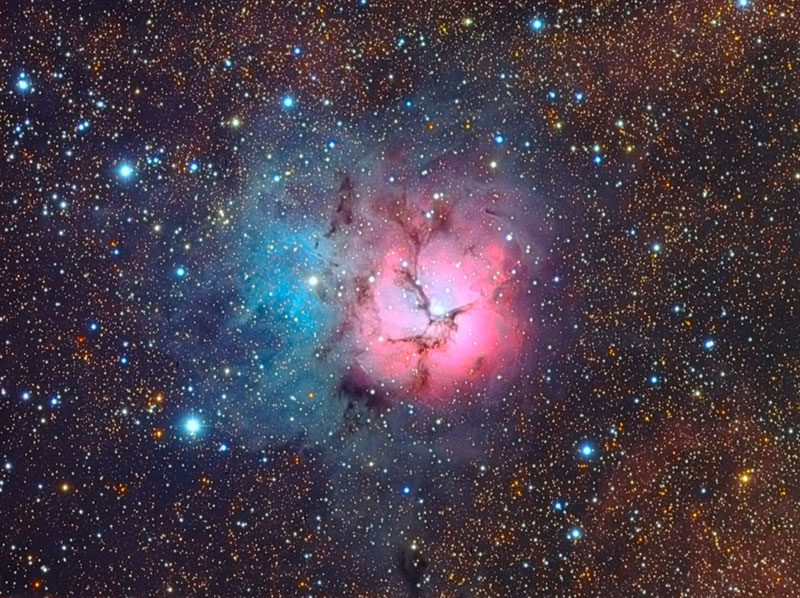
[A photo of the Trifid Nebula, Messier 20, posted online by ThePlanets.org. It is far larger and brighter than the Northern Trifid.]
The Northern Trifid isn’t so grand. But it is lovely too.
NGC 1579, located in Perseus, is only 10.2 by 10.2 arcminutes, TheSkyLive points out. Another site, DeepSkyCorner, reckons it is 12 by 8 arcminutes. One degree is 60 arcminutes; half a degree, about the width of the Trifid Nebula, is 30 arcminutes. So the Northern Trifid is only 35 to 40 percent as far across, seen from our planet. It’s also much dimmer, though I have not found a magnitude estimate for it.
NGC 1579 is in a good position to observe or photograph this month. If you are extremely patient, with a telescope tracking the nebula, this is how your perspective changes. When darkness falls around 7:15 p.m., the object is 27 degrees above the horizon in an east-northeast direction. It continues to rise, reaching about 85 degrees to the southeast at 12:45 a.m. Then it slowly slides lower, until shortly before dawn it is at 33 degrees altitude to the west-northwest. In other words, the Northern Trifid Nebula is right where you’d like it all night, if you don’t mind the cold.
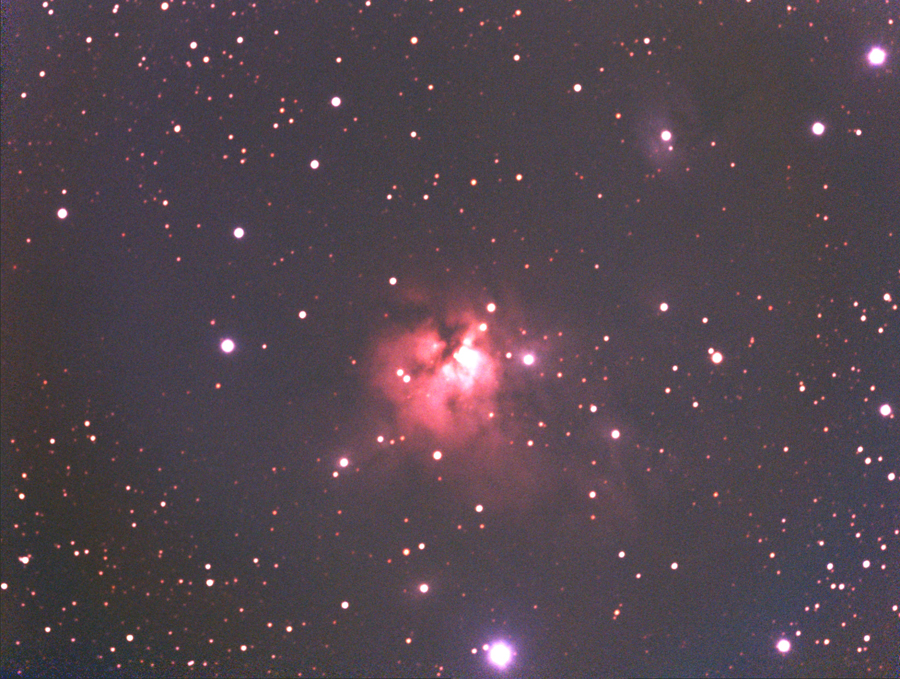
[The Northern Trifid Nebula, NGC 1579, photographed from Salt Lake City on the night of Nov. 1-2, 2025. Exposures through luminance, red, blue and green filters totaled more than three hours. Photo by Joe Bauman]
The Northern Trifid looks somewhat mauzy, as though seen through fog or smoke. That’s because the molecular cloud in which it is embedded extends far beyond the bright pink section, with some hot blue stars that burn through, giving the gas a bluish tint. The fuzziness and steaking remind me of the Pleiades, where the effects are much more pronounced but arise from the same cause.
According to NASA’s Astronomy Picture of the Day for March 9, 2021, the nebula is approximately 2,100 light-years away and three light-years across. Like the Trifid, it is a vast cloud of gas and dust where stars are forming. Writing about the two, authors of the picture of the day caption note, “In both, dust reflects starlight to produce beautiful blue reflection nebulae.” However, the Trifid’s red comes from hydrogen gas that glows because it is excited by ultraviolet (beyond blue) light from a nearby star, while the red of the Northern Trifid is illumination from a red star in its midst — same effect, different causes.
Despite its peaceful looks, a lot is churning beneath the surface.
The European Space Agency and NASA explain, “Many regions like the Trifid of the North — named H II regions — are clumpy and strangely shaped due to the powerful winds emanating from the stars within them.”
Stars are forming inside the cloud, crushing material onto themselves and growing larger. Meanwhile they are erupting with powerful tides of radiation. Eventually, the nebula’s glowing pinks and searing blues will be gone, as the gas and dust blow out into the cosmic depths or are pulled into the inferno of the stars. No longer with dark dust lanes arch across the region.
As the cloud of the Northern Trifid Nebula thins out, left behind, marking the place of their formation, will be a glittering globular cluster of hundreds of young stars.


Leave a Reply