By Joe Bauman, Salt Lake City
I was a Cub Scout, Boy Scout and Sea Explorer Scout. I mention this not because I was outstanding in any of these organizations — after all, the word scout implies someone who can find the way, and what good is a dyslexic scout? I would have blundered around and led a wagon train back to the East.
No, the reason I’ve been thinking about the scouting program is that the official colors of the Cub Scouts are blue and gold. One of the biggest community events back in the 1950s when I was a Cub was the Blue and Gold Dinner, in which the families of the entire pack took part. I remember my mother brought a pot of her baked beans.
This set of colors is why Albireo is nicknamed the Cub Scout star, because it’s really two visible stars — though to the naked eye it’s a single point — and its components are blue and gold. (Nobody quibbles much about the color of the blue star but the other has been cited as deep yellow, orangish-gold or topaz). Even a small telescope brings into view the pair and shows off their beautiful colors.
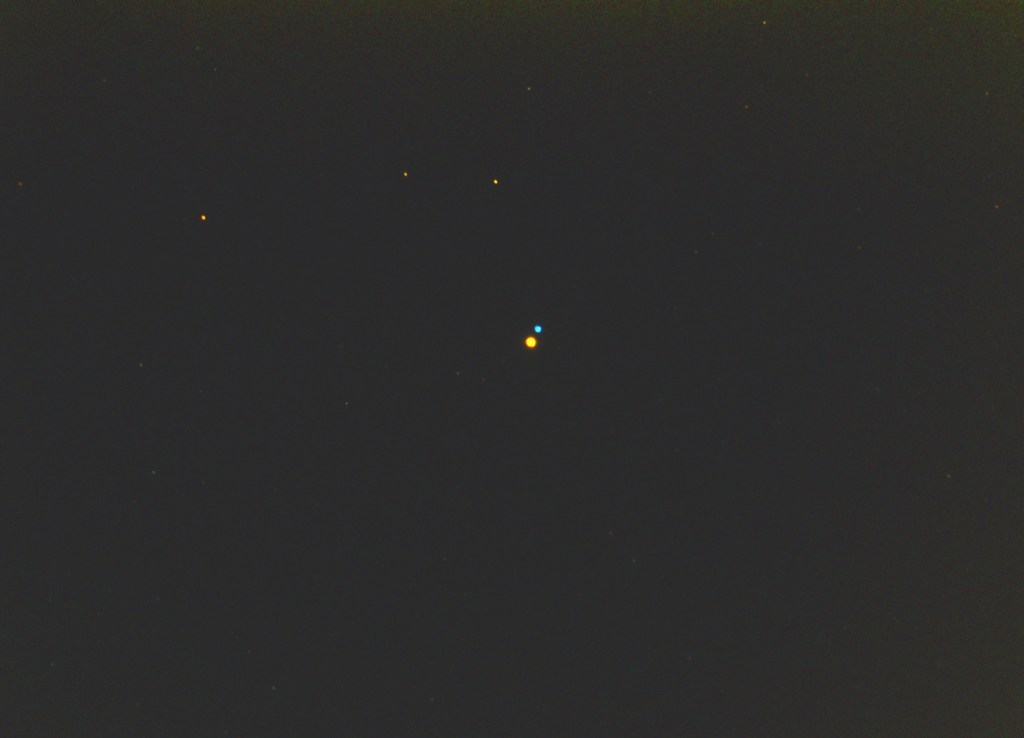
[Albireo, the so-called Cub Scout star, photographed on the morning of July 26, 2026, in Salt Lake City by Joe Bauman]
Albireo is in the constellation Cygnus (the Swan), flying high above during these summer nights; it marks the head of the long-necked bird.
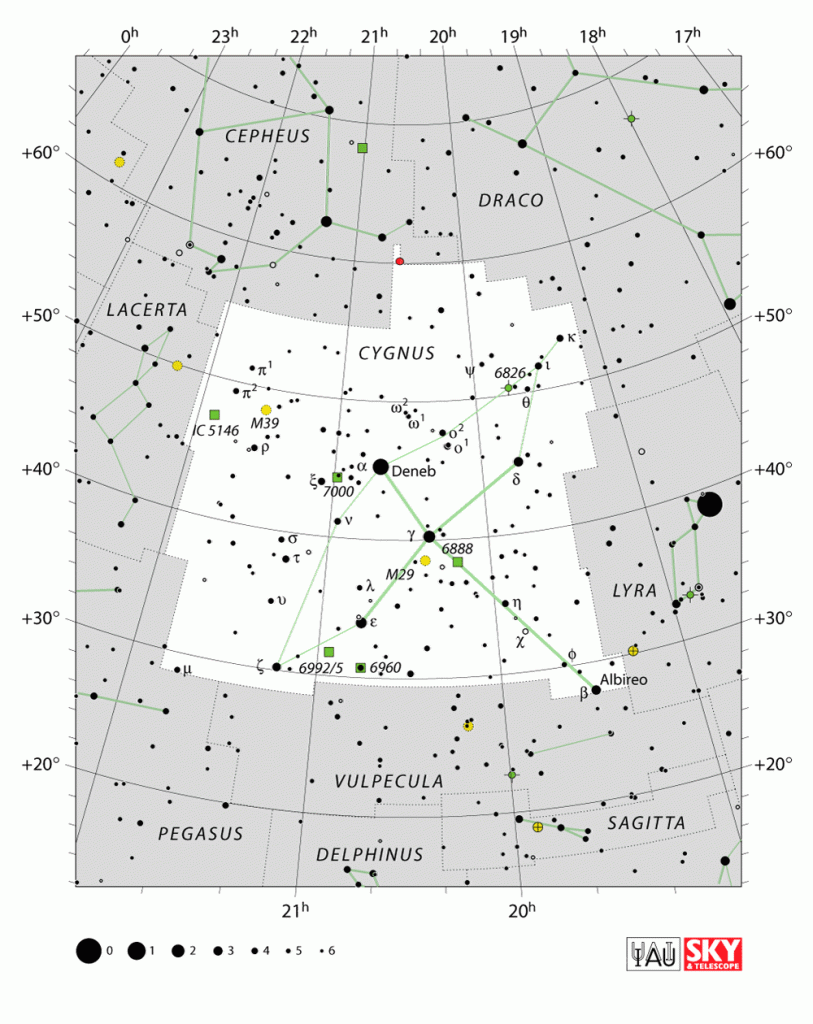
[The Cygnus constellation in a star atlas placed on-line by the European Southern Observatory; map provided by the International Astronomical Union and Sky & Telescope Magazine]
The Albireo system is rated magnitude 3.08, the fifth brightest in the constellation. Confusingly, its formal title is Beta Cygni, meaning the second-brightest in Cygnus. But the shinier stars in the group are, working our way down from the top, Deneb, Sadr, Aljanah, and Fawaris, according to one of my favorite sites on the internet, theskylive.com.
I had a hard time getting an acceptable photo of Albireo because it is so bright. The first time I tried, I shot one-second sub-exposures, which badly overexposed the pair, making them white blobs. Finally I took a series of exposures at the fastest speed my astronomy camera could achieve, 1/1000 of a second. That gave a pleasing view of them but captured photons from only a few of the nearby stars that were bright enough to register on the chip.
The golden-red star, the brighter one, is called Albireo A while its blue partner is Albireo B. The former has long been suspected to have an unseen companion because of A’s complicated spectrum with one star contributing certain values and the unseen one other values. Recently a study in the journal Astronomy & Astrophysics, May 2022, confirmed the suspicion. It reported the proof of a tiny unseen companion to A, now dubbed Albireo C, found by measuring velocities of A. Patterns in the velocity indicated something was in a close orbit with A.
Many stars are true doubles bound by gravity, having hatched from the same primordial cloud of dust and gas, which seems to be the situation with A and C. In 2005 NASA posted a photo with a discussion that estimated Albireo’s distance at 380 light-years from Earth and said the two main components, stars A and B, orbit each other.
But another study in Astronomy & Astrophysics, November 2018, concluded that A and B are “most probably an optical double.” In other words, they just happen to be in the same line of sight from Earth but aren’t close enough to be bound by gravity. The authors, U. Bastian and R. Anton, both with German scientific institutions, found that A and B have different proper motions that are large enough to indicate they aren’t traveling together. Just two stars that pass in the night.
They found that the mass of the A component is “surprisingly small,” no more than about 70 percent that of the Sun. Now that we know the golden A is relatively little, I would think its brightness indicates it is closer than had been believed.
A later NASA posting, dated Feb. 24, 2022, corrects the error, stating, “Well-separated Albireo A and B most likely represent an optical double star and not a physical binary system because the two components have clearly different measured motions through space.” The distance is then put at 420 light-years — farther, not closer. Science is always refining our understanding (and befuddling me).
Albireo A is designated a “giant star, cooler than the Sun and emitting most of its energy at yellow and red wavelengths,” says the 2022 article. Albireo B is “much hotter than the Sun, emitting more energy in blue and violet.”
Robert Burnham Jr., in his wonderful, three-volume Burnham’s Celestial Handbook, writes, “Albireo is one of the most beautiful double stars in the sky, considered by many observers to be the finest in the heavens for a small telescope.”
Albireo’s best viewing is in the summer and fall — so go outside with a telescope some clear night and look up!


Leave a Reply