By Joe Bauman, Salt Lake City
Galaxy NGC 891 reminded the famous English amateur astronomer Sir Patrick Alfred Caldwell-Moore (1923-2012) of “two fried eggs clapped back to back.” To me, it looks more like a flying saucer.
Located in the constellation Andromeda close to Perseus, the galaxy is about 30 million light-years distant. Besides its New General Catalog (NGC) number, this star city is also known as Caldwell 23, for its place in the Caldwell catalog of 109 deep-sky objects for amateurs to study with their telescopes. (In the 1980s Caldwell-Moore compiled the catalog in order of declination, from north to south in the sky; another striking advantage over the better-known Messier list is that it consists of interesting objects that Charles Messier missed.)
NGC 891 or C23, whichever you prefer, is notable because it is turned sidewards to the line of sight of any being living in our Milky Way Galaxy. That gives astronomers a good view of what a spiral galaxy looks like from the edge; both the Milky Way and NGC 891 are spirals. The Milky Way is thought to be a barred-spiral galaxy with a dense bar-like structure of stars running through the center while NGC 891 is a non-barred spiral. Both are about 100,000 light-years across. Each floats in the midst of what is called a halo of stars beyond the galaxy’s plane.
According to NASA, NGC 891 is “seen exactly edge-on, and reveals its thick plane of dust and interstellar gas. While initially thought to look like our own Milky Way if seen from the side, more detailed surveys revealed the existence of filaments of dust and gas escaping the plane of the galaxy into the halo over hundreds of light-years.”
A photo taken by the Hubble Space Telescope shows “wispy tendrils of dust and gas branching off from the plane of the galaxy into the halo,” NASA points out.
“Astronomers believe these filaments to be the result of the ejection of material due to supernovae or intense stellar formation activity. By lighting up when they are born, or exploding when they die, stars cause powerful winds that can blow dust and gas over hundreds of light-years in space.”
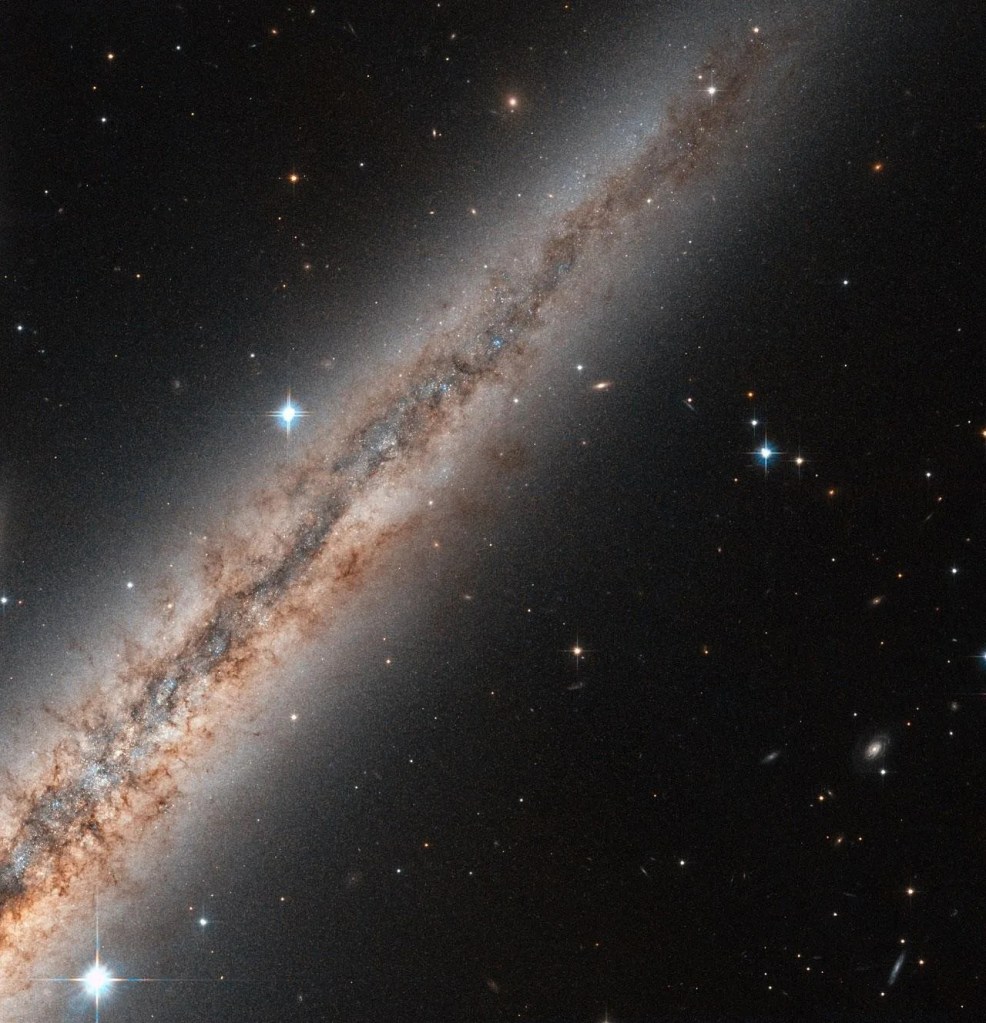
[A Hubble Space Telescope photo of part of the galaxy NGC 891 shows orangish and brownish “tendrils” of material stretching into the halo of stars on either side of the dust lanes. The galaxy’s rounded nucleus was to the lower left outside the frame of this image. Much more distant galaxies also are visible in the view. “A version of this image was entered into the Hubble’s Hidden Treasures Image Processing Competition by contestant Nick Rose,” the agency says. Credit: Hubble Space Telescope and Nick Rose]
A study submitted on Aug. 24 to the site ARXIV by a team of astronomers including Dr. Aleksandr V. Mosenkov, assistant professor in the Department of Physics and Astronomy, Brigham Young University, Provo, UT, indicates that dusty streaks reach out to about 13,000 light-years. The material is “in the form of filaments, arcs, and super-bubbles,” the study says. The estimate is based on measurements of photographs taken by the James Webb Space Telescope.
“The presence of dust at these altitudes raises questions about the transport mechanisms at play and suggests that small dust grains are able to survive for several tens of million years after having been ejected by galactic winds in the disk-halo interface,” the report adds.
“We lay out several scenarios that could explain this emission: dust grains may be shielded in the outer layers of cool dense clouds expelled from the galaxy disk, and/or the emission comes from the mixing layers around these cool clumps where material from the hot gas is able to cool down and mix with these cool cloudlets.” (I sent Dr. Mosenkov an email requesting an interview but so far have not heard back.)
The relatively near galaxy NGC 891 is in a fine position for viewing now, for those who can brave the cold. At 10:30 p.m. it’s at 85 degrees altitude, almost straight up, to the west-northwest. The nearest bright object is Almach, a quadruple star system in Andromeda (it looks like a single star to the unaided eye). NGC 891 has an apparent magnitude of 10.83, so a moderate-sized telescope and a clear, dark night are best for seeing it.
It’s such an interesting object that I tried to photograph it four times from our Salt Lake City backyard, on the nights of Sept. 14-15, Sept. 20-21, Sept. 25-26 and Oct. 1-2. Only the last attempt met my standards, with more than three hours’ exposure in luminance, red, green and blue filters. Even then, light pollution was a demonic problem, requiring special photo processing to reduce the green tint.
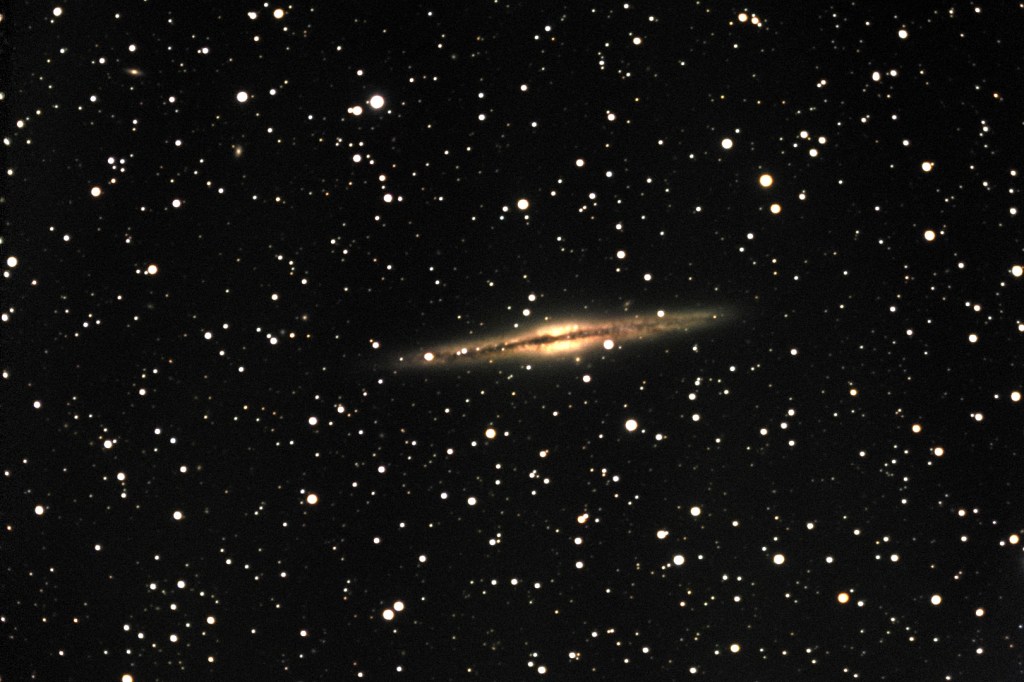
[The edge-on galaxy NGC 891 photographed from a Salt Lake City backyard on the night of Oct. 1-2, 2024. About three and a quarter hours’ of light gathering went into this image, in addition to hundreds of flats, bias, darks, and other exposures needed to clear out distortions. The stars are foreground objects in the Milky Way Galaxy. Photo by Joe Bauman]
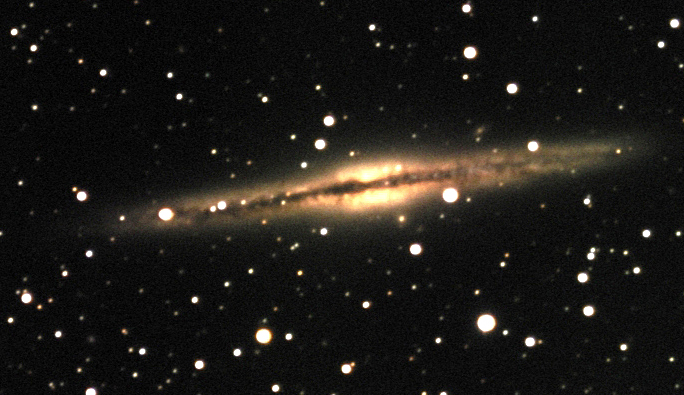
[A cropped section of the previous pictures allows for a closer view of NGC 891 and its dust lanes. Photo by Joe Bauman, Oct. 1-2, 2024]


Leave a Reply