By Joe Bauman, Salt Lake City
In Greece, a mountain called Athos is so high that its top is above the clouds and its shadow stretches 76 miles. Because it reaches over the weather, the air at the summit is windless, and so clear and dry that no animals can live there. When scientists ventured up, they held to their noses sponges moistened with water so they could breathe despite the dryness.
“And above, in the dust and in the powder of those hills, they wrote letters and figures with their fingers. And at the year’s end they came again, and found the same letters and figures, the which they had written the year before, without any default. And therefore it seemeth well, that these hills pass the clouds and join to the pure air.”
The description of Athos and the scientists is from a remarkable late Medieval book, The Travels of Sir John Mandeville, written in the middle 1300s. It was passed off as a true account of an English knight’s journey through much of the known world. The author’s name is a pseudonym and the account wasn’t one person’s adventures but a compilation of several travel narratives. It was so influential that it was translated into at least eight languages and was consulted by Columbus. It could verge on the ridiculous, as with Mount Athos, but some of its descriptions are fairly accurate.
As an example of its sort-of accuracy, take this estimate of Earth’s circumference: “For the earth is full large and full great, and holds in roundness and about environ, by above and by beneath, 20425 miles, after the opinion of old wise astronomers; and their sayings I reprove nought.”
But the author has a quibble with the old wise astronomers. He figures that each of Earth’s 360 degrees is equal to 87 miles and four furlongs (that is, 87.5 miles). At 360 degrees, that comes out to 31,500 miles around our world. “So much hath the earth in roundness and of height environ, after mine opinion and mine understanding.”
So we have two distances, 20,425 miles by the wise old astronomers’ calculations and 31,500 miles by Sir John’s. If we average them we get about 28,000 miles — pretty close to the actual circumference, which is 24,901 miles. Incidentally, this explodes the myth that Columbus thought he risked falling off the world; he knew it was round and had a good idea of its size.
An illustration of the “philosophers” (an early way of referring to wise people, including scientists) on Mount Athos was the highlight of a fabulous exhibition that Cory and I admired last Thursday in the Getty Center Museum in Los Angeles. The exhibit was “Lumen: The Art & Science of Light.” It ran from Sept. 10 through Dec. 8, and we were lucky to catch it before it closed. We had planned a trip to the Getty museums and our friend Dusan Stulik recommended the exhibit. From the Getty poster:
“Lumen examines scientific understandings of light during the ‘long Middle Ages’ (800-1600). The exhibition also includes a selection of contemporary artworks that show how artists continue to engage with light today.
“Careful observations of the heavens was foundational in establishing timekeeping, calendars, agricultural cycles, and navigation. ….”
The first display visitors saw was an illustration from a Czech edition of The Travels of Sir John Mandeville, dating to about 1400 to 1425. The volume was open to a page that showed astronomers making observations on Mount Athos and writing in the dust.
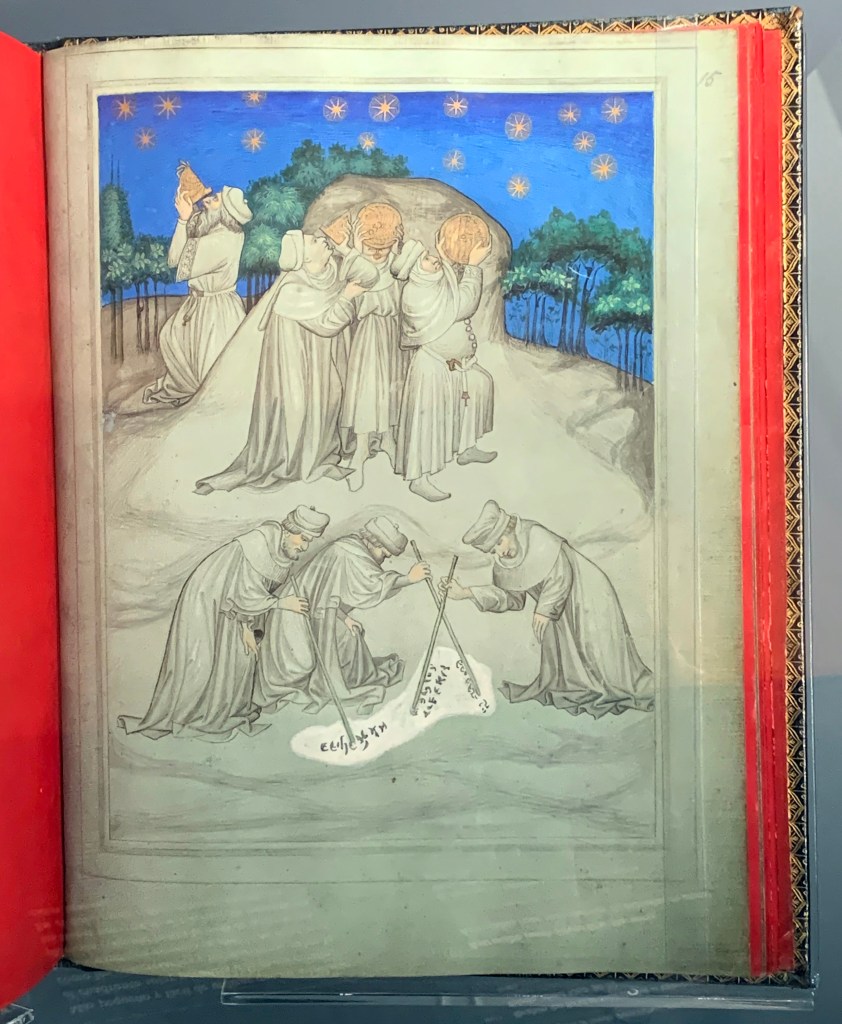
[Illustration from a Czech edition of The Travels of Sir John Mandeville, dated to about 1400-1425, displayed at the Lumen exhibition, Getty Center Museum, Los Angeles. The description reads, “Astronomers in this scene use the lights of the heavens as guides for their instruments, which include astrolabes and quadrants.” The volume was borrowed from the British Library’s collection. Photo by Joe Bauman, Dec. 5, 2024]
A cropped view of the picture provides a better look at the instruments:
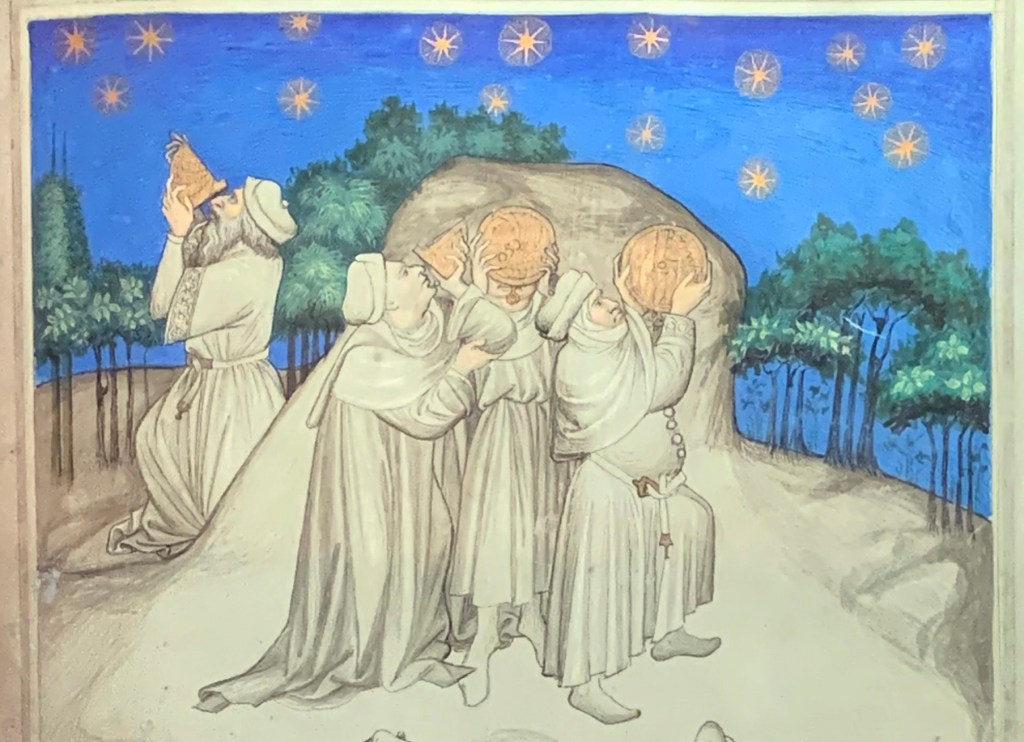
[A cropped version of the previous picture. The instruments the astronomers are lining up with the stars are two astrolabes and two quadrant astrolabes. The quadrants are a quarter of a circle and are a lighter-weight version of a full astrolabe. The artist knew what an astrolabe looked like, but he drew them upside-down. The ring was at top, in order to let the instrument hang down evenly. Photo by Joe Bauman, Dec. 5, 2024]
Close to the illuminated book was a large brass astrolabe, made in England about 1370. It is truly a scientific marvel.
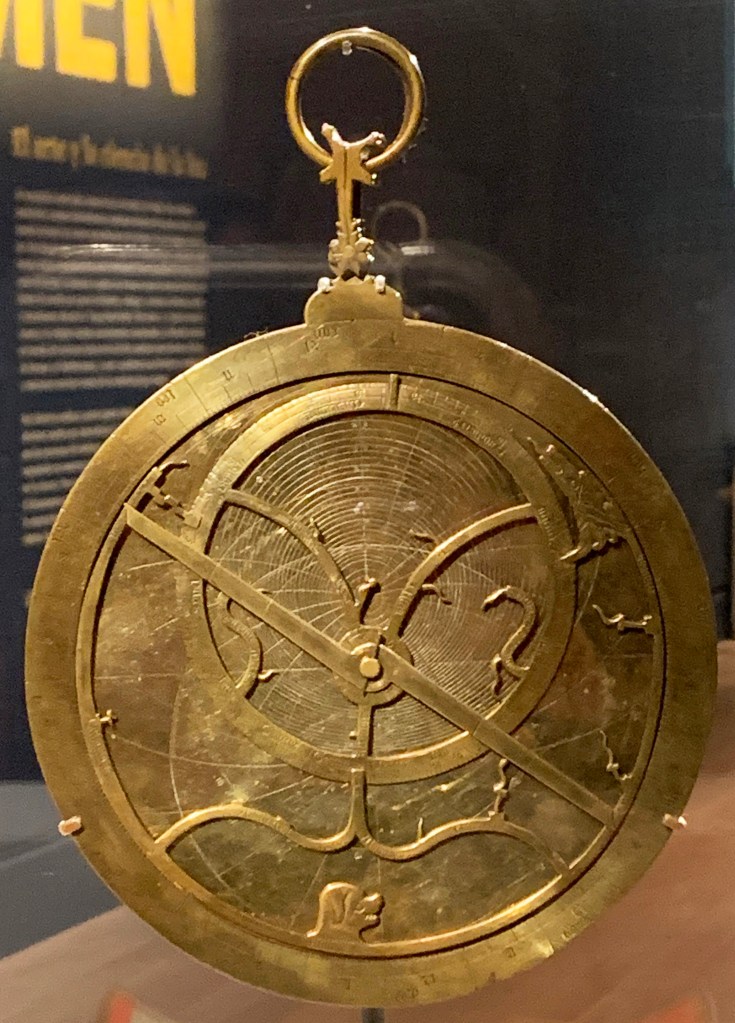
[An English astrolabe dated to 1370, displayed at the Getty Museum’s Lumen exhibit. It was loaned by the History of Science Museum, Oxford, England. The plates could be switched out, changing the readings, depending on locality. Photo, Dec. 5, 2024, by Joe Bauman]
At bottom, a dog’s head points to Sirius, still known as the dog star. A dragon, head at upper right, indicates Antares, according to the exhibit’s caption. Antares, a giant red double star, is the brightest member of the Scorpius constellation and often is called the heart of the scorpion.
Astrolabes are mentioned several times by Sir John. One passage includes it among a number of other instruments, most of doubtful utility. Speaking of the court of “the great Chan,” the emperor of Cathay (China), the book relates —
“And at one side of the emperor’s table sit many philosophers that be proved for wise men in many diverse sciences, as of astronomy, necromancy, geomancy, pyromancy, hydromancy, of augury and of many other sciences. And everych of them have before them astrolabes of gold, some spheres, some the brain pan of a dead man, some vessels of gold full of gravel or sand, some vessels of gold full of coals burning, some vessels of gold full of water and of wine and of oil, and some horologes of gold, made full nobly and richly wrought, and many other manner of instruments after their sciences.”
A horologe, which is a timekeeping device, certainly is useful. I’m not sure I would depend on advice sprouting from part of a dead man’s skull or a vessel full of gravel. But an astrolabe — ah, now that is a valuable instrument.
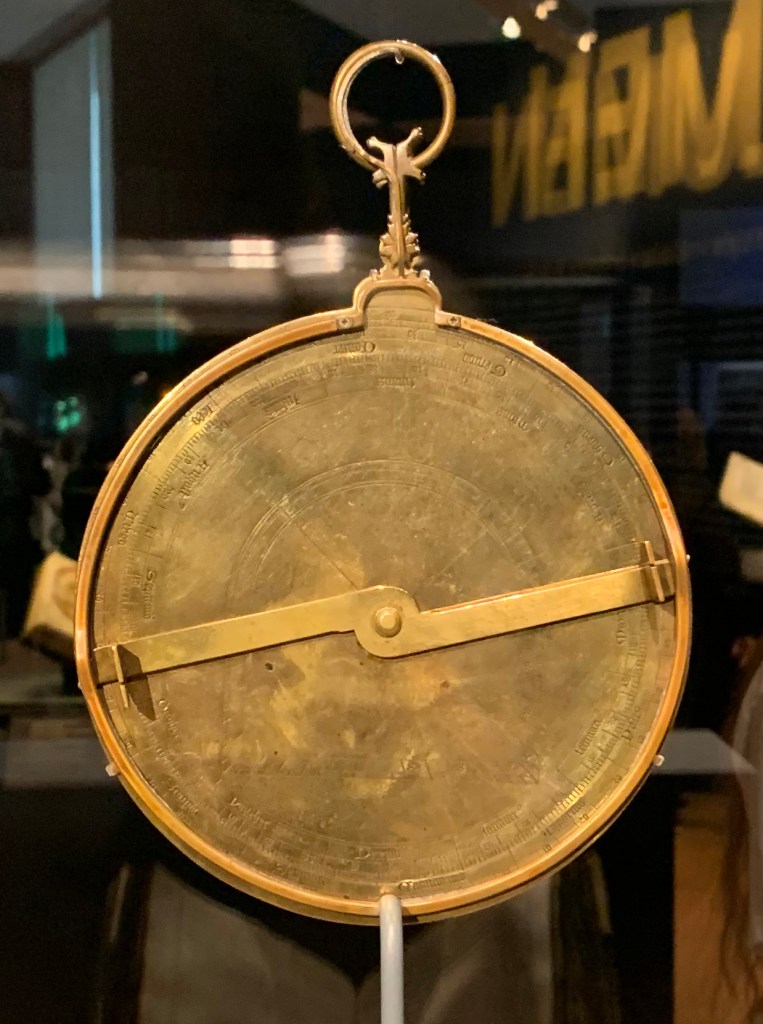
[The other side of the astrolabe shown above. Holes or notches in the upturned ends of the bar were used to sight particular stars. Photo by Joe Bauman at the Lumen exhibit, Getty Center Museum, Los Angeles, Dec. 5, 2024]
The Encyclopedia Britannica has this to say about the astrolabe:
“Type of early scientific instrument used for reckoning time and for observational purposes. Astrolabes can be traced to the 6th century AD; they came into wide use in Europe and the Islamic world in the early Middle Ages and were adopted by mariners by the mid-15th century. One widely used variety, the planispheric astrolabe, can be regarded as a rudimentary analog computer. It enabled astronomers to calculate the positions of the Sun and prominent stars with respect to both the horizon and the meridian.” The device shown here is the planisphere type.
A skillful practitioner would turn the pointer, line up stars, check the notations on the astrolabe. He could tell time in daylight or night, find a location, know when to plant crops, figure when stars rise and set, and measure the height of mountains, among many other applications.
According to a 2017 Smithsonian Magazine article, astrolabes probably were invented around the second century AD. Claudius Ptolemy, an ancient Greek astronomer, left records from that era “suggesting he used a three-dimensional instrument similar to the astrolabe to make calculations,” says the article, written by Laura Poppick, quoting a researcher at New York University named Alexander Jones. As with so much of our learning in science, math and literature, the astrolabe reappeared in Europe by way of the Islamic world.
“The astrolabe’s evolution in the Islamic world was not merely a technical pursuit but also a cultural and artistic endeavor,” says the internet site Ancientscholar.org. “Artisans crafted astrolabes from precious metals and adorned them with intricate designs, reflecting the aesthetic values of the time. These instruments became a tool for teaching and disseminating astronomical knowledge, as educational institutions flourished and manuscripts circulated widely. The astrolabe served as a bridge between practical application and theoretical exploration, fostering a deeper understanding of the cosmos.”
In later centuries the astrolabe evolved for easier use aboard ships. Because the solid metal disk was likely to swing in the wind and upend calculations, it was replaced by one with cutouts that were not as easily blown around, called the mariner’s astrolabe. This device evolved into the sextant, which is still in use.
Sir John claims to have used an astrolabe to measure the altitude of a star at different locations, which points out that the change in degrees can be used to calculate the latitude of a location. (Longitude is a different story. For a wonderful description of how to find it and how that ability was finally perfected, read Dava Sobel’s Longitude: The True Story of a Lone Genius Who Solved the Greatest Scientific Problem of His Time, one of my favorite books.)
The beauty of an astrolabe is obvious, as it is a fine combination of form and function, crafted for scientific measurements. It’s the greatest astronomical instrument to come down to us from antiquity.
 Joe's Astro Stuff
Leave a comment