By Joe Bauman, Salt Lake City
On Oct. 5, 2024, a cold night, I searched for the Cocoon Nebula with my elderly telescope. This interesting star-nest, technically named Sh2-125 (among several designations), looms large and dim in the Cygnus constellation. It was supposed to be almost straight up in the north-northwest at an ideal altitude above my temporary observatory in the backyard. But the Cocoon was hidden in the light pollution that plagues our home and those of all city-dwellers. I couldn’t find it.
A few nights later Baby, the telescope, developed one of its recurrent problems. It has a maddening tendency to shake loose a small internal screw that regulates the gears’ tension. This happens infrequently, but invariably at a super-inconvenient time. With a horrible screech, it will lunge around like a drunk telescope. Power must be switched off immediately to prevent damage. As it occurs during an astronomy session, it blows up the night’s plans. The disassembly and corrections can only be carried out safely in full daylight.
Lifting the 85-pound instrument off its wedge and tripod and onto a folding table is a tough job. Getting the bottom plate off follows. Adjusting that screw just the precise amount necessary, and tightening two bolts that have lost their grip, is another hassle. Next come the tasks of testing the tracking, shutting down, adjusting the screw again, testing again, shutting down, putting the bottom back on and hefting that big Baby back up onto the wedge and tripod.
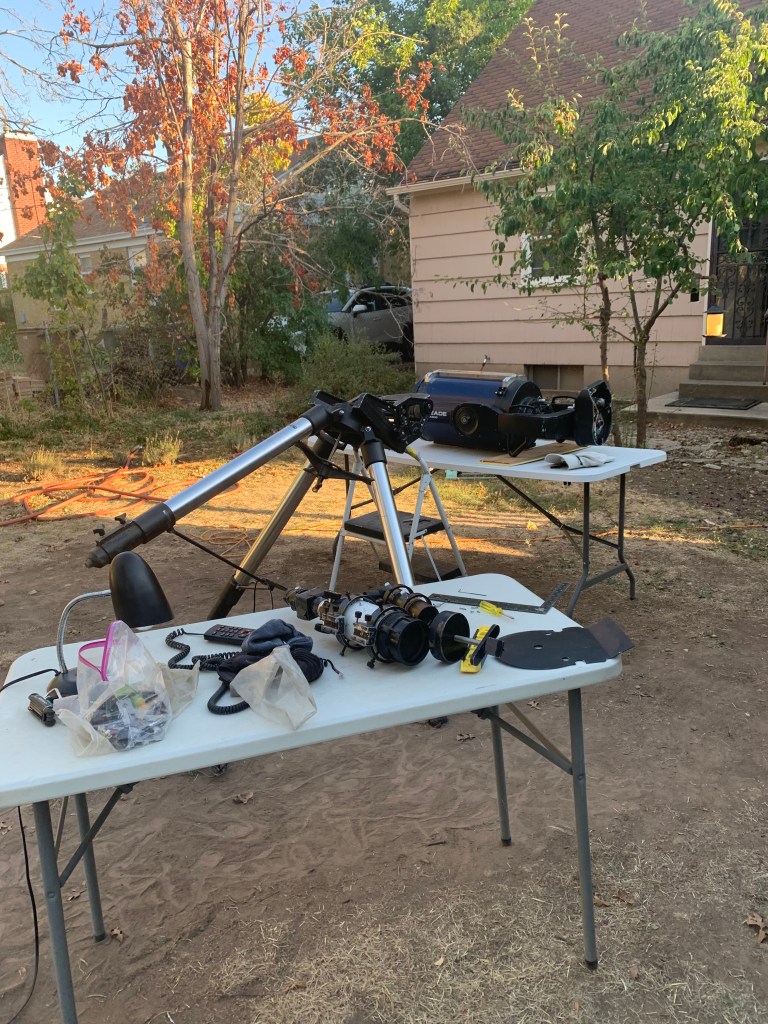
[Baby the Telescope on its operating bed in the backyard, where use of the temporary observatory has killed grass and trampled the surface of the ground into powder. Photo taken Oct. 9, 2024, in Salt Lake City by Joe Bauman]
Finally, a week after I began searching for the Cocoon, I succeeded. I shot two hours of light exposures, half an hour each with four filters: luminance (colorless), red, green and blue, plus innumerable images that I would need to control other problems that we can call static. Each light exposure was one minute. I also took two sets of views of the Pleaides star cluster.
“I was up until 5 this morning, on and off, but I seem to have mastered the art of napping for about half an hour and an hour at a time, so I wasn’t terribly sleep-deprived,” I noted later that day, Oct. 13. I was surprised by the beauty of the nebula.
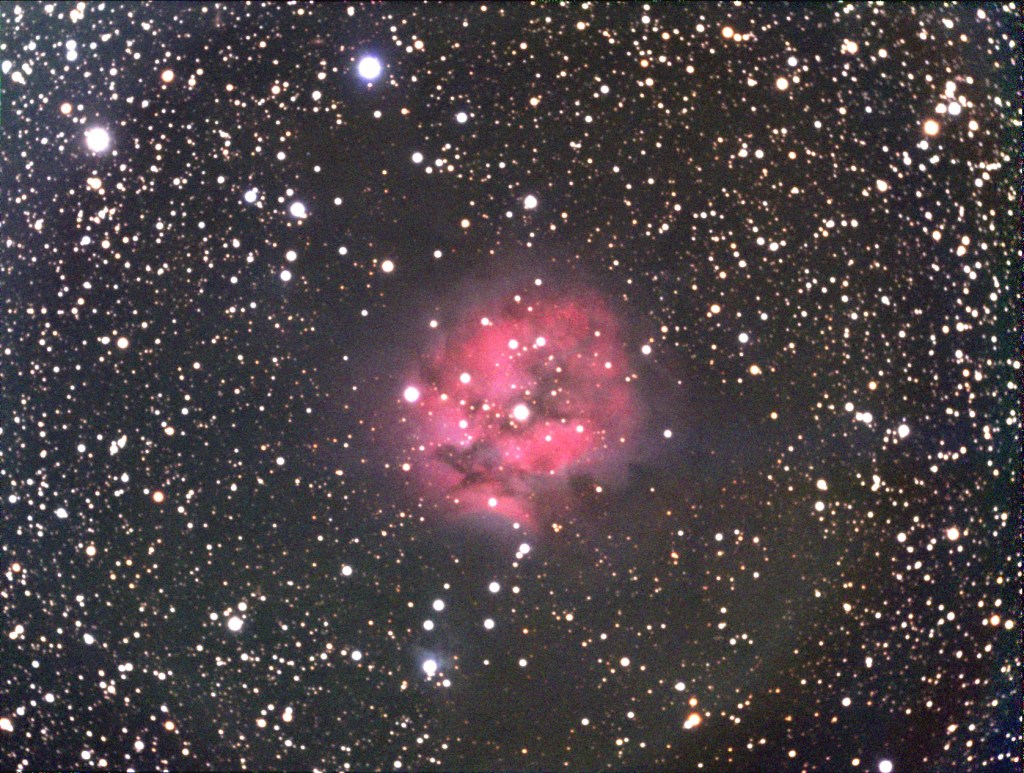
[The Cocoon Nebula, Sh2-125, taken from our backyard in Salt Lake City the night of Oct. 12-13, 2024. Photo by Joe Bauman]
The nebula is a clump of molecular gas and dust where gravity pulls together concentrations of that primordial material. The concentrations, when they become dense enough, ignite as stars. Some are full-blown stars burning away the surrounding cloud, while others are continuing to form. According to the NASA Astronomical Photo of the Day for Aug. 27, 2022, in a description written by the astronomer David Jenkins, the nebula is 4,000 light-years away and is 15 light-years across.
The overall red tones are from hydrogen gas glowing in the heat of the stars, which are quite young by astronomical standards. “In fact, the bright star found near the center of this nebula is likely only a few hundred thousand years old, powering the nebular glow as it clears out a cavity in the molecular cloud’s star-forming dust and gas,” reads the caption.
Most astronomers whose work on the nebula shows up on the internet refer to the Cocoon as IC 5146. But according to the Irida Observatory, “Properly speaking, IC 5146 refers to the star cluster and Sh2-125 to the nebula.” We can see the nebula even where it is not glowing because it blocks some of the stars behind it, leaving dark streaks and puffy areas.
The gas cloud has a long dark tail stretching off to the west, down in this picture. Little of the tail shows in my closer view, but it is about five times the width of the glowing section.
An interesting blue fan appears the region where the tail joins the central part.
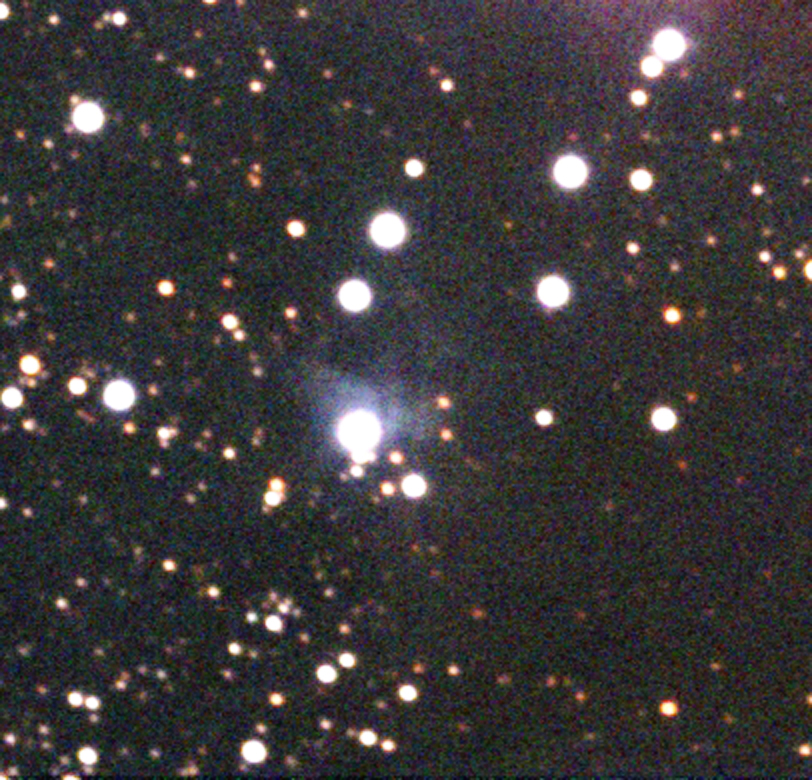
[Gas glowing blue forms a fan-like structure near the central glow. It is a nebula known as VdB 147. This is an enlargement of a cropped section of the previous view.]
The blue flame is a nebula that goes by the title Van den Bergh 147, the 147th object listed in Sidney Van den Burg’s list of reflection nebulas. This type of nebula differs from the Cocoon, which is an emission nebula. The latter is lit up by a star or cluster of stars whose cumulative heat — more than 44,000 degrees F — is fierce enough to ionize hydrogen in the cloud, giving off a reddish glow. An emission nebula like VdB 147 shines when light from a nearby star excites a gas cloud, but the star is not hot enough to ionize hydrogen. The dimmer glow generally is blue; the color can be caused by the star’s own tint and/or by the scattering of the star’s light the way our atmosphere scatters sunlight and looks blue.
The most exciting objects in the photo are small and drab. They are two tiny galaxies at the top of the picture, to the left of the highest bright star. They are barely more than smudges. Jim Thommes, an astrophotographer from San Diego, posted his spectacular image of the Cocoon Nebula in the Cloudy Nights astronomy discussion group. Along with the photo he provided an annotated view, showing names of nearby features. It gave the designations of three small galaxies that happen to be in the background. (My image did not include one of them.)
The “three little galaxies,” he wrote, are known as LEDA 167590, LEDA 167593 and LEDA 167597. The most distant known of these, LEDA 167590, is estimated at about 1.129 billion light-years away, he added.
To let the immense number sink in, consider the most individual objects that you can envision at one time, strictly in your mind. My limit is about 1,000. I can picture a slender box with ten rows of stars, each row with ten stars. That makes 100. Without blurring out any, I can “see” a set of ten of these boxes, making 1,000 objects. Beyond that, say 2,000, the boxes tend to mash together or collapse.
Now consider the meaning of a light year. I doubt anyone could grasp the reality of that distance. It is the stretch of space that a photon of light, from a star for example, will race through in a year — all the time traveling 186,000 miles per second. Per second! Now think of how many seconds are in a billion years and multiply that by 186,000 and you get an answer in miles.
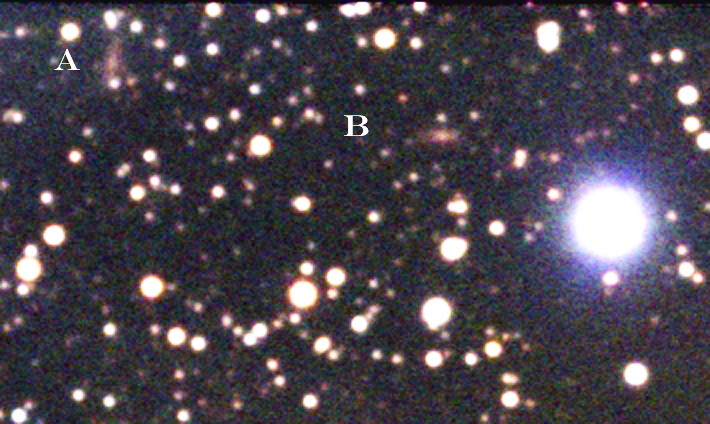
[An enlarged part of my Cocoon Nebula photo. The galaxy labeled A is LEDA 167590, 1.2 billion light-years away, and B is galaxy LEDA 167593, distance not available. The large orb is the highest bright star in the overall photo, where it is at top about a third of the way from the left.]
Using Tommes’ annotation, I found what he labeled as LEDAs 167590 and 167593 on my photo. The picture is not exactly Hubble-worthy, but I was thrilled to have photographed a galaxy more than a billion light-years away. But then I wondered if the distance given was too good to be true. I’m a skeptical person. I spent far more time tracking down the facts about the galaxy than I did photographing it.
No mistake, the designation of the farthest one is LEDA 167590, I discovered by using the NASA/IPAC Extragalactic Database, which is maintained by the California Institute of Technology in Pasadena. The database carries a photo of the galaxy taken by a professional observatory (the site is unclear about which observatory). Although the view is far better than mine, they both show the same galaxy and starfield.
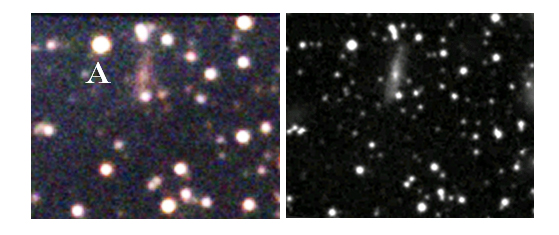
[Proof of the identity of the galaxy in my picture. To the left, a cropped enlargement of my photo; on right, an image placed online by Caltech of galaxy LEDA 167590. They were enlarged and adjusted in orientation. Photo on right courtesy of the California Institute of Technology, Pasadena.]
Making sure of the galaxy’s designation proved to be easy, compared with determining its distance from Earth. That was because of several reasons:
*** I used the wrong terms in searching the internet, such as “distance to LEDA 167590,” which brought up nothing authoritative.
*** I went to the Hyper-LEDA extragalactic database maintained by the University of Lyon, France. Sometimes it would deliver information about the location of the galaxy, magnitude, size, etc., without indicating distance. More often I probably asked my question in the wrong way and it replied, “Désolé, mais rien ne correspond à vos critères de recherche. Veuillez réessayer avec d’autres mots-clés” — to the best of my translating ability, “Sorry, but nothing corresponds to your research (query?). Try researching with other words.”
*** Figuring how far away a galaxy is today and how long light has traveled from it is not simple.
Eventually I tried the Caltech site again. I fed in the name of the galaxy and up came its location, type, the photo, alternate designations for it, external links and other information. Then I noticed a criterion labeled “Redshifts.”
Wait a minute — redshift is a way to measure the distance to an astronomical object. If a galaxy is moving away from us in space, its light is shifted toward the red end of the spectrum; if something is moving in our direction, the light is bluer. This effect of changing the light’s frequency — stretching or compressing its wavelength — has an equivalent in changes in soundwaves. The horn of a locomotive barreling along in our direction sounds different than it does after it passes. This is the Doppler effect.
Redshift is determined by spectroscopic measurements. Because the universe’s expansion rate is a function of an object’s distance, knowing its redshift can tell how far away it is. (Questions about the expansion rate and its consistency are too complex to get into here.) Redshift is expressed in terms of the letter z. The distance is derived from a mathematical formula, which ensures that 2 z is not twice as far as 1 z. The length of time that light has been traveling, if it is at 1 z, is 7.731 billion years; because the universe has been expanding all that time, the object that emitted the light is not 7.731 billion light-years away but 10.147 billion light-years from us, assuming it still exists. Those who would like to dive deeper into the subject are invited to check out postings by the Las Cumbres Observatory, based in Goleta, CA.
When we derive the value of z, we are finding how far away an object is now, taking account of the distance added by the expansion of the universe since the light started its trip. Let’s call the difference between those numbers a differential, for lack of a better word.
If you ask about LEDA 167590 at the Caltech site and click on “Redshifts,” you get “z = 0.087283.” A simple conversion, carried out by an internet site, comes up with a distance of a little more than 1.2 billion light-years. Because of the differential, that is not the distance from us that the galaxy was whenever that light started, and it does not mean the light has traveled for 1.2 billion years.
The term z is how far away the galaxy is now. But of course, we’re seeing it as it was some time in the past. So how long has light been traveling if it has a redshift of z = 0.087283? The math is too much for a poor mortal non-scientist, but fortunately this site at the University of California Los Angeles will do the calculations for you. Just plug in the z value 0.087283 and the answer is “The light travel time was 1.121 Gyr.” and “The luminosity distance DL is 389.8 Mpc or 1.272 Gly.”
A Gyr, or gigayear, is one billion years. The galaxy LEDA 167590 is now 1.272 billion years away, and its light took 1.121 billion years to reach our backyard. When it started out, the most sophisticated organisms on Earth were bacteria. Multicellular animals were still 500 million years in the future.
 Joe's Astro Stuff
Leave a comment