By Joe Bauman, Salt Lake City
Galaxies generally travel in gangs, where, as in the human variety, the most massive individual dominates. Our immediate cosmic region is a collection of three large galaxies and an estimated 50 dwarf galaxies gravitationally bound together. The big three, in order of mass, are the Andromeda Galaxy (Messier 31), our Milky Way Galaxy and the Triangulum Galaxy (M 33). Spread out over an area of 10 million light-years, the most distant is some 5 million light-years away.
If this planet’s residents weren’t so egotistical, our bunch would be named after its largest denizen: it would be called the Andromeda Group. But as humans are certain that we are the be-all and end-all, that won’t do. Instead, it is known (unimaginatively) as the Local Group of Galaxies.
Which brings up another group that is more appropriately named. The Messier 74 Group is called after its most massive example, the M 74 galaxy. The group contains “about half a dozen galaxies” says a Hubble Space Telescope site. Since I’m a quibbling mood, I’ll ask, What is about half a dozen? Five? Seven? Anyway, M 74 itself has an estimated100 billion stars, the site adds, “making it slightly smaller” than the Milky Way.
This blog discussed Messier 74 back in November 2017, and at the time I had not photographed it. This past fall I decided to give it a try with our telescope. But it’s a sort of tough one to photograph.
The 110 deep-space objects in Charles Messier‘s catalog of things that look like comets but aren’t, lie scattered across the cosmos, from the nearest — the beautiful naked-eye cluster of stars called the Pleiades (M 45), at 444 light-years away — to the farthest off, according to NASA, the barred spiral galaxy Messier 58 at 62 million light-years. (We should note that plenty of disputation has taken place about which is the most distant, with some holding out for M 109 at a claimed distance of 83.5 million light-years.)
Messier objects are all relatively bright and close, in terms of the vastness of space, since they were visible in the small telescopes of the 18th century, when Messier compiled his list. M 74 is toward the distant end of the scale at 32 million light-years.
Located in the Pisces constellation, M 74 is “one of the most difficult Messier objects to observe,” NASA notes on a Hubble Space Telescope site. The reason it is challenging to see is that it’s fairly far off and is turned face-on to us. It’s shaped something like a dimly glowing plate with a bulge in the middle. If it were at an angle to us, its combined output of stars would shine as a brighter sliver; as it is, the flat disk spreads out the light, resulting in low surface brightness.
But what a beauty. M 74 is a “grand design” spiral galaxy, with curving arms outlined by dramatic dust lanes. “Its perfectly symmetrical spiral arms emanate from the central nucleus and are dotted with clusters of young blue stars and glowing pink regions of ionized hydrogen (hydrogen atoms that have lost their electrons),” reports a NASA site. “These regions of star formation show an excess of light at ultraviolet wavelengths. Tracing along the spiral arms are winding dust lanes that also begin very near the galaxy’s nucleus and follow along the length of the spiral arms.”
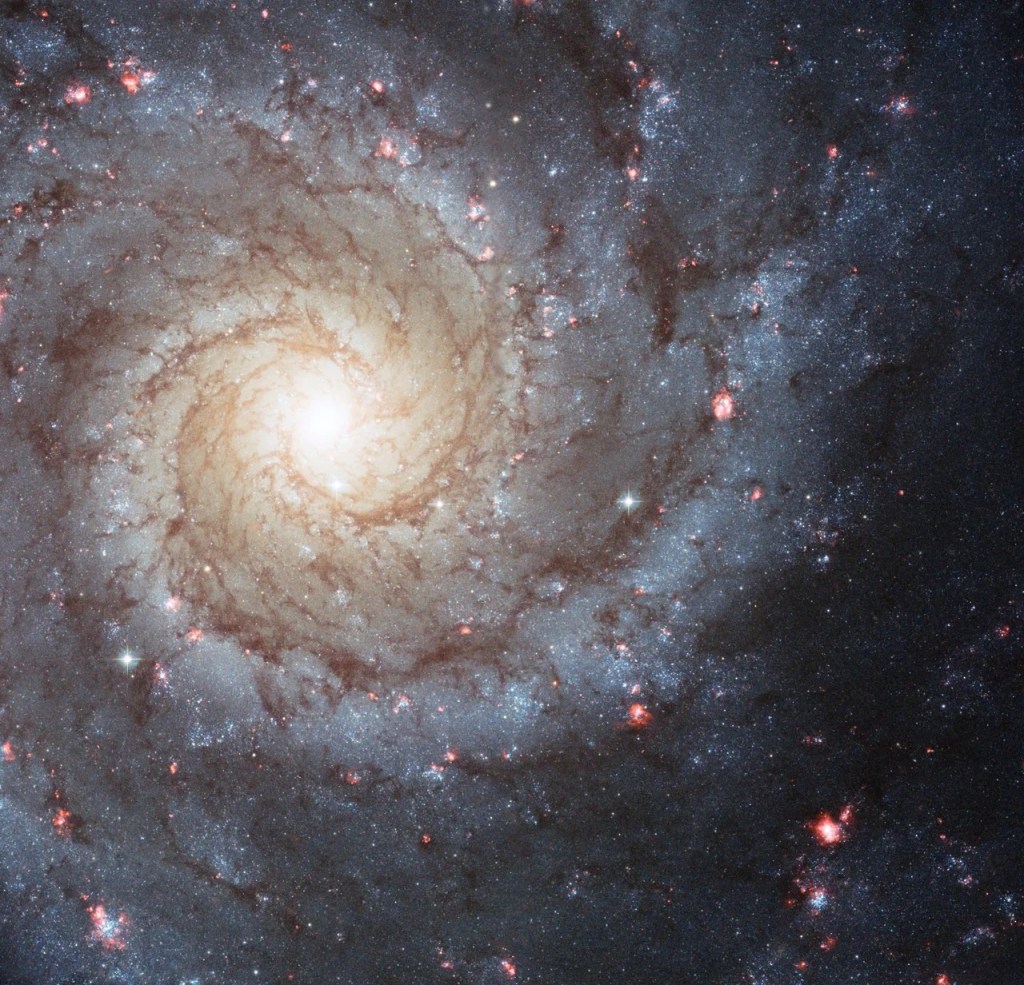
[The impressive “grand design” spiral galaxy M 74 as photographed by the Hubble Space Telescope in November and December, 2003 and February-June, 2005. Image credit: NASA]
Last October I tried to take a portrait of this interesting galaxy, although with a telescope far smaller than the Hubble with its mirror of seven feet, ten inches in diameter; that is, using my 12-inch diameter Meade in our Salt Lake City backyard. (The larger the mirror the more light can be collected per minutes of exposure and the better the image resolution.) Also, Hubble orbits above the atmosphere, so it has no trouble with stray light, unlike any instrument in Salt Lake City’s deep bowl of murky light pollution.
A smaller mirror not only reduces resolution so that fewer details are visible, but it requires longer exposures to collect enough light. My efforts were carried out over two nights, Oct. 6-7 and Oct. 8-9, 2024. The filtered exposures were one and two minutes long, with a total of 76 good images, plus others that were unusable because of clouds. They were shot through luminance, red, green and blue filters. Then there were many hundreds of exposures that were needed to reduce noise (these are termed bias, dark, flat and flat-dark images).
The worst problem was light pollution, which gave a mottled greenish cast to the view. This defect had to be ameliorated in processing the photos.
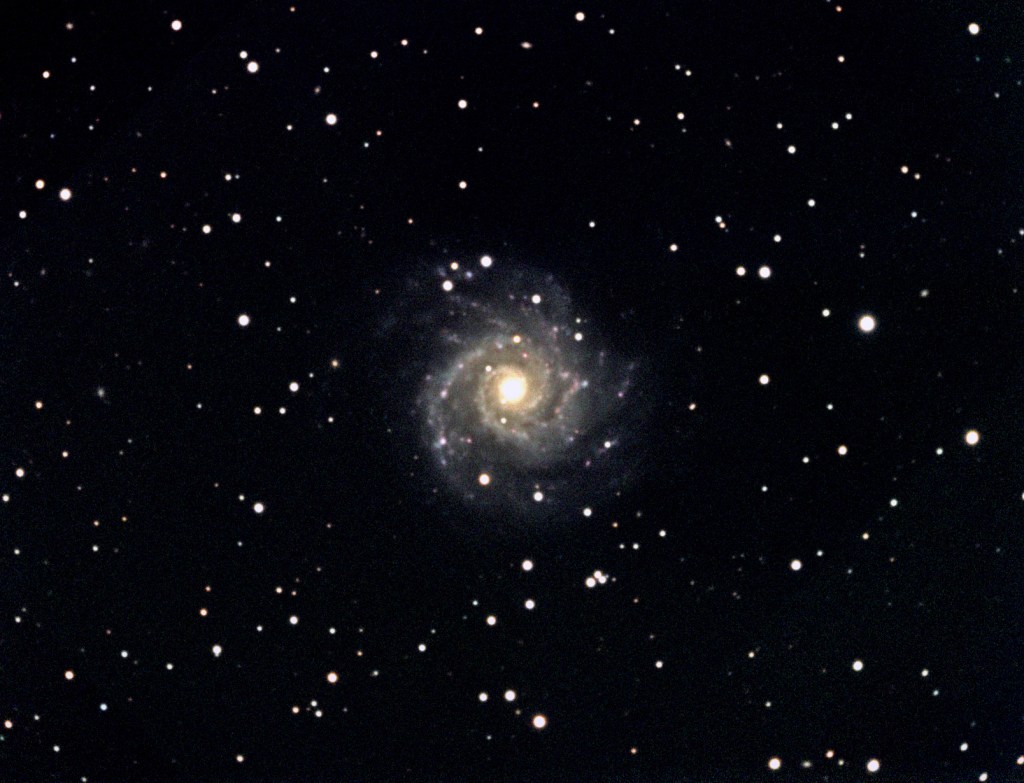
[M 74, a view from the nights of Oct. 6-7 and Oct. 8-9, 2024. Photo taken in Salt Lake City by Joe Bauman]
It’s no Hubble view. I don’t like the big fat foreground stars, which are a result of the telescope’s limitations; sharper telescopes make pinpoint stars. Also, I would love to have more detail. But for a faint galaxy 32 million light-years away photographed in a city, it’s not bad.
Sometimes Messier 74 is called the Christmas Wreath Galaxy and sometimes the Phantom Galaxy. Both names are appropriate, because it’s a wintertime object with a cheerful circular pattern like a wreath, and because, at Magnitude 10, it is as faint as a ghost. Maybe we could jam the names together and call it the Christmas Wraith.


Leave a Reply