By Joe Bauman, Salt Lake City
The Utah Astronomy Club and guests experienced one of the rarest treats in science on March 12: we heard about surprising new astronomy discoveries in a talk by the lead author of the scientific paper announcing those findings — news that rewrites the textbooks on two areas of research.
“Using the Dark Energy Spectroscopic Instrument — DESI– survey, we have actually identified nearly 2,500 active black holes in dwarf galaxies, which has tripled the known census of these active black holes in dwarf galaxies,” said Dr. Ragadeepika Pucha, a second-year post-doctoral researcher in the University of Utah Department of Physics and Astronomy. “Additionally, we also found 300 of the intermediate-mass black holes in galaxies, the largest sample known to date.”
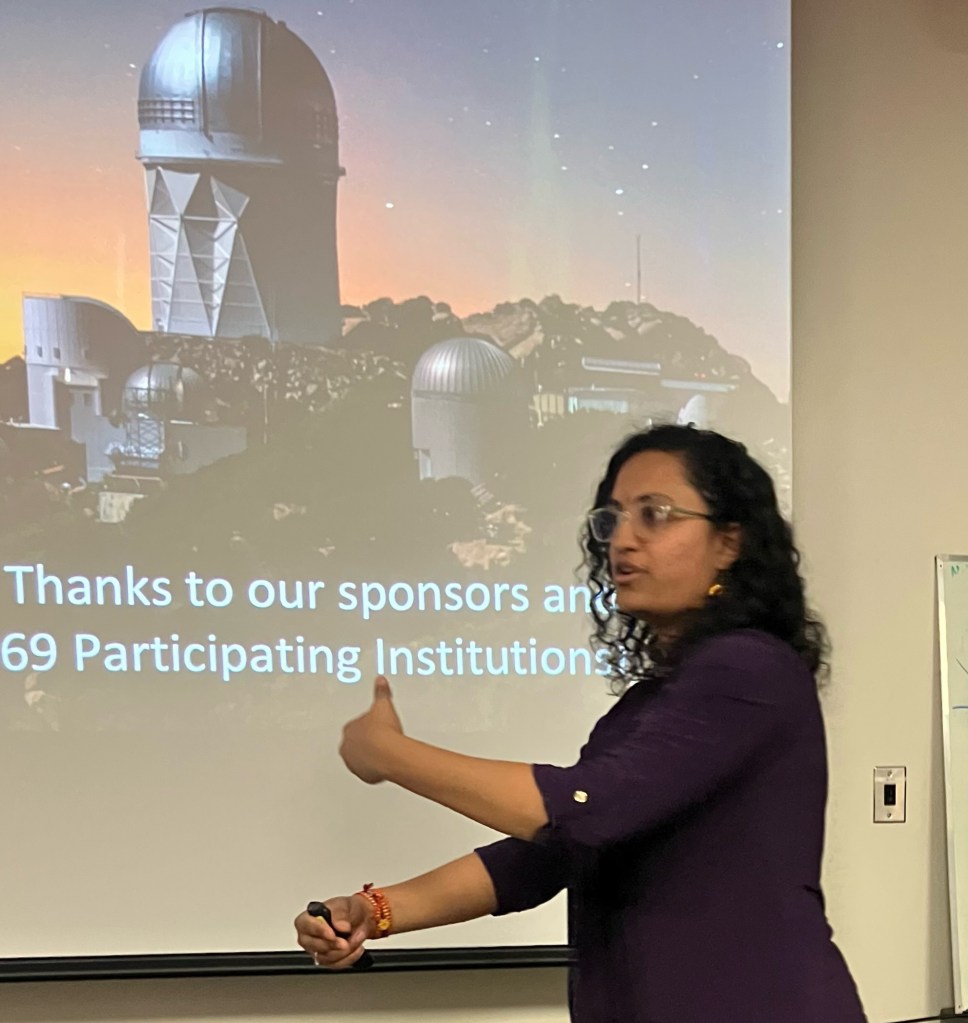
[Dr. Ragadeepika Pucha speaks to the Utah Astronomy Club and guests on March 12, 2025. Photo by Cory Bauman]
Dr. Pucha spoke before a larger crowd than usual for the club’s monthly sessions. Hosted by Paul Ricketts, director of the University’s South Physics Building observatory, the meeting was held on the fourth floor of the building. It was one of the last to be held there, as within a few months a new location is expected to become available in the U.’s new Applied Sciences facility.

[Some of the attendees at the March 12, 2025, meeting of the Utah Astronomy Club. Photo by Joe Bauman]
The discoveries may help scientists understand how the first black holes formed and how black holes affect galaxy evolution, she said. Galaxies are the total amount of gas, dust, stars, planets, black holes, clusters, nebulas, comets and other matter and energy that are concentrated together. Our own galaxy is called the Milky Way, since parts are visible on clear, moonless nights as a swath of filmy material stretching across the sky. Billions of stars are so distant that their combined light looks a little like a stretch of milk.
Black holes are regions of space with such enormous gravity that nothing can escape them. Even light, which has no rest mass (although it has what is called relativistic mass), is unable to overcome the region’s astonishing gravitational pull. Astronomical black holes come in three known varieties: stellar-mass, the smallest; intermediate; and supermassive, the largest. NASA explains the creation of the smallest of the three this way:
“A stellar-mass black hole forms when a star with more than 20 solar masses [more than 20 times the mass of our Sun] exhausts the nuclear fuel in its core and collapses under its own weight. The collapse triggers a supernova explosion that blows off the star’s outer layers. But if the crushed core contains more than about three times the Sun’s mass, no known force can stop its collapse to a black hole.”
At one end of the scale, stellar black holes are a few times the mass of the Sun; the difference between the “few” masses and the 20 masses that the star has at the start of the collapse is explained by the amount of material thrown out in its supernova explosion. The other end of the range of stellar black holes is hundreds of times the Sun’s mass. NASA adds, “Stellar-mass black holes can continue to gain mass through collisions with stars and other black holes.”
Supermassive black holes are those of at least 1 million times the mass of our Sun. They are found at the centers of most major galaxies and their formation is still somewhat mysterious, although black-hole mergers have been recorded. Both stellar-mass and supermassive black holes have been extensively studied. What has been missing for many decades are intermediate-mass examples, those in between the two other sizes.
In a now-outdated posting, NASA stated:
“Astronomers had long suspected an in-between class called intermediate-mass black holes, weighing 100 to more than 10,000 solar masses. While a handful of candidates have been identified with indirect evidence, the most convincing example to date came on May 21, 2019, when the National Science Foundation’s Laser Interferometer Gravitational-Wave Observatory (LIGO) located in Livingston, Louisiana, and Hanford, Washington, detected gravitational waves from a merger of two stellar-mass black holes. This event, dubbed GW190521, resulted in a black hole weighing 142 Suns.”
That has changed. The new discoveries will force a rewriting concerning those most peculiar objects, black holes. Instead of “a handful of candidates,” astronomers now will be able to study 300 intermediate black hole candidates.
Not only that, but the survey Dr. Pucha headed raked in another great discovery, finding 2,500 active galactic nuclei (AGNs) — indicative of black holes drawing in gigantic amounts of material — in dwarf galaxies. That’s three times the number of AGNs known before in dwarf galaxies.
Dr. Pucha said the definition of dwarf galaxies is somewhat arbitrary. It is based on the size of the Large Magellanic Cloud, a small galaxy visible from the southern hemisphere; it and a sister dwarf, the Small Magellanic Cloud, are the closest galaxies to our Milky Way. (The closest major galaxy, Andromeda, is far too big to be labeled a dwarf.) The Large Magellanic Cloud has something like a billion solar masses; any galaxy that size or smaller is labeled a dwarf galaxy. Some of them are only 1,000 solar masses.
“Dwarf galaxies are actually the most abundant galaxies in the universe, making them very important for us to understand how they grow and evolve,” Dr. Pucha said. A theory of galaxy formation says these small examples came first, then many merged, becoming larger and larger.
The research report — “Tripling the Census of Dwarf AGN Candidates Using DESI Early Data” — totals 35 pages. Published first in the XIRVl.org internet site on Feb. 20, the study was destined for The Astrophysical Journal. It has 49 authors from around the world, headed by Dr. Pucha. Among these is Yao-Yuan Mao, assistant professor in the U.’s Department of Physics and Astronomy.
The research was conducted using the DESI, which uses the four-meter (13-feet in diameter) Mayall telescope at Kitt Peak National Observatory, Arizona. The survey, which studies thousands of galaxies, is led by the U.S. Department of Energy Office of Science.
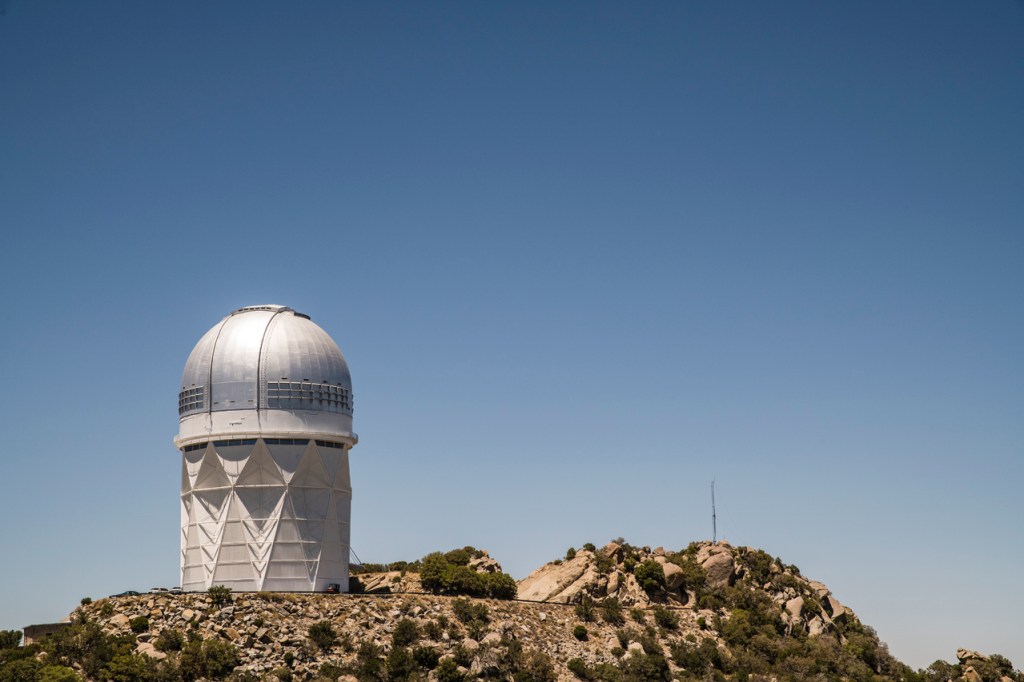
[The Mayall Telescope at Kitt Peak National Observatory, photo courtesy of the U.S. Department of Energy Office of Science]
Early data from the survey covered 410,757 galaxies that emit spectroscopic information. The study identified AGNs in 75,929 galaxies among 296,261 high-mass galaxies, a rate of about 25.6 percent. That means about a quarter of big galaxies have black holes that are busy gobbling matter. Even more exciting, the survey found that 4,181 AGNs among 114,496 dwarf galaxies, amounting to 2.1 percent of these smaller galaxies. The study analyzed the Hydrogen-alpha line in the active black holes’ spectra to determine their varying sizes.
“This study more than triples the census of dwarf AGN and doubles the number of intermediate-mass black hole … candidates,” the report says.
Dr. Pucha explained that the possibility of the existence of black holes was extrapolated from Albert Einstein’s equations before scientists had discovered any of them. She added, “I think that’s just so beautiful and poetic in the way that math can tell us about the universe before we can see it.”
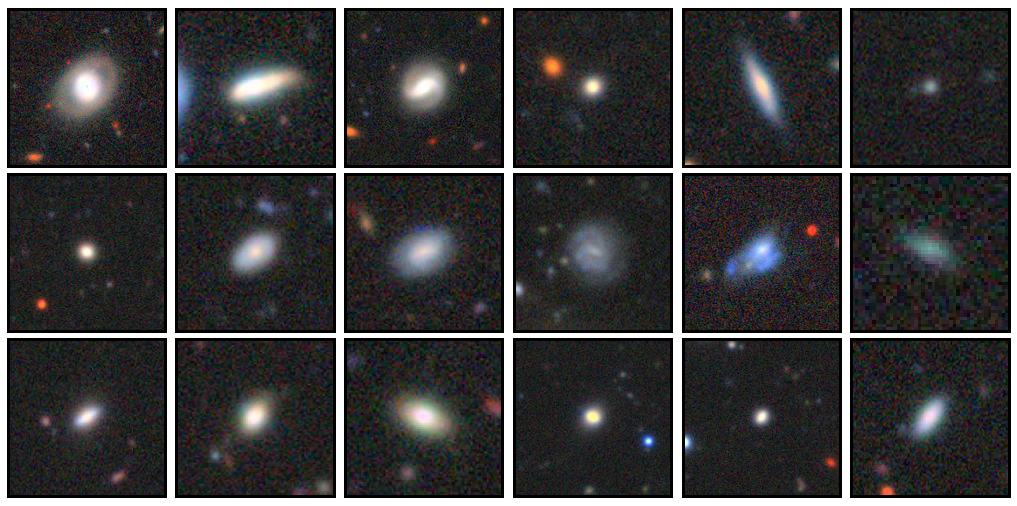
[Dwarf galaxies with black hole candidates, photo provided by Dr. Ragadeepika Pucha]


Leave a Reply