By Joe Bauman, Salt Lake City
I’ve been struggling for a couple of days, trying to think what I could say about the death of my friend Dave Bernson — not only my friend, but a friend to amateur astronomers everywhere, particularly those of us in Utah who were lucky enough to know him. He died on April 12, aged 70, a tremendously sad shock to so many of us.
On numerous astronomy adventures, Dave often traveled with his best friend, Nate Goodman. Nate died on Sept. 5, 2023, at age 77, and Dave seemed to pull back from connections after that. He had physical ailments, and also was subjected to more undeserved hard knocks than I care to talk about, but he retained his incredible sense of humor. He never liked — or maybe never quite got the hang of — such devices as cell phones, and it was hard to get him to return a call. He would lose his phone in sofa cushions for weeks at a time. But he became worse withdrawn after Nate died. I tried repeatedly to contact him in the past year, including driving to his apartment in Murray, and only connected once.
Among the outstanding aspects of Dave’s high intelligence was his knowledge of the entire night sky, all of the constellations and major (also scads of minor) stars and other deep-space objects, their mythology, how to find anything above us without setting circles or charts — and he could talk about them every month of the year — he did love to talk. It made no difference how the seasons rotated the sky; its features were like close friends he had no trouble recognizing. I remember seeing him at star parties, laser pointer outstretched, astounding everyone around him with details of the night sky. Here’s Draco the dragon, he’d say, sweeping the pointer along that enormous constellation and telling about its characteristics. He showed me ancient globular clusters “hanging” below the plane of the Milky Way.
He loved science fiction, and he and I delighted in recounting incidents found in obscure sci-fi books and movies. He claimed visitors from Zeta Reticuli were apt to raid his strawberry ice cream. Why strawberry? It was just a matter of their preference. He would instruct, in the most serious manner, that at the solstice you should pat your head and rotate three times clockwise or counterclockwise (I forget which) to keep the cosmos turning in the right direction. He had an endless supply of funny stories and was a great raconteur. On a long trip, we chatted continuously.
According to Dave, someone he thought wronged him in the long-ago was a dinosaur. An actual one.
Another he dubbed “Richard Potato.”
Why that name? I asked.
“Dick Tater.”
Before his back was damaged, he had been a world-class skier. Dave would tell about bizarre skiing incidents.
One of his astronomy stories was about a group going to a desert site, which would be away from light pollution, for an observing session. A woman friend and her dog were in one of the cars. As soon as the car stopped and the door opened, the dog jumped out, ran straight toward a cliff and went over. The woman was extremely upset, I imagine crying, and they went to look for its body, dreading what they would see — peered over the edge — and there it was on a narrow ledge six or eight feet below, staring up at them, unharmed, walking back and forth on the ledge. Others held Dave by his ankles and lowered him down, and he got the creature back to its owner.
He chased solar eclipses, both total and annular. It was during the May 1994 annular — which we watched from about 20 miles southeast of Las Cruces, NM — that I met Dave and Nate. As the eclipse progressed, Dave proclaimed, “Dragons are eating the sun.” Then he explained, “”It’s not a terribly detailed sun. But there is one small sunspot near the southeast limb, with a couple of bright plages [shinier regions] around the sunspot, which are little bright filamentary streaks.”
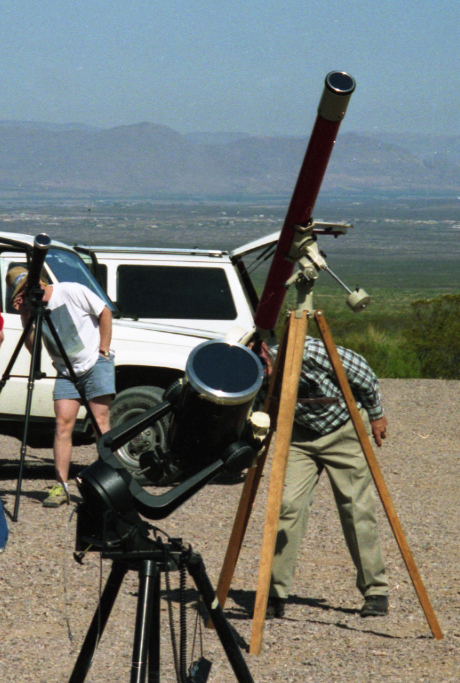
[A typical view of Dave Bernson, left, and his buddy Nate Goodman using telescopes with solar filters to watch the annular eclipse of May 10, 1994, from a site just below Organ Mountain, N.M. Photo by Joe Bauman]
In later years, he would visit a retirement home and teach about astronomy. He and Nate helped found the annual Heritage StarFest in Wayne County, in some of Utah’s best dark-sky country. In the Astronomical League’s Alcon (astronomical convention) in 2011, held at Bryce Canyon National Park, a speaker bio for Dave mentioned that he ” helped lead more than 100 astronomical expeditions to dark sky sites in Utah’s mountains and deserts.”
The League’s 2017 Alcon was held in Casper, WY and timed to coincide with the Aug 21 total eclipse. The convention drew thousands of participants worldwide for that year’s solar spectacle. Dave was the keynote speaker, delighting his audience. His topic was “Across the water to the Princess in Chains …. Celestial Highlights of the Autumn Sky” — the water reference was to the so-called “water constellations” of Aquarius, Capricornus the Sea Goat, Pices the Fishes, Cetus the Whale or Sea Monster, and others. The princess in chains is the constellation Andromeda, offered as a sacrifice to Cetus, to be rescued by Perseus (another constellation).
Undoubtedly quoting him, Dave’s bio for the 2017 Alcon concluded, “His career as an experimental cognitive cosmologist began at the age of 5 when he stuck his sister’s lovely pink hair barrette into the electrical outlet.”
Dave had a career as a respiratory therapist at St. Mark’s Hospital and I understand he was great in this calling. That was another rich source of tales. It seems strange that he died in the St. Mark’s hospice unit. I hope some of the folks at the hospital remembered him.
Often on Wednesdays he and Nate would get together in Nate’s home to watch Japanese Anime movies, of which Nate had a huge library. My wife Cory and I joined them once or twice.
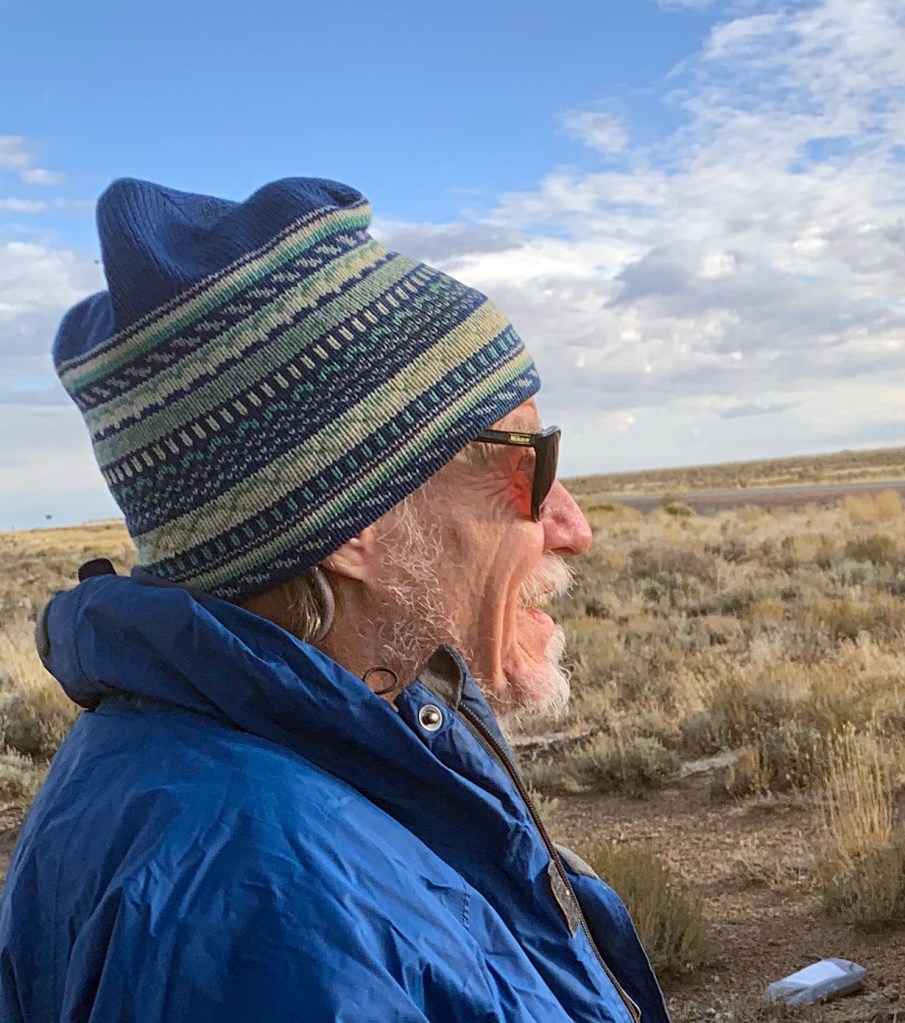
[Dave Bernson near Cherry Creek, Nevada, on a trip to see an annular solar eclipse, Oct. 14, 2023. Photo by Joe Bauman]
I believe his last public presentation was a talk to the Utah Astronomy Club on Oct. 20, 2021; the subjects were constellations and sky explorations, but of course he ranged through a great many other subjects, gesturing, joking at times, serious at others. My journal from that day reads, “Tonight’s Utah Astronomy Club meeting had a great turnout, 18, and a wonderful speaker, Dave Bernson.”
He and Nate continued to attend the club’s monthly meetings, though both were in less than optimal health. Sometimes they took a bus in to Salt Lake City and afterwards Cory and I would drive them to their respective homes. Dave carried a seating pad to ease his painful back. One of the last club meetings they attended was on April 12, 2023. Nate died that September. Dave and I drove to Nevada for an annular eclipse the next month.
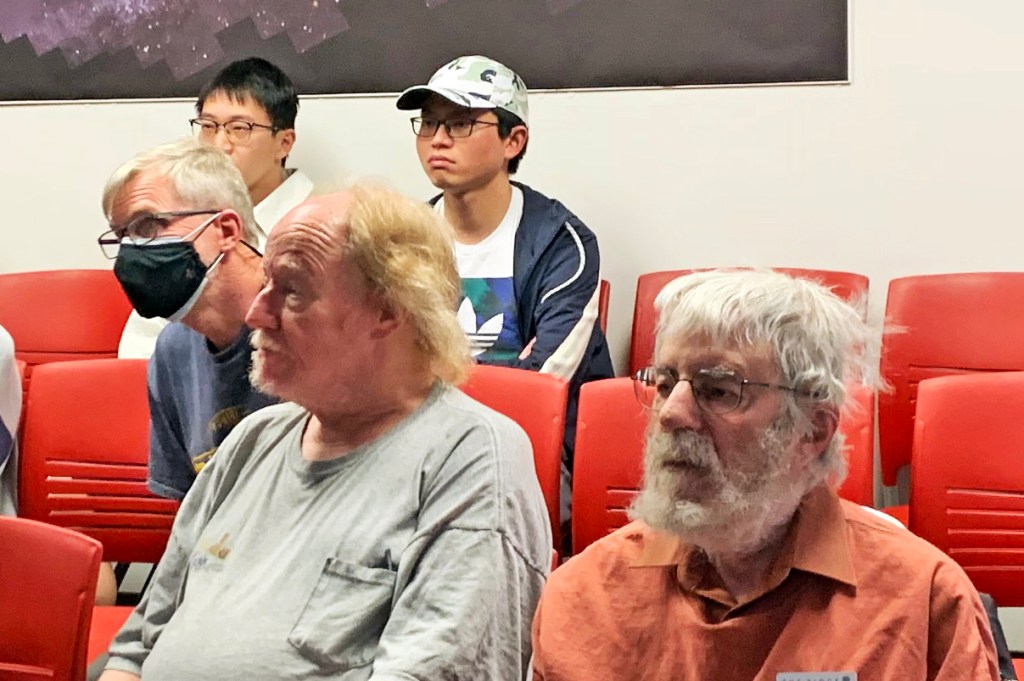
[Dave Bernson and Nate Goodman, meeting of the Utah Astronomy Club, April 12, 2023. The meeting was held in the University of Utah South Physics Building. Photo by Joe Bauman]
I lay awake all last night thinking about Dave. His death is a truly sad event. But something connected to astronomy has given me a small lift, a sort of hopeful feeling: possible signs of life emanating from the star K2-18 b, detected in spectroscopic data collected by the James Webb Space Telescope. The planet is nearly nine times as massive as Earth and it closely orbits a red dwarf star 124 light-years away.
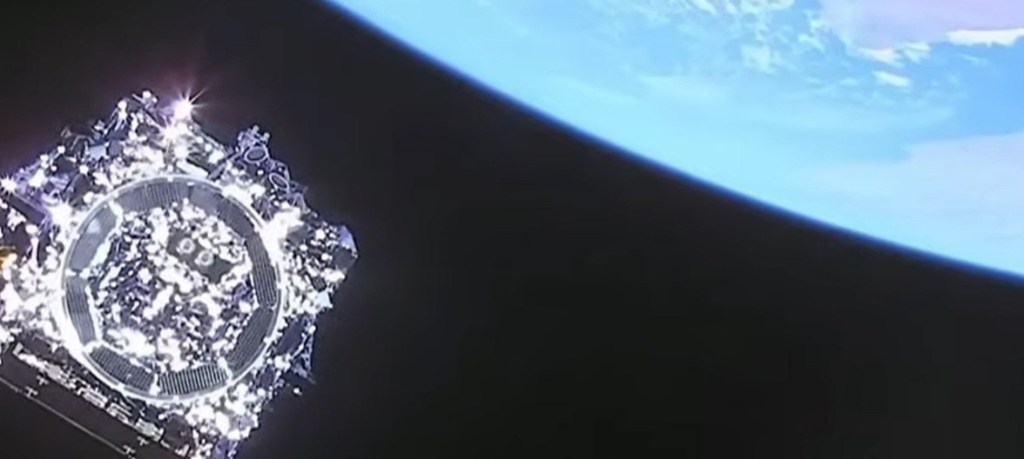
[The James Webb Space Telescope as it soars from the launch vehicle, an Ariane 5 rocket, Dec. 25, 2021. This was before its complex mechanism unfolded the giant Webb observatory. Earth’s limb shows to the right. Photo courtesy of NASA and ESA]
The research results were published in Astrophysical Journal Letters on April 17, in a paper titled “New Constraints on DMS and DMDS in the Atmosphere of K2-18 b from JWST MIRI.” (JWST is the James Webb Space Telescope and MIRI is the Mid Infared Instrument.) A team led by Nikku Madhusudhan of the University of Cambridge, England, reports the discovery of “carbon-bearing molecules” in the planet’ atmosphere. The atmospheric makeup was detected by taking spectra of starlight that passed through the planet’s atmosphere, then deducting the star spectra from that. “We find that the spectrum cannot be explained by most molecules predicted for K2-18 b, with the exception of DMS [dimethyl sulfide, a gas possibly released by living organisms] and dimethyl disulfide (DMDS), also a potential biosignature gas,” the report says.
It adds, “We report new independent evidence for DMS and/or DMDS in the atmosphere at 3σ significance, with high abundance … of at least one of the two molecules. More observations are needed to increase the robustness of the findings. …”
To explain the scientific jargon:
— 3σ means 3 sigma, an estimate of how likely it is that the findings are the result of natural, non-living chemistry. Three sigma has a statistical meaning. In Stanford University’s Kavli Institute for Particle Astrophysics and Cosmology, Dr. Andrea Albert writes, “In short, a 3-sigma detection event has a 0.3% probability of occurring by chance, and a 5-sigma event has just a 0.00006% probability of occurring by chance. Physicists traditionally call a 3-sigma detection ‘evidence’, while a 5-sigma detection is considered a ‘discovery’.” Until the Webb Telescope has gathered more evidence from the planet’s spectra, it is at the “evidence for” stage, but later it could be verified as an official discovery.
The authors suspect K2-18 b is an ocean world. Although close to its star, the red dwarf is cool enough not to boil away any sea; also, it’s not so far from the star that water would be frozen. Speculation is that organisms something like earthly plankton are releasing the gas. Whether they and/or other creatures exist on the exoplanet is not proven.
Since the announcement, articles have appeared claiming the speculation about life 124 light-years away is overblown. Criticisms have been leveled that it doesn’t meet the 5-sigma rating, and others question the study assumptions, saying the calculations were based on extrapolations of what an ocean world would be like without life.
Yet if I had a 99.7 percent probability of winning at roulette — that is, if it were a 3-sigma likelihood that I would win — I’d bet the farm and the neighbor’s farm.
Carl Sagan’s rubric, “Extraordinary claims need extraordinary evidence” has been waved around to rebut the excitement. But let’s think about it. A 0.3 percent chance that the evidence is wrong seems extraordinarily strong to me, 5-sigma be — ah — darned.
Also, I don’t agree with Sagan. Extraordinary claims don’t necessarily need extraordinary evidence. Say I’m an Indonesian living on that island where no outsiders are allowed. Say I’m walking along a beach remote from my village and a helicopter flies over. I run back to report this astonishing sight. All the Carl Sagans of the village revile me, demanding extraordinary evidence — which of course I’m unable to provide. But the chief, who’s a wise woman, says, “I know Joe. He tells the truth. He’s observant; he can smell a Komodo dragon farther off than anybody. I believe him.” The fact is, a big metallic object did fly over.
That “extraordinary evidence” can’t be produced in some cases doesn’t mean the claim is false. It doesn’t even mean that you should be highly skeptical of it.
What if detecting evidence of life with a future, more-sophisticated space telescope turns out to be common? Maybe life is so likely to form under certain conditions, that it would be extraordinary if the telescope reads the atmosphere of the right kind of planet and doesn’t find signs of biology. Would we demand extraordinary evidence that no life was there? Maybe, maybe, maybe.
When I heard about K2-18 b, I did not take the findings as proof. But I felt a glow, as if my insides were smiling. The universe would make some kind of sense, to my way of thinking, if life goes on elsewhere no matter what we lose on this small part of it. We lost Dave. But maybe there’s something beyond Earth.


Leave a Reply