By Joe Bauman, Salt Lake City
Something was wrong with the stars in my photos, particularly near the edges, and I figured it involved the spacing between my reducer-field flattener lens and the camera’s chip. That is, I had a problem with my back-focus spacing.
Warning: This is a somewhat technical blog, but it does have one astronomical photo.
A reducer-flattener has two purposes. Optically, it shortens the telescope’s focal length, so that it operates like a shorter ‘scope but still lets as much light in — which means that its field of view is greater and the concentration of light is more, so the photographer can get more objects in one picture and, at the same time, the amount of light is greater per exposure. The other effect of this special les is that it “flattens” the field, removing distortions.
Shortening the focal length may seem like a disadvantage because objects photographed through one of these add-ons are smaller. Doesn’t that go against the whole purpose of a telescope, to make things bigger? No, in many cases. A shorter focal length really an advantage in my setup because, without a reducer-flattener, my pictures are “oversampled.” That is, the amount of light per pixel in the camera chip is too great. (A pixel — the word derives from “picture element” — is a light-gathering segment of a camera’s chip. My camera’s chip has an array of 8.3 million pixels.)
Oversampling, undersampling and the correct amount of sampling are measured by the number of arcseconds encompassed in each pixel in an astrophoto. One arcsecond is 1/3600 of a degree; held at arm’s length, an index finger is around one degree wide. (An arcminute is one-sixtieth of a degree; an arcsecond is one-sixtieth of an arcminute.)
For reasonable sky conditions in a city, a nice arcsecond-to-pixel resolution is from 1 to 1.5, according to High Point Scientific. The site explains the difference between oversampling and undersampling:
“When astrophotographers incorrectly pair their focal length and pixel size with their seeing conditions it can result in either undersampling or oversampling. Undersampling occurs when the pixels on your camera sensor are too large for a given scope’s focal length. This creates blocky, pixelated stars. This indicates that there are not enough pixels within the star to create a round star shape. Oversampling, on the other hand, occurs when the camera’s pixels are too small for a given scope’s focal length. The incoming light is being spread over too many pixels resulting in a soft and bloated image.”
For the advantage of more light per exposure time and to correct my oversampling problem, a reducer-flattener is a must. This specialty lens goes directly on the telescope’s end, in front of the camera and whatever else the camera uses.
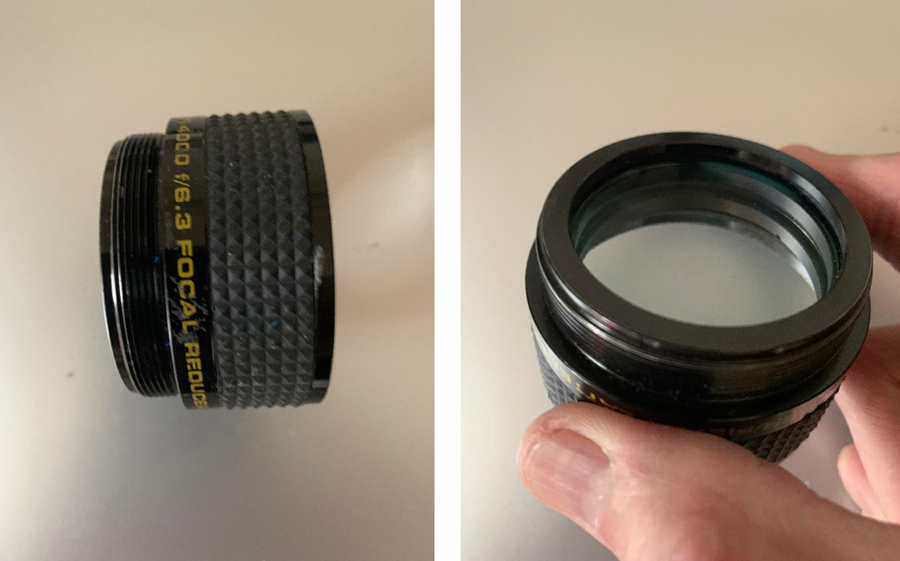
[The reducer-flattener in question, a Meade f/6.3. Photo by Joe Bauman, Aug. 29, 2026]
Meade, the now-defunct company that sold these reducer-flatteners, actually put out two varieties of the device, both labeled, confusingly, “Series 4000.” It is an f/6.3 lens, meaning that when used correctly, the focal length of the telescope will be 63 percent of what it was without the lens.
My telescope, a Meade LX200GPS 12-inch, has a “native” (unadjusted) focal length of 3,048 mm. and a speed of f/10. With the reducer-flattener on correctly, the focal length is reduced to 1,920 mm. and the speed increased to f/6.3.
With a reducer-flattener, it is critically important that the lens is a particular distance from the camera chip. Otherwise, the reduction in image size will be too great or too little; also, if the distance is not right, the picture will be distorted.
I have a hearty distrust of artificial intelligence. I never use it in writing since I have full confidence in my abilities. But I wasn’t sure which Meade Series 4000 reducer-flattener I had. So I decided to have my first discussion — if that’s the right word — with a chatbot. I used the one connected to Yahoo.com.
It convinced me that I had the Meade reducer-flattener requiring a separation of 105 mm., measured from the end of the glass in that lens to the camera chip. The distance is also required in the Celestron company’s version of the reducer, and Celestron is widely used.
I couldn’t find my ruler with millimeters, so sometimes in figuring the separation I had to rely on converting inches and fractions to millimeters, using an ordinary ruler. Mostly though I knew how deep items were in millimeters by looking up their dimensions.
The question was, given that I needed a separation of 105 mm., what length of spacer rings did I need to add to my setup? I have two sets of spacers of various depth; fortunately, each ring is marked in millimeters.
Here’s what the telescope’s light must pass through on its way to the camera: reducer-flattener; connecting adapter, 19 mm.; unknown distance of spacers; off-axis guider, used to guide the ‘scope while taking exposures, 19 mm.; filter wheel, 20 mm., changes caused by refraction in the filters (add 1 mm); plus distance inside the camera body to the light-gathering chip, another 17.5 mm.
Adding the known distances gets 76.5 mm. (Originally I used a slightly different set of figures, which gave me about 74 or 75 mm.) Since Yahoo said I needed a back focus distance of 105 mm., I added 31 mm. in spacers for a total distance of close to 105 or 106 mm.
Then I took an astrophoto of the great Andromeda galaxy (Messier 31) and its smaller satellite galaxy, M-32. Total exposure was two hours, not counting such items as flats and darks.
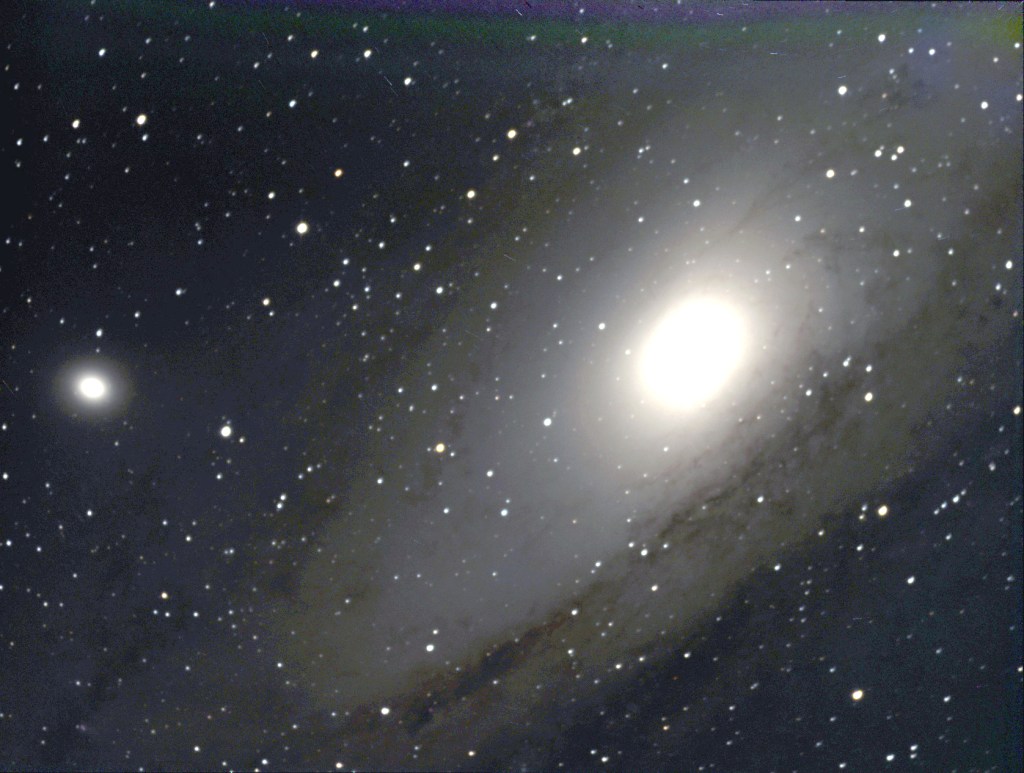
[The great galaxy in Andromeda (M-31) and a little sister galaxy (M-32), taken on the morning of August 21, 2026, from Salt Lake City. Photo by Joe Bauman]
When I had my atrophoto program analyze one of raw images, it found the focal length was 1509.2 mm., not the correct length, which is 1920 mm. Also the arcsecond-pixel ratio was slightly higher than it should have been at 1.48 arcseconds per pixel.
The spacers were the wrong size. Cumulatively the back focus was so long that it increased the reduction and caused distortion.
Back I went to a chatbot. Yahoo analyzed the image information and said I had to cut out a lot of my spacer distance — more than the amount I had on! So I turned to the Google AI chatterbox and asked about the issue. It said,
“Your rigid gear block (STF-8300 Camera + SBIG Filter Wheel + SBIG OAG-8300) measures 60.9 mm.” When I add the 19 mm. connecting adapter, that makes it 79.9 mm. without spacers. If the reducer was the one requiring 105 mm., using Google’s figures, I would need to add about 25 mm. of spacers — not far from what I had.
Google then gave a couple of ways to check which of the Series 4000 reducers I have. This is the simpler way:
“While not 100% foolproof due to Meade swapping factories over the years, the text stamped on the metal housing [of the reducer-flattener] offers clear indicators:
“Legacy Model: Typically stamped with “MADE IN JAPAN“. These units use identical optical geometry to classic Celestron f/6.3 reducers and strictly perform best at the legacy 105 mm spacing target.
“Modern Model: Stamped with “MADE IN CHINA.“ These models rolled out to drastically reduce the required back-focus distance to prevent bulky imaging trains from physically smacking the front-mount base when the telescope slews straight up to the zenith. These default to the 85 mm spacing target.”
I told the chatbot that mine has the Chinese indication.
This evoked the following from Google:
“Since your reducer is stamped ‘Made in China,’ you have a modern production model. This means your optical system is optimized for a shorter back-focus distance of exactly 85 mm.”
To get to 85 mm., I needed to add about 6 mm., not the 31 mm. that lying liar Yahoo had talked me into. I made the change.
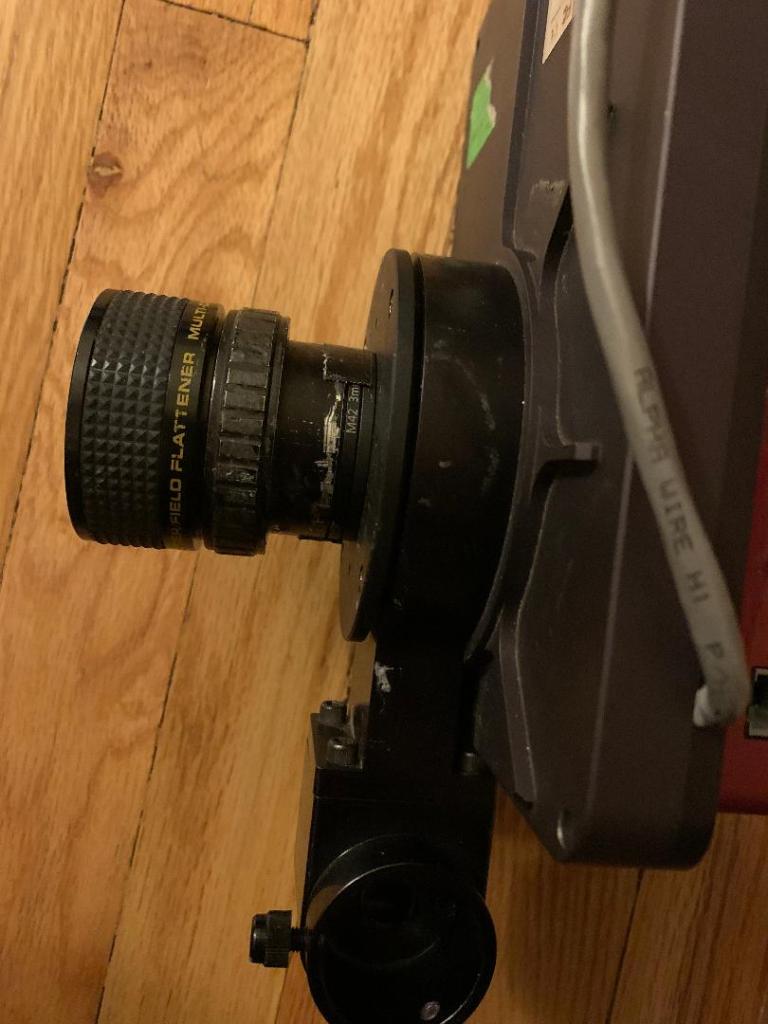
[The new setup. From left, the reducer-flattener; connection adapter; two 3 mm. spacers together to make 6 mm.; off-axis guider; filter wheel; camera (only a little showing to the lower right.) Taken Aug. 20, 2026, in Salt Lake City by Joe Bauman]
I’m now one of the few Utahns who don’t like rain in a drought, at least temporarily. I have to wait until the clouds blow away before I can test it.


Leave a Reply