By Joe Bauman, Salt Lake City
The spiral galaxy called NGC 7331 is a favorite of amateur astronomers for several reasons: it’s easy to find, as it’s close to Matar, one of the brighter stars in the constellation Pegasus; it is part of a flotilla of galaxies known as the Deer Lick Group; it’s handsome, emphasis on hand — looks a little like an open hand missing a couple fingers; it is high in the summer and fall, when observers don’t freeze; and at a close 45.7 million light-years away, it is relatively big and bright, glowing at magnitude 9.48.
Another reason that pushed it, temporarily at least, to the top of the list of favorites and pulled many telescopes toward it this month was the discovery of a bright supernova in NGC 7331. NASA estimates that a supernova typically occurs in our Milky Way galaxy about once in 50 years. But this is the second in a little over a year in NGC 7331.
Designated Supernova 2026aaiv, it was discovered by ATLAS, the Asteroid Terrestrial-impact Last Alert System, which uses four telescopes to scan and rescan the entire sky every night looking for moving objects that could potentially threaten Earth. The automated telescopes — two in Hawaii, one each in Chile and South Africa — take photos and the views are compared to see if anything has changed. Detected by their motions, ATLAS has found comets, interstellar objects, asteroids and supernovae. On September 1, ATLAS observed a new bright star in NGC 7331.
The monstrous explosion was determined to be a Type Ia supernova, a rare variety that acts as visual yardsticks — termed “standard candles” –allowing astronomers to calculate the distance to the supernova with precision. The one last year in the same galaxy also was Type Ia. (In these designations, I is the Roman numeral I, meaning one; it is pronounced “one-a.”)
NASA experts with the Nancy Grace Roman Space Telescope explain:
“Many supernovae occur when massive stars run out of fuel, rapidly collapse under their own weight, and then explode because of strong shock waves that propel out of their interiors. … [E]vidence shows that type Ia supernovae originate from some binary star systems that contain at least one white dwarf — the small, hot core remnant of a Sun-like star. Type Ia supernovae are much rarer [than more ordinary types], happening roughly once every 500 years in the Milky Way.
“In some cases, the dwarf may siphon material from its companion. This ultimately triggers a runaway reaction that detonates the thief once it reaches a specific point where it has gained so much mass that it becomes unstable. Astronomers have also found evidence supporting another scenario, involving two white dwarfs that spiral toward each other until they merge. If their combined mass is high enough that it leads to instability, they, too, may produce a type Ia supernova.”
A white dwarf whose gravity syphons off enough material from a companion star to reach 1.4 times the mass of our Sun will ignite in a supernova. The progenitor star is not big enough to produce a black hole (that scenario requires a minimum mass around 20 times that of the Sun.) Instead, it just blows itself to smithereens. Since Ia super-blasts always explode when thieving white dwarfs reach that particular size, the brightness of one Type Ia supernova is about the same as that of another. Scientists can measure the brightness as seen from our planet to figure how far away the explosion is.
NGC 7331’s supernova should remain visible for quite a while. Scientists with America’s Vera C. Ruben Observatory note, “Type Ia supernovae increase to a peak brightness and then dim continuously over a period of months. At their peak brightness, Type Ia supernovae emit about 10 billion times more energy than the Sun …. “
I spent four nights making astrophotos of NGC 7331. Knowing where the supernova is, I was impressed by its brightness when the images were coming onto the laptop screen. But when I compared my views with photos taken of the galaxy before September, I was stumped. A star was visible at the same spot, I thought. I wondered if someone had cried wolf about a non-supernova.
Then by careful comparison, I found that the star I had seen earlier was still there in the pictures of the supernova. It was just beside it (as we viewed the galaxy but no doubt they are many light-years apart). The familiar star was swamped by the glare of the newcomer.
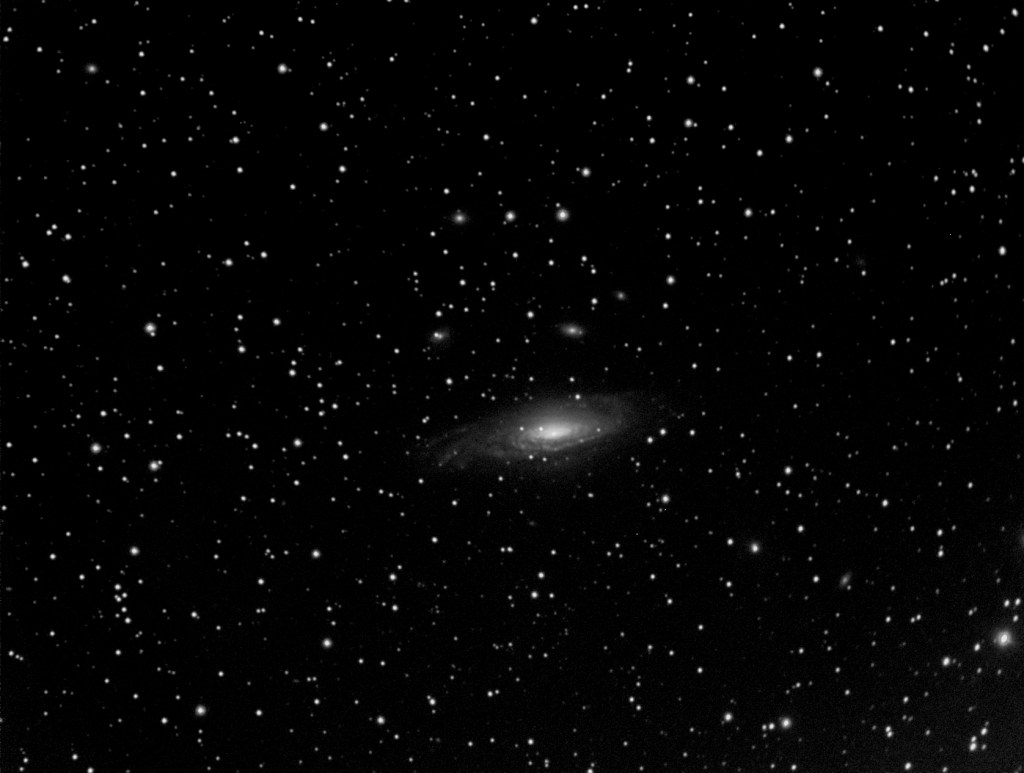
[NGC 7331 with Supernova 2026aaiv and small galaxies of the Deer Lick Group, a black and white photo taken in Salt Lake City on the morning of Sept. 8, 2026, by Joe Bauman]
Did the explosion wipe out life on a planet or planets? How far does the kill zone of a supernova reach? No star that we know of seems likely to explode near Earth, but if one did and we survived, would its light be blinding?
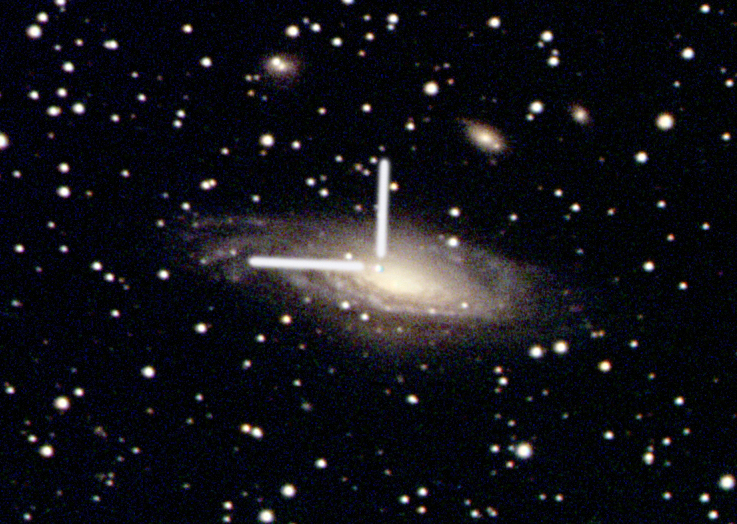
[Lines indicate the supernova’s location. Note also smaller galaxies of the Deer Lick Group. This color photo, cropped to the main subject, is a combination of images taken on Sept. 7 and 10, 2026, in Salt Lake City by Joe Bauman]
After the September explosion fades, it might be smart to check NGC 7331 every so often. The galaxy just possibly could make it three for three — a trio of supernovas in as many years.
 Joe's Astro Stuff
Leave a comment