By Joe Bauman, Salt Lake City
A region in the constellation Vulpecula (“Little Fox” in Latin) showcases a beautiful variety of astronomical systems: a star-forming region, new gigantic stars and dark pillars caused by energy from stars eroding the nebula’s material.
The overall nebula is designated NGC 6820 while an open cluster of stars in the midst of the nebula is NGC 6823. I photographed them with narrow-band filters on the night of August 30-31 from our backyard in Salt Lake City. The 120 one-minute exposures totaled one hour each with the hydrogen-alpha and sulfur-2 filters. The colors were assigned artificially and are not what one would see in ordinary light.
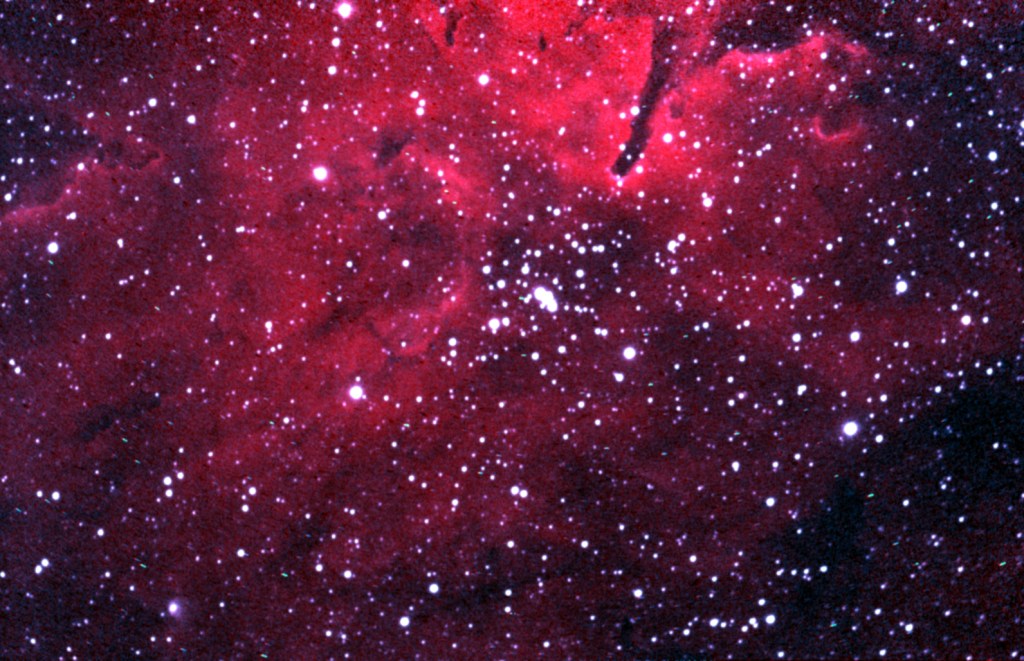
[The NGC 6823 open star cluster amid the NGC 6820 nebula, photographed the night of August 30-31 from Salt Lake City by Joe Bauman]
The star cluster has been measured at around 6,600 to 8,000 light-years away, according to a paper in the Monthly Notices of the Royal Astronomical Society. That’s relatively close by galactic standards.
The paper, “Young Stellar Objects in NGC 6823,” by scientists B. Riaz, E.L. Martín, R. Tata, J.-L. Monin, N. Phan-Bao and H. Bouy, published in January 2012, says three pillar-like structures are located northeast of the cluster. A large pillar shows up in my photo, with possibly one or two smaller examples. The study adds, “Such pillars have been associated with recent episodes of star formation,” and that a nearby remnant of a supernova explosion “suggests a possible case of triggered star formation in this cluster.”
In simpler language, the shockwave of a supernova explosion may have set off star formation in the cluster, rather than the more typical cause, which is that gravity gradually concentrates nebular gas and dust until stars ignite.
“This is thus a young cluster that has likely seen a recent burst of star formation,” the study says.
NGC 6823, the open star cluster, is at the center of what is termed Vulpecula OB1, a much more massive association of stars. The O and B in the name stand for types O and B stars. NASA’s Photo Journal points out, “O and B stars are the largest stars that can form.
“The giant stars at the heart of Vulpecula OB1 are some of the biggest in the galaxy. Containing dozens of times the mass of the sun, they have short lives, astronomically speaking, because they burn their fuel so quickly. At an estimated age of 2 million years, they are already well through their lifespans. When their fuel runs out, they will collapse and explode as supernovas. The shock this will send through the surrounding cloud will trigger the birth of even more stars, and the cycle will begin again.”
Types O and B are perfect examples of the saying, Live fast and die young.
Type O stars, NASA adds, are at least 16 times as massive as our Sun, and can reach 100 times as massive. “They are anywhere from 30,000 to 1 million times brighter than the sun, but they only live up to a few million years before exploding.” You wouldn’t want to live on a planet near one.
Type B stars are smaller, between a size twice as massive as the sun and the Type O minimum, 16 times the solar mass. “They can range from 25 to 30,000 times brighter than the sun.”
“Physics Forum” says the lifespan of a Type B would be “somewhere between 16.4 million and 20 million years.”
By comparison, the Sun — a G star, called a yellow dwarf — is 4.5 billion years old with another 5 billion years to go before it turns into a red giant star.
The NASA Photo Journal notes, “Since OB stars have such short lives, finding them in large numbers indicates the region must be a strong site of ongoing star formation, which will include many more smaller stars that will survive far longer.”
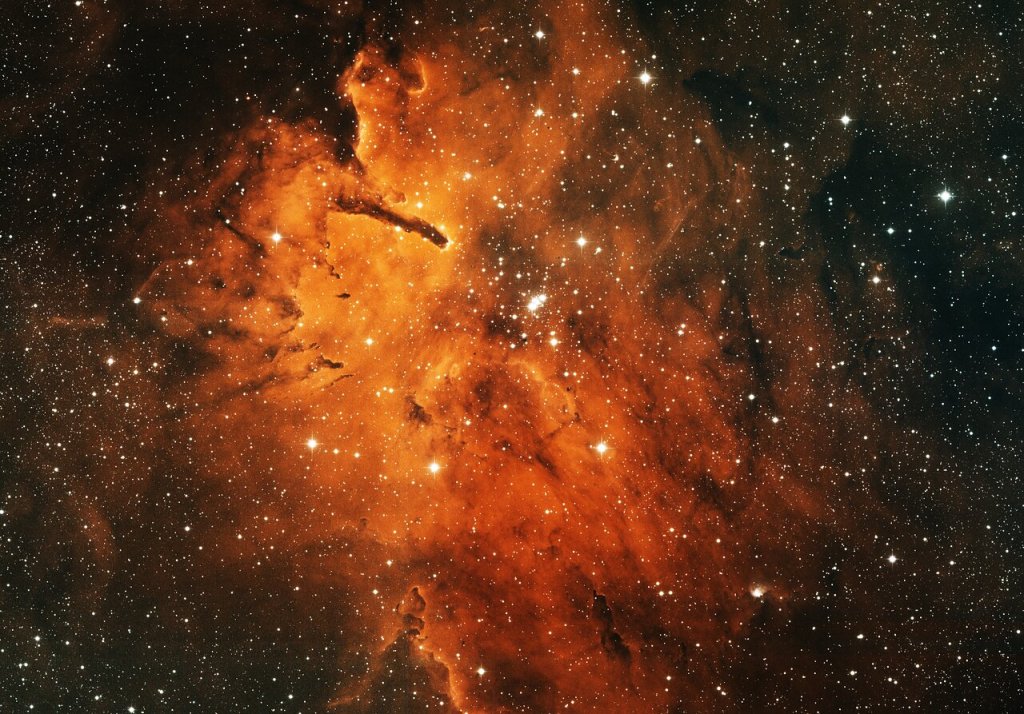
Concerning the above photo, the National Science Foundation’s NOIRLab describes the pillars of NGC 2680, “The intense light from the hot, massive stars in the cluster is blowing away the gas in the nebula, causing the distinctive “pillar” shapes on the left side of the image.” This picture also was taken with narrow-band filters with colors assigned to emphasize the structures.


Leave a Reply