By Joe Bauman, Salt Lake City
filed July 21, 2025
Last October I went trolling for a flower and ended up with a fish.
In my little backyard observatory, I wanted to photograph a beautiful bluish knot of interstellar gas called the Iris Nebula, which gets its name not only because of its color but also as it does look a lot like the flower. I thought the telescope was pointing in the right general direction, but when I used the free online service Astrometry.net, I found I was not very close to the Iris. There was some interesting nebulosity in the photo, though.
Nebulas are vast clouds in space, mostly dust and gas. Some are where stars are coalescing and others were left after stars exploded. Some are dark and show up against glowing gas beyond them. Some are seen by reflected light (reflection nebulas) and a larger number are aglow because of the shining stars embedded in them (emission nebulas).
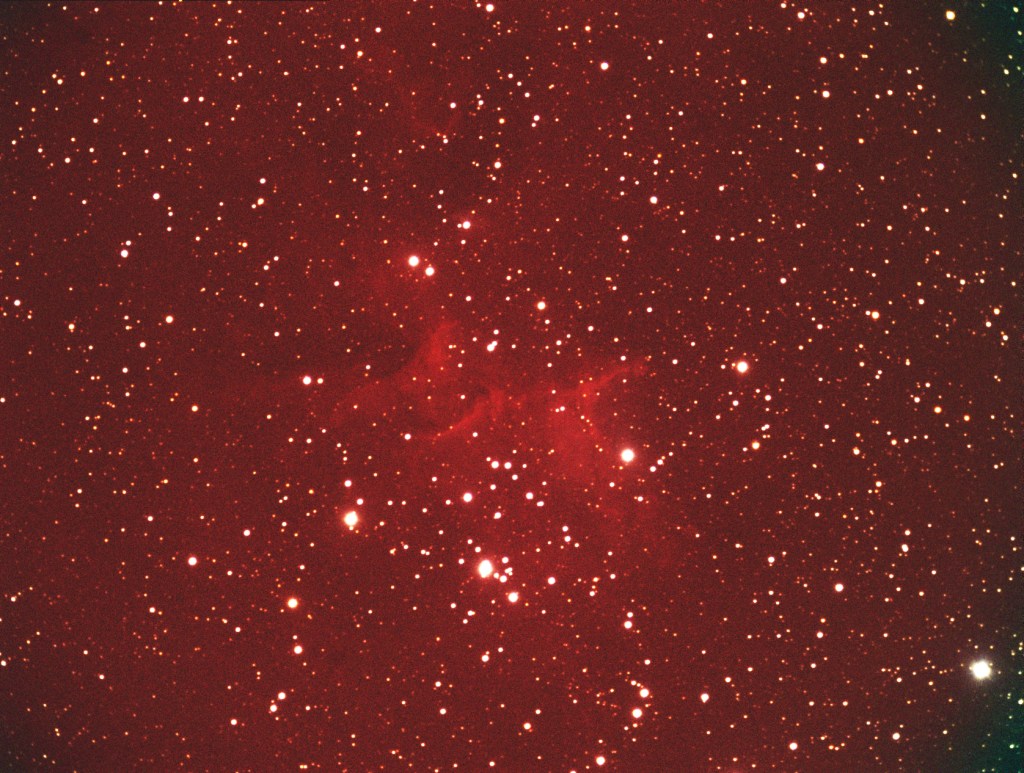
[Not the Iris Nebula, but a picture showing red nebulosity on the night of October 5-6, 2024, taken from Salt Lake City. Photo by Joe Bauman]
To know what Astrometry.net does, it’s necessary to understand celestial coordinates. Any spot on Earth can be located by means of its latitude and longitude. Latitude is measured by the imaginary lines that circle Earth in rings north and south of the Equator; they are shorter the father one moves from the Equator. Longitude lines are all of equal length, going around the world from pole to pole. As with latitude and longitude on Earth, any point in the sky has its own coordinates, which are set out in terms of right ascension and declination. Right ascension is equivalent to a point’s longitude and declination to its latitude.
Sky and Telescope magazine explains that the celestial equator is directly above this planet’s equator; lines of declination north of the equator are marked with a positive sign and its number (frequently the plus sign is omitted) and anything south of the celestial equator is marked with a negative sign (not omitted) and its number. Just as the North Pole is at 90 degrees north latitude, the north celestial pole — close to the star Polaris — is at +90 degrees declination. Declination is expressed in degrees and portions of degrees; the portions, somewhat confusingly, are minutes and seconds of degree.
Right ascension, equivalent to longitude, is counted by the number of degrees in a circle, 360. It is measured in hours, minutes and seconds, corresponding to those of a day. Because each day is 24 hours, each “hour” in the right ascension model is equal to 15 degrees. A star will seem to move 15 degrees westward in an hour as the world rotates. The closer the star is to the north or south celestial pole, the shorter distance that 15 degrees is.
Right ascension is measured from the Vernal Equinox, which is, Sky and Telescope notes, “the spot the Sun arrives at on the first day of spring.” A position in right ascension is expressed in hours, minutes, seconds and parts of seconds east of that equinox.
Blame the ancient Babylonians for all this base-60 stuff!
Astrometry.net will take an astro photo and analyze its patterns of stars against a chart tucked away in the recesses of its digital brain, and figure out what it shows. It also will point out the celestial coordinates of the center of the photograph. With that information, it can be used as a virtual finder scope to help aim a telescope at a target.
Often it does this in a few minutes, but sometimes, when the service has a great deal of demand, as on a Saturday night in the time of the New Moon, it may get so jammed up that you can’t get through. (For those who like to tinker with computer programs, you can download charts and programs to do it all on your laptop. I haven’t had much luck with that.) As I’m now restricted to backyard astronomy — don’t ask why, but it has something to do with the Jeep getting stuck twice in the western Utah outback my wife’s resulting rules — it’s easy to just cruise over to Astrometry.net by way of our home’s modem.
Astrometry.net gave the coordinates of the center of the above photo as 02 hours, 33 minutes, 33.513 seconds right ascension and 61 degrees, 27 minutes, 07.748 seconds declination. However, the Iris Nebula, according to the internet site theskylive.com, is centered on the celestial coordinates of 21 hours, 1 minutes, 54 seconds right ascension and 68 degrees, 16 minutes and 15 seconds declination.
I continued to offer pics to Astrometry.net to solve. One of these showed part of a structure in the upper left corner, which it labeled NGC 896. Looking up the designation on the internet, I found that NGC 896 is the Fish Head Nebula. Its coordinates are about 02 hours, 24 minutes, 47 seconds right ascension and 61 degrees, 53 minutes, 52 seconds declination. So I went fishin’.
The catch of the night was a view of the Fish Head:
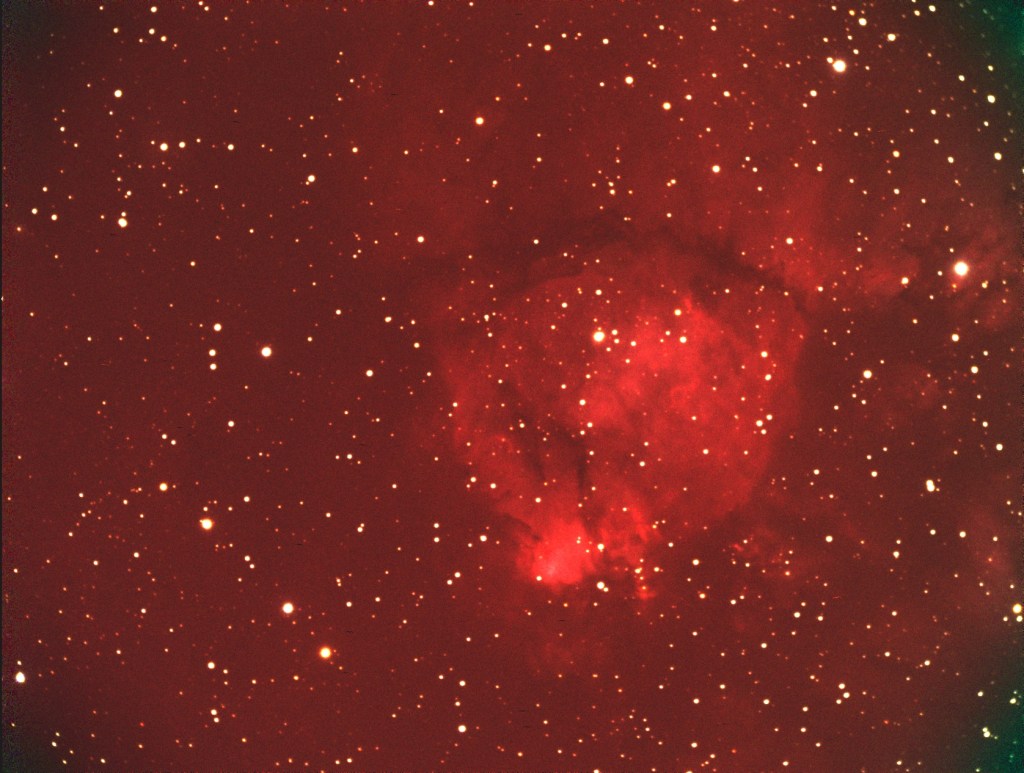
[The Fish Head Nebula, NGC 896, photographed from Salt Lake City on October 6, 2024, by Joe Bauman]
The nebula does look like a great big fish head hanging upside-down in the constellation Cassiopia. Dark lanes and bright concentrations mark it as an interesting deep-space object.
It is an emission nebula, which NASA defines as a region of gas and dust where “energetic ultraviolet light from a hot young star [or stars] strips electrons from the surrounding hydrogen atoms. As the electrons and atoms recombine they emit longer wavelength, lower energy light in a well known characteristic pattern of bright spectral lines. At visible wavelengths, the strongest emission line in this pattern is in the red part of the spectrum and is known as ‘Hydrogen-alpha’ or just H-alpha.” (Find out more about the use of special filters to record H-alpha and other narrow-band emissions in my Blog 161.)
The Fish Head Nebula is known by several designations, NGC 891, the Fishhead (one word) Nebula, IC 1795 and even the Northern Bear Nebula. The last seems to be popularized by a private amateur observatory in Texas, the Waid Observatory. The Fish Head is a section of a vast molecular cloud in the Persius spiral arm of the Milky Way Galaxy, according to the NASA Astronomy Picture of the Day for Dec. 24, 2014.
The best time to view the Fish Head is November, according to ConstellationGuide.com.
At 6,000 light-years away, it a smaller appendage to another nebular clump, the gigantic Heart Nebula. Maybe we oughta call it the aorta.
 Joe's Astro Stuff
Leave a comment